
AMD FSR Redstone Ray Regeneration in Call of Duty: Black Ops 7 – Look out NVIDIA
 Follow Us
AMD FSR Redstone ray regeneration debuts as a machine-learning reflection denoiser in Black Ops 7 multiplayer.
The feature focuses on ray-traced reflections, competing directly with Nvidia’s DLSS ray reconstruction but with a different rendering pipeline.
Image quality varies scene by scene, yet performance overhead is tiny and the wider Redstone roadmap looks very ambitious.

Call of Duty: Black Ops 7 is the first game to ship with AMD’s new FSR Redstone ray regeneration feature, a machine-learning denoiser designed to clean up noisy ray-traced reflections and stand toe-to-toe with Nvidia’s DLSS ray reconstruction. It is an important debut, not just for AMD’s Radeon RX 9000 series, but for where real-time ray tracing is headed on PC.
 Survey
Black Ops has long been a showcase for cutting edge PC graphics, and Black Ops 7 continues that trend with heavy use of ray-traced reflections across metallic surfaces, polished floors and wet environments. Those effects look impressive, yet they are also expensive and prone to noise. This is where ray regeneration steps in, trying to offer cleaner reflections at lower cost, while matching or beating Nvidia’s long-established AI denoiser.
We looked at how the game plays with the new denoiser from AMD and to compare how it performs, we’ve got several screenshots including a baseline “vanilla” rendering using the game’s own denoiser, AMD FSR Ray Regeneration, and Nvidia DLSS Ray Reconstruction. Taken together, they paint a surprisingly nuanced picture of AMD’s first-generation model.
What is AMD FSR Redstone?
Redstone is AMD’s new umbrella term for neural rendering technologies, sitting on top of the FidelityFX Super Resolution (FSR) brand. It is built for RDNA 4 based Radeon RX 9000 GPUs and is positioned as a direct answer to Nvidia’s DLSS stack.
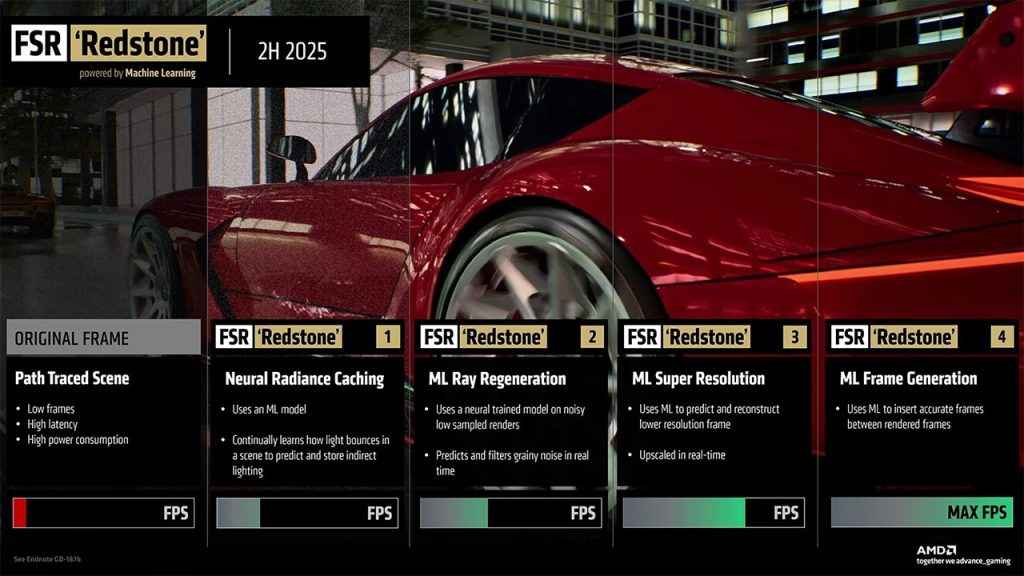
According to AMD’s own developer documentation, Redstone is a suite of machine-learning features, not a single toggle. At a high level it includes:
- ML Super Resolution, which corresponds to FSR 4, an AI upscaler that reconstructs high resolution frames from lower resolution inputs.
- ML Frame Generation, which predicts and inserts intermediate frames to boost frame rate, building on the groundwork of FSR 3.1.
- Neural Radiance Caching, which learns how light behaves in a scene to deliver more efficient, higher quality global illumination.
- ML Ray Regeneration, the reflection-focused denoiser in focus here, which takes sparsely sampled ray tracing data and reconstructs a cleaner, more detailed result.
In Black Ops 7, the ray regeneration piece of Redstone made a surprise debut. It is available in multiplayer, zombies and the internal benchmark, and only on Radeon RX 9000 series GPUs.
How Ray Regeneration works in Black Ops 7
Conceptually, AMD and Nvidia are solving similar problems. Path traced or heavily ray-traced scenes are too expensive to render with fully converged rays per pixel, so developers rely on a denoiser to interpolate from a noisy, sparsely sampled signal to something that looks clean and stable.
Nvidia’s DLSS ray reconstruction bakes this into the wider DLSS pipeline, using motion vectors, depth and other history buffers alongside low sample count ray-traced data to rebuild reflections and lighting across the entire frame. In many titles this model affects a wide range of ray-traced effects: reflections, global illumination, caustics and so on.
Redstone ray regeneration in Black Ops 7 is more constrained and more modular. It is focused purely on ray-traced reflections, rather than full-scene coverage, and can be paired with any of the game’s upscalers, including FSR 3.1, native FSR 4, DLSS and XeSS.
The consequence is that the reflection denoiser is not tied to the upscaler’s resolution. It takes the ray tracing output at its own internal resolution and then hands the result to whichever super resolution or native pass the user has chosen. That flexibility is appealing, but current implementations show sub-native artefacts in certain scenes, hinting that AMD’s internal reflection resolution can fall noticeably below the final display resolution.
The ambient effect is fascinating in practice. In some scenes, ray regeneration is convincingly sharp, reacts quickly to motion and produces fewer ghosting and smearing artefacts than the game’s built-in denoiser or Nvidia’s reconstruction. In others, contact hardening and distance-based blur are not handled convincingly, and inconsistencies appear between what the Radeon and GeForce paths are actually drawing into the reflection buffer.
Ray Regeneration scene-by-scene image analysis
The seven accompanying images tell the story better than any spec sheet. They highlight where AMD’s approach already shines and where it still feels like a first-generation effort compared to Nvidia’s more mature ray reconstruction.
1. Poolside reflections and water behaviour
In the pool scene, the baseline rendering does its best with screen space reflections and the game’s own denoiser, but it lacks nuance. The bright sun glinting off metal letter blocks above the water feels flat, and the water surface behaves more like a noisy mirror than a volume.
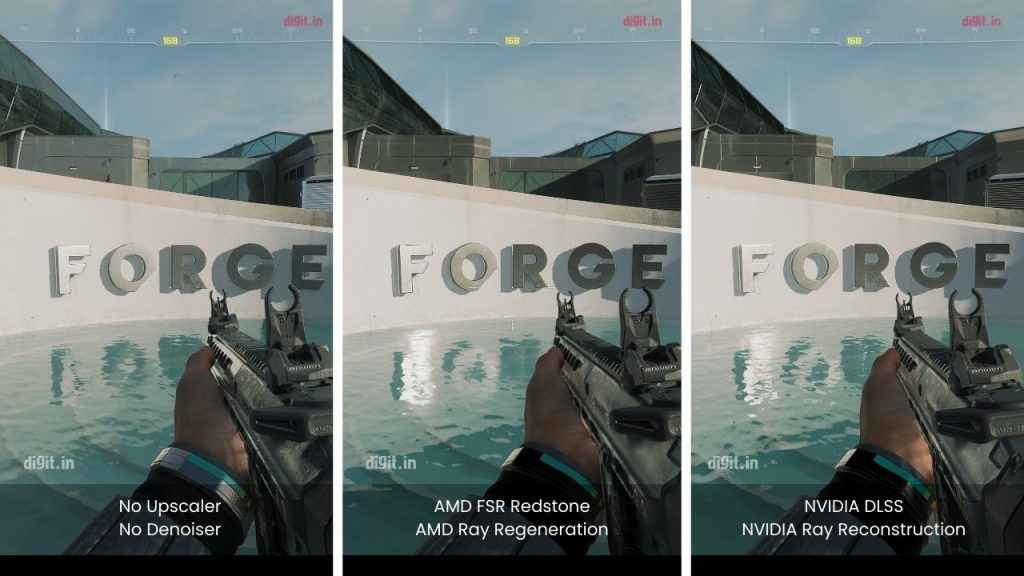
Switch over to AMD’s ray regeneration and the first thing that stands out is the glare on the water exactly where the sunlight hits those metal letters. The bloom feels more physically plausible, suggesting that the denoiser is preserving subtle energy variations in the ray-traced signal instead of flattening them away. There is also better continuity between what sits above the surface and how it appears within the water.
Nvidia’s reconstruction looks cleaner overall than the baseline, yet it makes an interesting mistake here. In one of tthe runs, the overall pool reflection is stable but the underwater facets of the pool floor disappear. We redid the run over again a few times and the underwaters bits were rendered this time around. As for the glare, it’s a bit more subtle than what AMD’s ray regeneration output.
On balance, AMD’s presentation in this shot trades a little raw cleanliness for a more physically believable handling of glare and volume, which is exactly the type of win ray regeneration is aiming for.
2. Hallway scene with frosted glass and ceiling lights
The hallway scene is a great stress test because it mixes glossy and diffused reflections across glass, polished floors and ceiling panels. Without any AI denoiser, the game falls back on baked reflections. The frosted glass door panes at the far end show static patterns that do not quite match the scene, and their reflection in the shiny floor feels “pasted on” rather than truly ray traced.
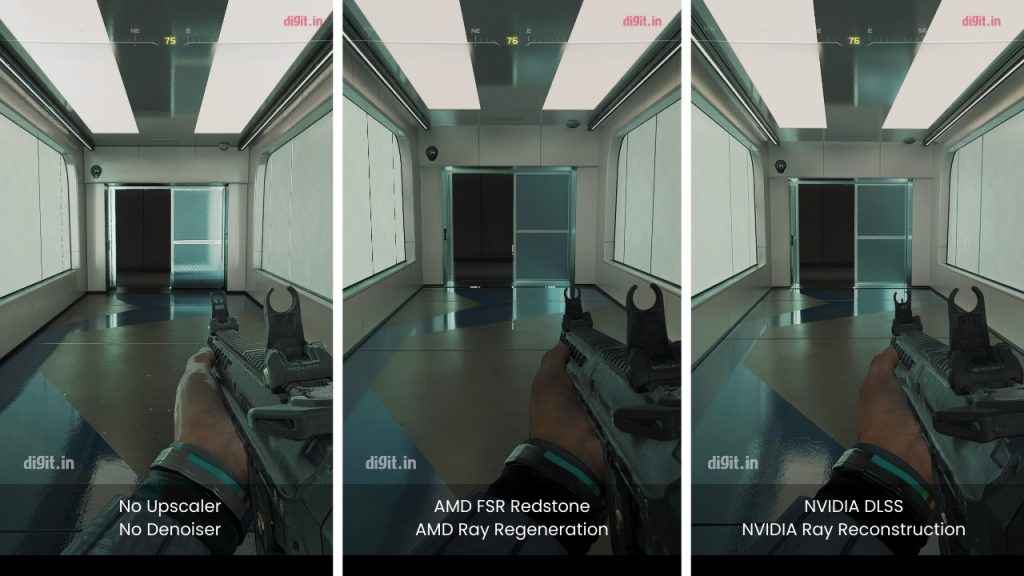
Enable AMD or Nvidia’s solution and the entire composition changes. Both vendors introduce dynamic reflections that track scene geometry more faithfully. AMD’s ray regeneration has a particularly nice touch on the floor, where reflections blur gradually as they recede from the objects being reflected. That distance-dependent falloff feels closer to real-world materials where micro-surface roughness grows more apparent with angle and distance.
Look up to the ceiling and the two approaches draw closer. Ceiling lights and panels are rendered with similar sharpness and stability in both AMD and Nvidia variants, suggesting that the input signal for those elements is less ambiguous and both denoisers are converging on a similar solution.
3. Close-up of the frosted glass door
Move closer to the frosted glass door and the differences become more subjective. In AMD’s version, the floor reflection immediately in front of the doorway appears slightly over-blurred, as if the model is being too conservative in retaining fine detail at close range. At the same time, the open door on the left side of the frame shows noticeable aliasing on its edges. The high contrast line work seems to expose the sub-native resolution of the reflection buffer more than in the hallway wide shot.
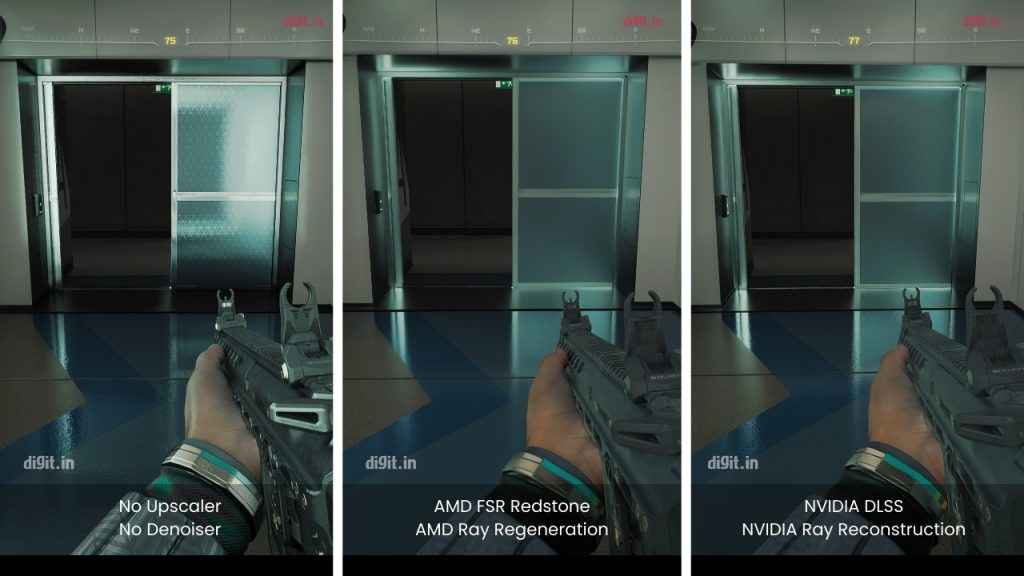
Nvidia counters that with heavier overall blur. Edges on the left are smoother and aliasing is less visible, but some users may find that it softens the scene a little too much, especially when compared to crisp geometry outside the reflection.
On the right side of the door, AMD’s ray regeneration pulls ahead again, preserving more of the subtle structure in the glass and surrounding frame. Nvidia is marginally better in some fine details, although those differences will be hard to spot outside of side-by-side pixel peeping. Seems like AMD’s denoiser is still wrestling with that ideal balance between sharpness, stability and temporal coherence at close range.
4. Metal floor and painted steps
A shiny, thickly painted metal surface with horizontal tactile ridges and bright ceiling lights pressing down from above is a perfect recipe for shimmer and temporal instability. The game’s built-in solution essentially collapses and fakes multiple light sources, painting a reflection for every major emitter but lacking correct occlusion or intensity falloff. It communicates that something is reflective, but not how it should really behave.
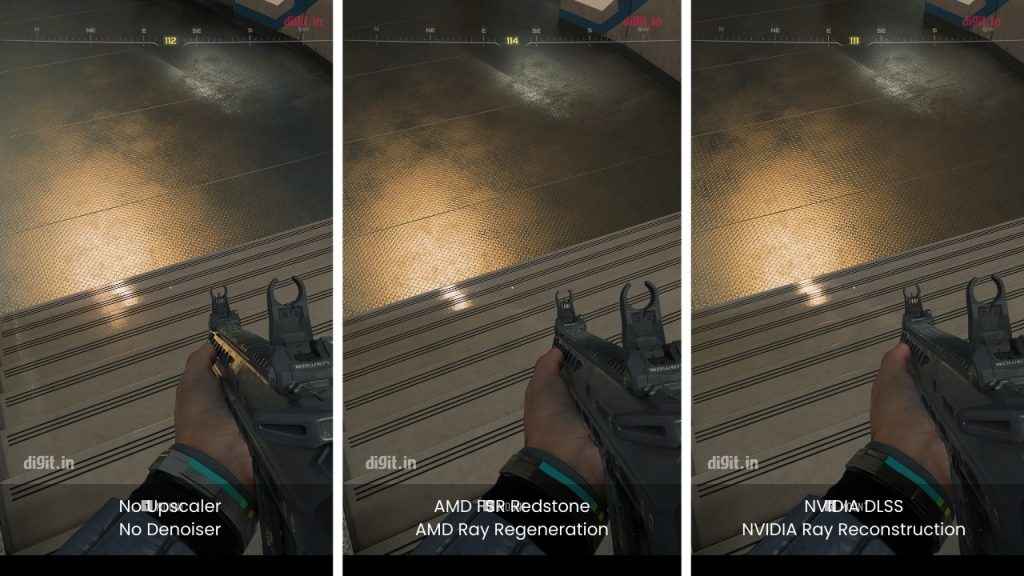
With ray regeneration, AMD delivers sharper, more structured reflections. Each ceiling light appears as a distinct streak along the steps, and the tactile grooves break the reflections in a believable way. There is a satisfying sense of depth in the way the light wraps around the steps.
Nvidia’s reconstruction is broadly similar, but a touch softer. Some viewers will actually prefer this, since a slightly diffused highlight can feel more material-appropriate for painted metal. Others will lean towards AMD’s added crispness and the extra definition in the step edges. What matters technically is that both AI denoisers are clearly a tier above the vanilla output. AMD’s minor edge in sharpness is visible here, even if that advantage flips in other scenes.
5. Trash can and reflective metal wall
This composition is almost a textbook example of interreflections in the real world. A shiny metal trash can sits snugly against a reflective metal wall, which should create a complex interplay of light, shadow and reflected geometry. The non-AI denoised version barely attempts to simulate this. You get a small shadow at the contact edge and vague darkening, but the sense of two reflective materials influencing each other is missing.
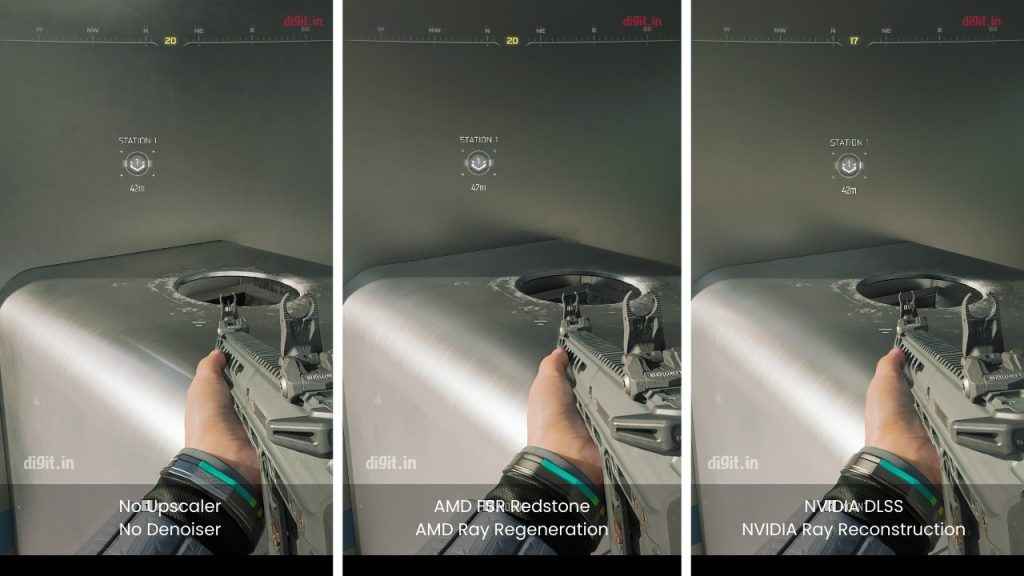
Nvidia’s ray reconstruction leans heavily into physically correct behaviour. The joint between can and wall shows a rich mix of bounced light and subtle occlusion. The curvature of the bin and the slight unevenness of the panel this sits against both read very clearly in the reflection. It is a great showcase of what the model can do when the input is relatively stable.
AMD takes a hybrid path. There is clear ray-traced reflection happening on both the can and the wall, with more nuance than the vanilla pass, but there is also a noticeably darker contact shadow where the two meet. The result looks good, just stylistically different, as if the denoiser is preserving a stronger shadow term instead of fully embracing pure light transport. AMD is competitive, yet not always identical, and in certain highly constrained scenes Nvidia still retains the edge in reproducing fine contact detail.
6. Ceiling lights on ceramic tiles
Ceramic tiles with small surface bumps are notorious for pushing denoisers too far. Every micro-facet wants to shimmer and flicker as the camera moves. Here AMD’s ray regeneration performs very well. The ceiling lights reflected on the tiles are crisp where they should be, and the micro-bump structure of the tile surface is hinted at without turning into crawling noise. When zoomed in, there is a grainy character to the reflection that sits on the edge between deliberate material detail and residual noise.
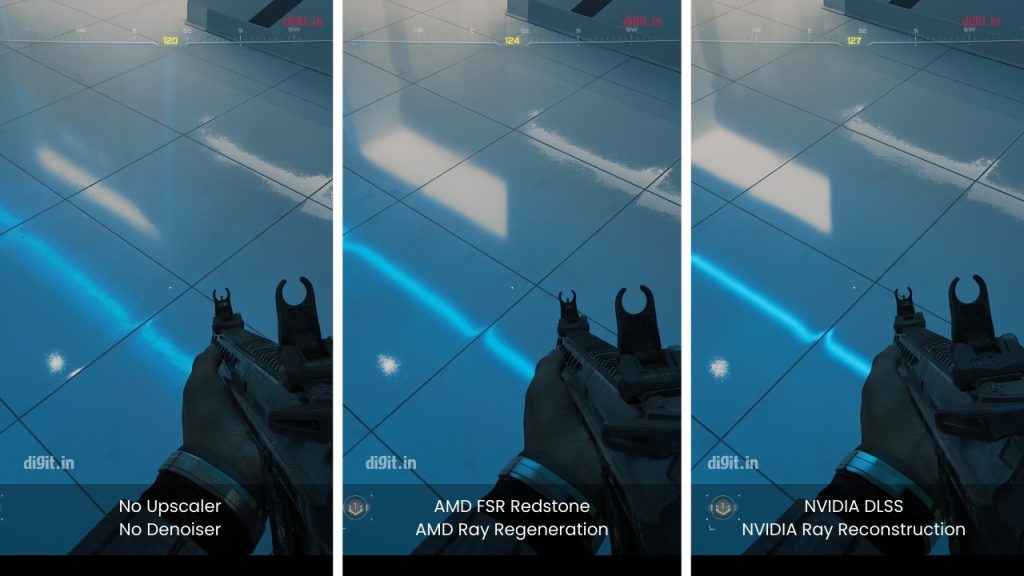
Nvidia’s take looks remarkably similar at normal viewing distances. Reflections track correctly and the tiles hold their character. Any differences are mainly visible in slow motion or when comparing static crops. At that point AMD’s image can show a little more speckling, while Nvidia’s appears slightly smoother. For most players, this is one of the more straightforward “both are fine” cases, with ray regeneration matching Nvidia closely and clearly improving on the stock presentation.
7. Balcony puddle and missing sky reflections
The final balcony shot is the oddity in the set. A shallow puddle sits on an outdoor balcony, with open sky taking up a large chunk of the view above. In a physically correct path traced scene, the puddle would behave like a mirror and strongly reflect the sky, railing and any large structures looming above.
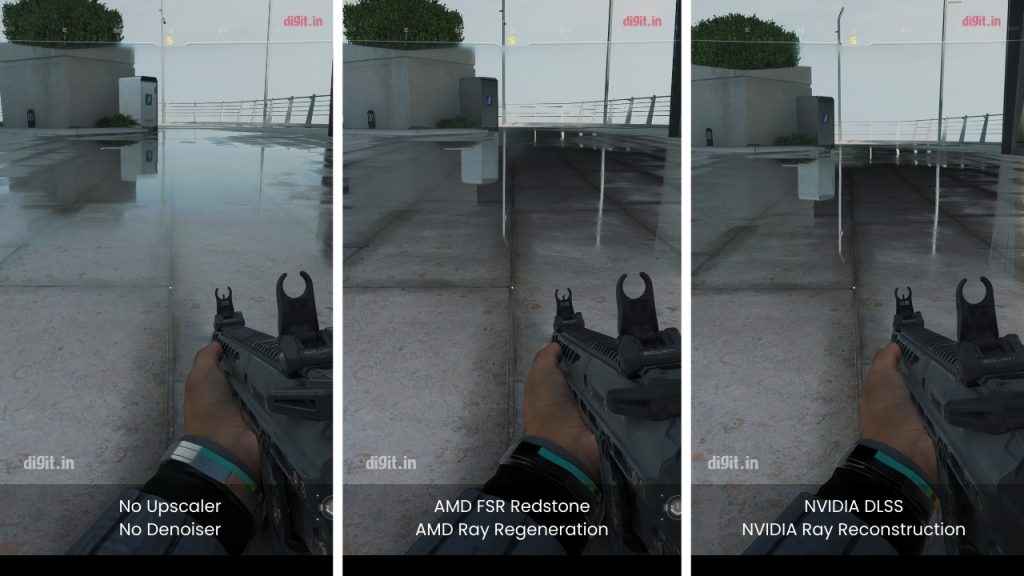
Instead, both AMD and Nvidia essentially fail to capture the sky. The puddle shows reflections of nearby geometry and lighting, but the dominant blue canopy is absent, as if the primary light source had shifted behind the player or the sky contribution had been culled.
What makes AMD’s version interesting is the way it handles the edges of the puddle. At the transition from wet to dry surface, ray regeneration adds a gentle blur and softening, mimicking how thin films of water scatter light differently from fully soaked areas. It is a subtle but pleasing touch. Nvidia’s variant renders the same broad reflection pattern, but the edge behaviour is slightly more clinical. The lack of sky remains the main distraction on both sides, and likely points to limitations or bugs higher up the rendering pipeline rather than purely in the denoisers.
Early verdict on Ray Regeneration
Judged purely as a technology demo, AMD’s ray regeneration is a promising yet uneven first showing. It delivers clear wins over Black Ops 7’s stock denoiser, especially in complex reflection scenarios such as the pool, the metal steps and the tile floor. It often tracks animation well, with less ghosting on moving objects and less smearing of silhouettes than some comparable Nvidia shots, although disocclusion artefacts remain an issue when objects move in and out of frame.
At the same time, the model currently falls short of a complete DLSS ray reconstruction replacement. Limited scope to reflections only, occasional over-blurred contact patches, aliasing on high contrast edges and inconsistent handling of contact hardening all suggest that AMD is still tuning its network and its game-side integration. FSR 4 is already rolling out, with driver-side replacements in many FSR 3.1 titles and explicit support across dozens of games, while Redstone as a whole is positioned as a long term neural rendering strategy for RDNA 4.

For now, Black Ops 7 gives players and developers a first chance to see AMD’s reflection denoiser in action in a shipping game. We see a feature that can already meaningfully uplift image quality in the right conditions, without hammering performance, but which also clearly has room to grow. As the rest of the Redstone stack comes online, and as more titles adopt it, ray regeneration could evolve from an interesting alternative into a standard part of the PC graphics toolkit.
If nothing else, it ensures that the next generation of ray-traced shooters will not just be a battle of frame rates, but a far more granular fight over how light behaves in every puddle, panel and polished floor.


