
WD_Black SN8100 NVMe SSD review
 Follow Us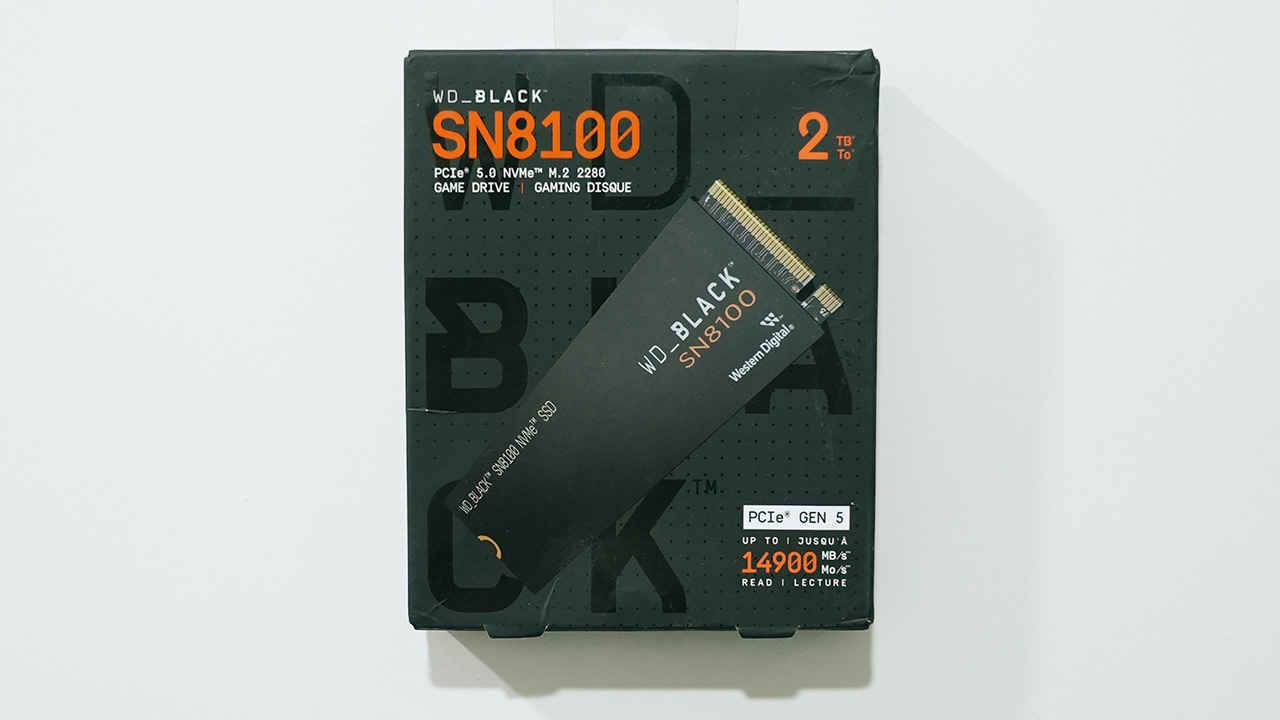

WD’s flagship consumer SSD has always aimed at a familiar brief, to play around with big games and big files with minimal fuss. The WD_Black SN8100 takes that brief into PCIe Gen5 territory and, based on our testing, it delivers the sort of latency and throughput that make a real difference in heavy creative work, AI model loading, and AAA video game asset streaming. With SanDisk spinning off from WD as a separate company, this drive is actually the SanDisk WD_Black SN8100 NVMe SSD. Yes, it’s a bit odd to have two company names attached to a single product, but as a product released in the middle of the split, it’s ended up with the peculiar name. It is a high-end drive, complete with DRAM, modern TLC NAND, hardware encryption, and a tidy heat sink option for compact builds. If you are upgrading from a fast Gen4 SSD, the SN8100’s strengths are most obvious when you push it hard, which is exactly what we did.
SanDisk WD_Black SN8100 Specifications
Across 1 TB, 2 TB, and 4 TB, the core platform stays consistent: a Silicon Motion SM2508 controller tuned for WD, TLC NAND, on-board DRAM, and an NVMe 2.0 interface over PCIe Gen5 x4. WD has always remained tight-lipped about the controller present on the PCIe Gen4 NVMe SSDs but it seems the cat’s finally out of the bag. Silicon Motion is one of the few companies to have a PCIe Gen5 controller in the market when the standard was initially launched and ends up spending a considerable amount on R&D. Naturally, it gets picked for most PCIe Gen5 SSDs in the market at the moment.
| SanDisk WD_Black SN8100 Specifications | |||
| Capacity | 1 TB | 2 TB | 4 TB |
| Interface | PCIe Gen5 x4, NVMe 2.0 | PCIe Gen5 x4, NVMe 2.0 | PCIe Gen5 x4, NVMe 2.0 |
| NAND | TLC 3D CBA | TLC 3D CBA | TLC 3D CBA |
| DRAM | Yes | Yes | Yes |
| Seq read | 14,900 MB/s | 14,900 MB/s | 14,900 MB/s |
| Seq write | 11,000 MB/s | 14,000 MB/s | 14,000 MB/s |
| Rand read | 1.6M IOPS | 2.3M IOPS | 2.3M IOPS |
| Rand write | 2.4M IOPS | 2.4M IOPS | 2.4M IOPS |
| Endurance | 600 TBW | 1,200 TBW | 2,400 TBW |
| Warranty | 5 years | 5 years | 5 years |
Sequential read speeds are quoted up to 14.9 GB/s on every capacity, with writes up to 14 GB/s on 2 TB and 4 TB, and 11 GB/s on 1 TB. Random performance is listed up to 2.3M read IOPS and 2.4M write IOPS on the two larger models, with the 1 TB variant dropping to 1.6M read IOPS. Endurance is rated at 600 TBW (1 TB), 1,200 TBW (2 TB), and 2,400 TBW (4 TB), alongside a five-year limited warranty and a quoted 1.75M-hour MTTF(Mean Time To Failure). Power draw during active use sits around 6.5 W to 7 W on the larger SKUs.
Features
The SN8100’s controller supports eight NAND channels at very high transfer rates, paired with features such as clock-gating to curb power draw under light loads and robust ECC through NANDXtend. WD includes its nCache 4.0 SLC write layer, which is now an expected ingredient in premium TLC drives. Security is handled via TCG Opal 2.02, so system integrators and power users can enforce hardware-level policies without performance-sapping software encryption.
WD has historically used anodised aluminium heat sinks with their heat sink models and some even have an RGB LED embedded in them. We didn’t get the heat sink model so we can’t comment on bit. The lighting can be adjusted in software if you care to match your case theme. Idle power is rated at a frugal 5 mW, and the active numbers are competitive for Gen5. In short, WD has built something that is fast, practical, and relatively easy to live with in both air-cooled towers and small form factor builds.
Management software
SanDisk Dashboard is the included software and it does a pretty good job of showcasing the SSD’s vitals. The overview screen shows health, temperature, firmware, capacity breakdown, and a live throughput graph. A particularly handy panel highlights both the drive’s capability, for example Gen5 x4, and the actual negotiated link of the slot it is installed in. This saves guesswork when motherboards split lanes or share bandwidth with PCIe slots and chipsets. The utility also handles firmware updates and supposedly even the RGB control on the heat sink variants. It covers the essentials without turning into bloat, which is what most buyers want.
Performance
We paired the SN8100 with several familiar comparison drives, including WD’s own SN850X and Crucial’s T705, then ran a blend of synthetic and application-level tests. Here’s the test rig that the drive was benchmarked on:
- AMD Ryzen 7 9800X3D
- Asus ROG Crosshair X870E Extreme
- DDR5-6000
- NVIDIA GeForce RTX 5090.
CrystalDiskMark
CrystalDiskMark gives a clear view of peak throughput and short burst responsiveness, which is still useful when judging how a drive feels in snappy tasks like installs or decompressing archives. In sequential 128K reads the SN8100 touches 15 GB/s, a notch above the Crucial T705 and far ahead of the Gen4 SN850X. Sequential writes tell a similar story, with the SN8100 at roughly 14.1 GB/s and the T705 a little behind. The twist arrives in small random writes.


Here the T705 edges ahead on 4K write IOPS, which can help when many tiny files are being updated at once. Random 4K reads lean back towards the SN8100, which contributes to quick app launches and level transitions in games. The SN850X behaves as a good Gen4 baseline, particularly for readers still on older platforms. Overall, CrystalDiskMark suggests the SN8100 has slightly broader strengths, while the T705 shows pockets of advantage.
AI LLM load time
Model load time is a straightforward way to connect storage performance with a practical outcome. Loading a 7B to 32B checkpoint stretches beyond simple file copies and into contiguous streaming, which suits fast sequential bandwidth and low latency. We use a local LLM tool to load three different models of different parameter levels and measure the time taken to move the model from the SSD to the memory.
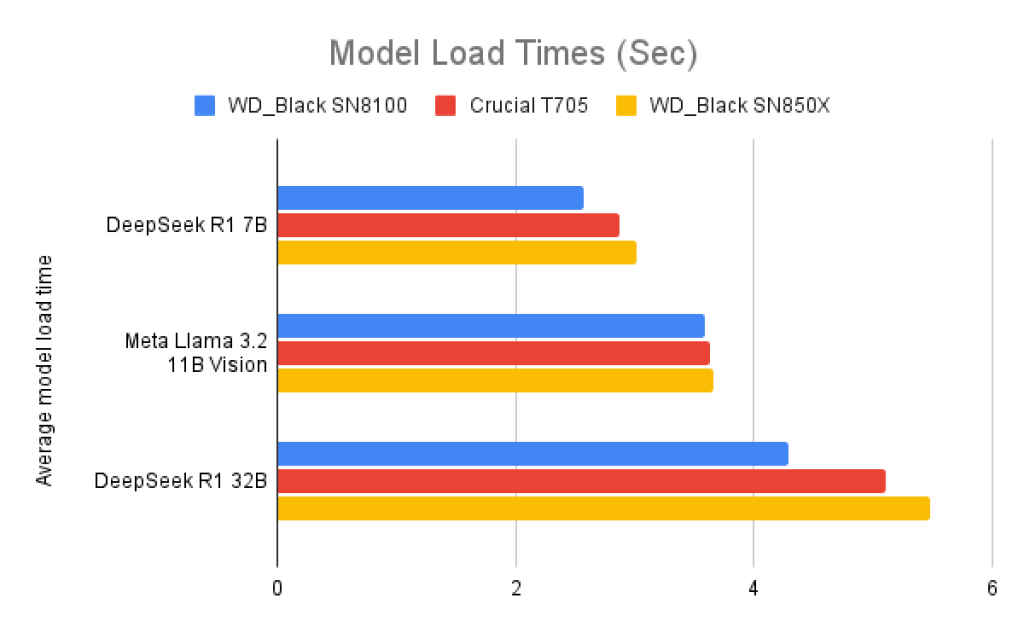
The SN8100 turns in the quickest averages across three model sizes, with the lead widening on the 32B case. That is consistent with its strong sequential read profile and steady small block behaviour. The T705 stays very close on the mid sized model and is within easy touching distance on the smallest one, so owners of that drive should expect similar outcomes for typical 7B to 13B work. The SN850X trails by a modest but repeatable margin, which matches expectations for a high end Gen4 design. If your workflow involves frequent checkpoint swaps or cold starts, the SN8100 trims a few seconds that add up over a day of experimentation.
PCMark 10
PCMark 10’s data drive test blends traces from everyday apps, content creation, and light gaming. It tends to reward consistency rather than one off peaks. In this mixed scenario the Crucial T705 inches ahead by a small but measurable amount, which suggests its scheduler and write behaviour align well with the trace mix. The SN8100 is a close second, and in practice the gap is unlikely to be noticeable outside careful A and B comparisons. The SN850X lags both Gen5 drives by a safer margin, though it still delivers a responsive desktop experience for most users.

If you care about general system feel, app updates, and background syncs running smoothly while you work, any of the three will do a respectable job. The takeaway is that PCMark does not penalise the SN8100 for chasing big sequential numbers. It remains composed across varied operations that look like a normal day on a workstation.
3DMark Storage
3DMark’s storage test focuses on gaming tasks, including installing, saving, loading, and gameplay recording. It is a useful complement to the DirectStorage feature test because it mixes file types and queue depths that mirror real game behaviour. The SN8100 leads the overall score, which lines up with its strong results in compressed storage to VRAM and RAM paths. That should mean brisker patching, faster map changes, and fewer pauses when games stream new assets.
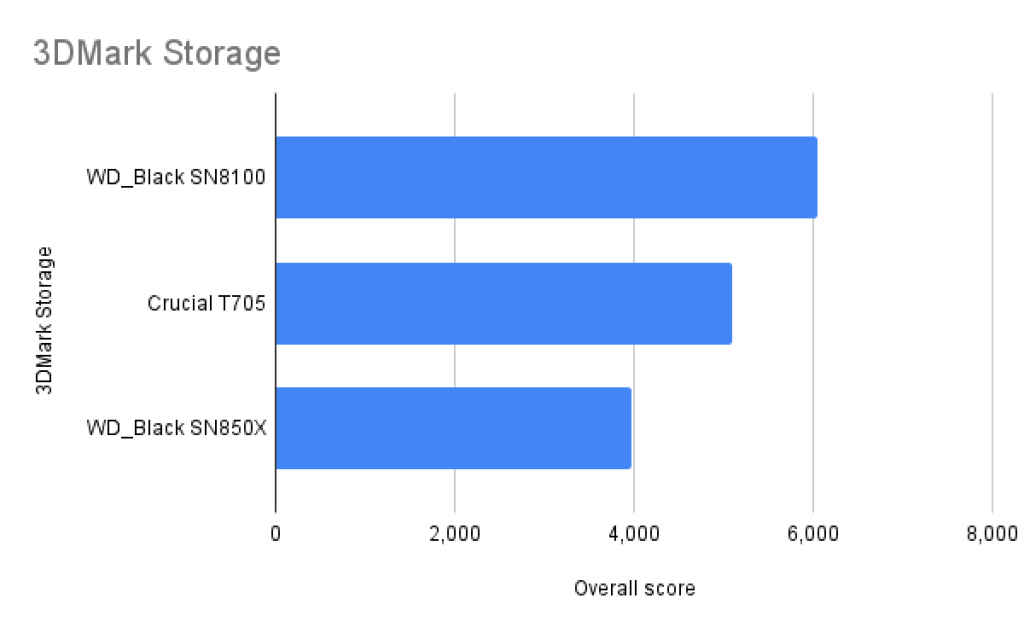
The Crucial T705 remains close enough that you would expect similar experiences in most titles, particularly those that are not heavily bottlenecked on storage. The SN850X trails, yet still feels fine in current releases that are not aggressively using modern IO stacks. For players building a new system around a Gen5 platform, this benchmark hints that the SN8100 offers a good blend of throughput and responsiveness across the storage tasks that matter to games.
Conclusion
The WD_Black SN8100 is a proper flagship Gen5 SSD. It hits the ceiling in sequential transfers, posts excellent 4K random numbers, and converts that into better results where it matters: faster model loads, quicker level transitions, and higher headroom for media projects. The endurance ratings are sensible for TLC, hardware encryption is on board, and the optional heat sink is practical rather than flashy. Power draw is in line with expectations for this class, so case airflow and motherboard heat spreaders remain relevant considerations.
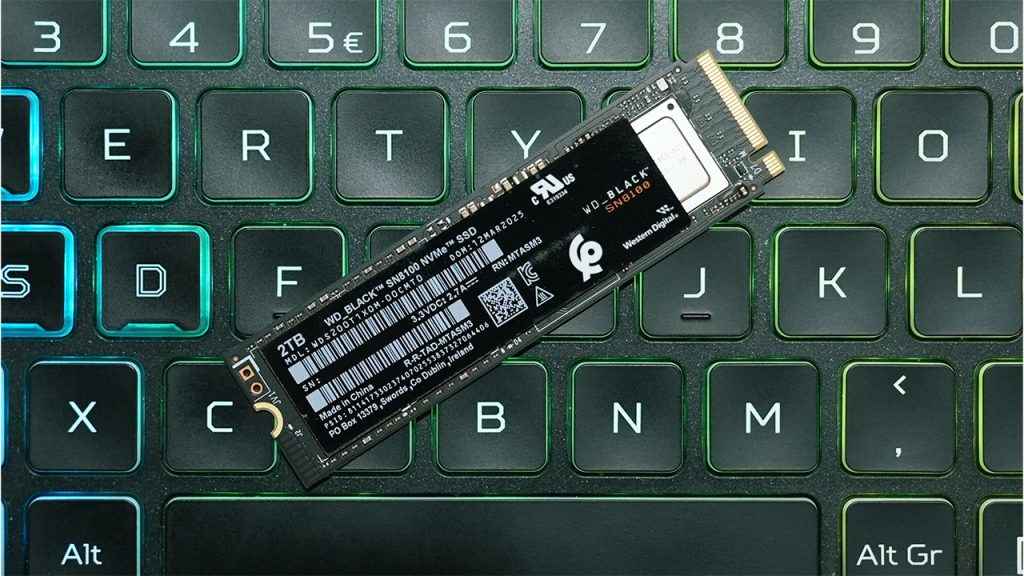
If you already own a premium Gen4 drive, day-to-day desktop work will not suddenly feel twice as fast, but the SN8100’s advantage becomes clear as datasets grow and as games adopt DirectStorage. For new Gen5 builds, or for creators and gamers who routinely move multi-gigabyte assets, the SN8100 belongs on the shortlist. It is one of the fastest consumer SSDs you can buy, and more importantly, it is consistently fast across a wide variety of workloads.


