
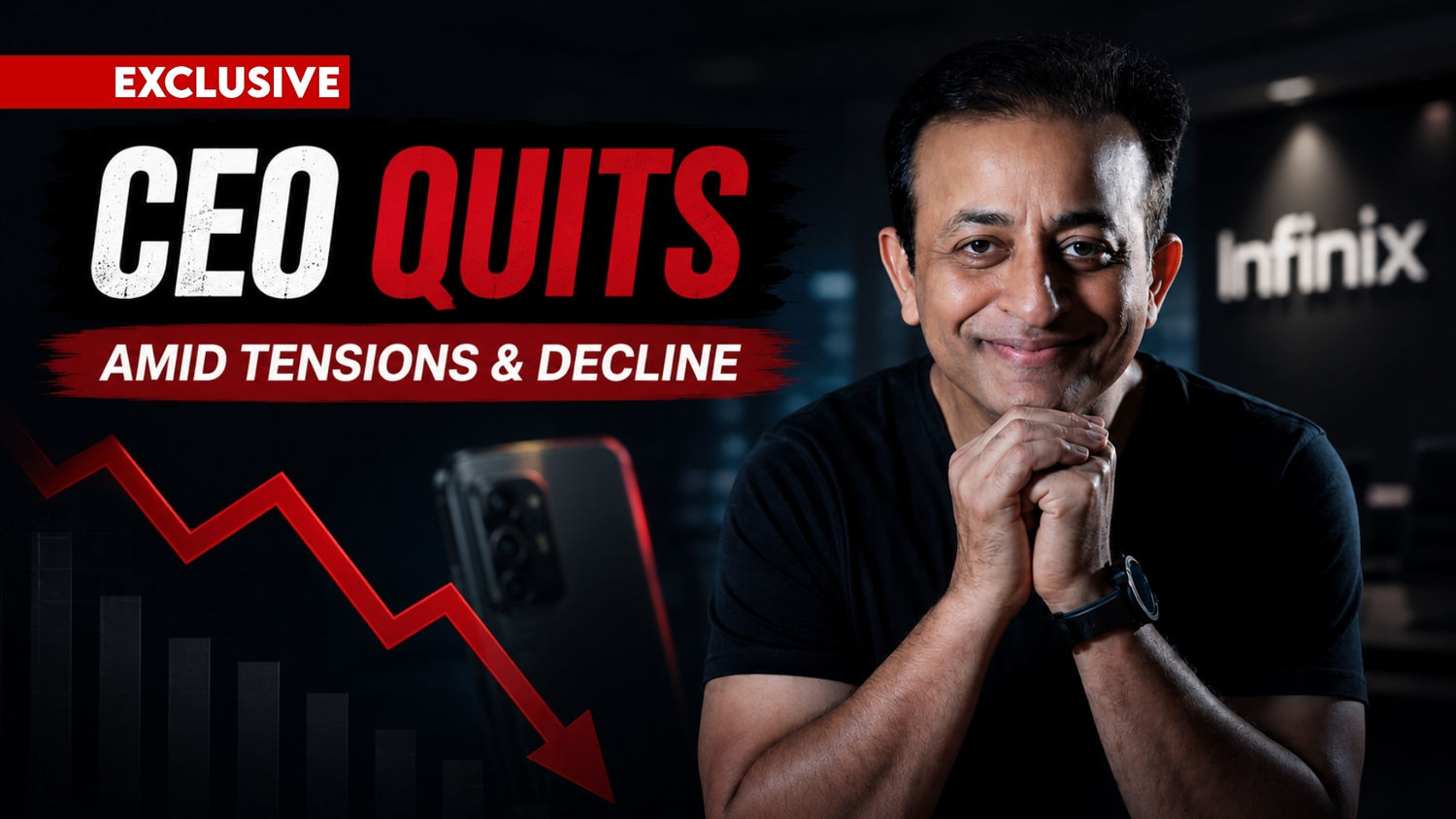
Exclusive: Infinix India CEO Anish Kapoor quits amid internal tensions and market decline
 Follow Us
Digit has learned from several industry sources that Anish Kapoor is on his way out of Infinix India
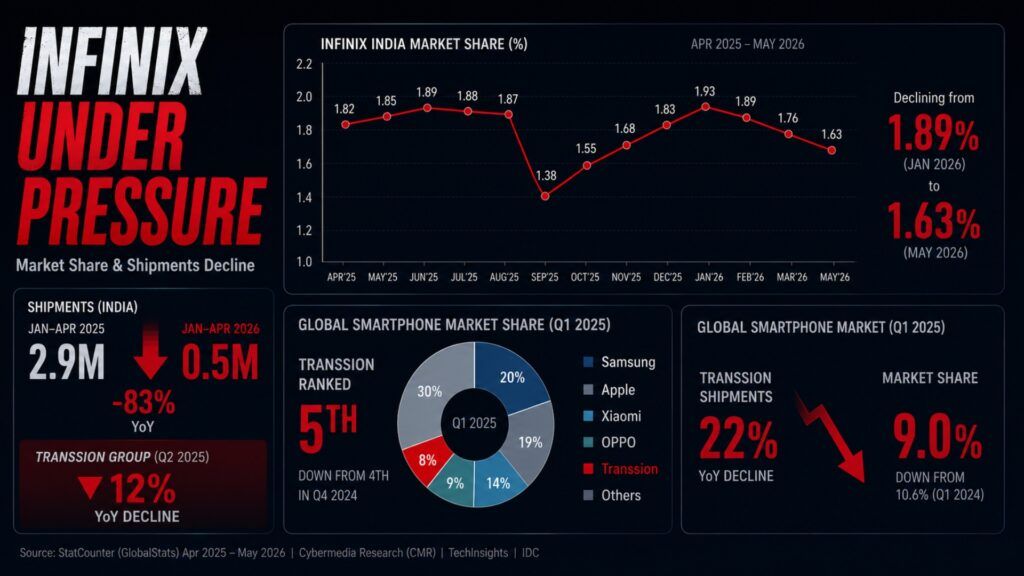
Infinix India's shipment volumes dropped from 2.9m units across all of 2025 to just 500,000 units between January and April 2026
Counterpoint forecasts a 32% decline for Transsion in 2026 and Infinix's India market share sliding to a 14-month low of 1.63% by May

The Indian smartphone market can be tough and another brand seems to be feeling the heat. Infinix, part of the Transsion group and known for making entry-to mid-level phones, is going through internal turmoil, witnessing a sharp decline in shipments, a reduced product portfolio and several internal leadership changes.
 Survey
Most importantly, Infinix India appears to be without a CEO (Chief Executive Officer). Multiple industry sources have told Digit that Anish Kapoor, who led Infinix India’s operations, is on his way out of the company. Anish could have resigned in January 2026 and is likely not a part of the company as of writing. Infinix, once the fastest-rising name in India’s budget smartphone segment, appears to be navigating its most turbulent period yet.
While the split has not been publicly acknowledged, sources describe the fallout after a period of sustained disagreement between the India leadership and the brand’s Chinese counterparts at parent company Transsion Holdings. According to one industry source, Anish’s vision for Infinix’s India strategy diverged sharply from what the Chinese leadership wanted. The tension, rooted in sales strategy and market positioning, eventually paved the way for Kapoor to part ways.
Digit also spoke to some employees at Infinix India who told us that people from the marketing and product teams are already jumping ship to rival brands.
While day-to-day operations are understood to have continued without major disruption, the leadership uncertainty appears to have left its mark on the brand’s product roadmap. Infinix launched considerably fewer smartphones (Note Edge and Note 60 Pro) between January and May 2026 than it did during the same period in 2025 which is a notable deceleration for a brand that once treated relentless product launches as a central pillar of its growth strategy.
Speaking with Digit, Yogesh Brar, tech analyst and market insights expert said, “A slower launch cadence is rarely a coincidence; it typically signals portfolio rationalisation, cash-flow constraints, or a strategic pause. Here, it’s a combination of all three, compounded by rising costs for key components like DRAM and NAND, which disproportionately impact vendors with smaller scale and high low-end shares,” Brar says.
Brar also addresses the multi-brand dynamic that underpins the tension within Transsion and what it means for Infinix. “Transsion’s intent is clear differentiation, where Tecno targets the mid-to-high end, Infinix courts fashion-forward youth and itel serves mass-market consumers. In theory, it’s elegant, but in practice and considering India’s price-sensitive market with low margins, the lines blur fast and internal cannibalisation becomes real,” he says.
Infinix had only recently consolidated its position as Transsion’s lead brand in India, but a string of market data points now collectively paint a more difficult picture: shrinking shipment volumes, softening market share and a global parent company facing mounting structural headwinds of its own.
Infinix’s rise and the cracks beneath
As recently as mid-2025, the brand’s India trajectory looked promising. According to a report published by OmIndia in July 2025, Infinix had overtaken Tecno to become Transsion’s lead brand in India, driven by its design-forward approach and campaigns targeting gaming and creator communities. At the time, the brand was contributing 45% of Transsion’s combined 1.8m India shipments.
But the cracks were already forming. A report by Cybermedia Research (CMR) published in August 2025 pointed to a 12% year-on-year decline for Transsion Group in Q2 2025, attributing the drop to weakened demand in aspirational India, limited traction in the entry-level 5G segment, reduced channel push and growing competition from aggressively priced rivals.
Infinix’s India market share data from StatCounter (GlobalStats), covering April 2025 to May 2026, traces the same trajectory. The brand held a stable position between 1.82% and 1.89% from April to August 2025, before dipping sharply to 1.38% in September 2025. It recovered through the final quarter of 2025 to post a near-term peak of 1.93% in December, but has since declined steadily, slipping from 1.89% in January 2026 to 1.63% by May 2026.
Brar puts the scale of the decline in perspective saying, “Infinix has faced a challenging 18 months in India. While the brand previously punched above its weight on volume, shipping 2.9 million units last year, volumes dropped to just 500,000 units from January to April 2026. This isn’t isolated; Transsion’s three brands, Tecno, itel, and Infinix, all posted a combined 20% year-on-year shipment decline.” This was inevitable, but a similar picture was simmering globally.
A global lifeline, but not for India
According to a TechInsights report published in June 2025, Transsion fell to fifth position in the global smartphone market in Q1 2025, having briefly climbed to fourth the previous quarter. The combined shipments of Tecno, Itel and Infinix posted a 22% year-on-year decline in Q1 2025, starkly underperforming a market that grew just 0.5% in the same period. TechInsights noted that before Q3 2024, the combined Transsion brands had enjoyed five consecutive quarters of growth. Rising component costs, weakening demand in key emerging markets, a more restrictive operating environment in Russia and intensified competition from Samsung and other Chinese brands were cited as the primary headwinds.
It is worth noting that Transsion’s global story is not uniformly bleak. An IDC report published in January 2026, covering Q3 2025 data, notes that Transsion continued to expand across North and East Africa, where strong distribution networks and a competitive sub-$200 portfolio have kept the group on solid footing globally. Shipments for Q3 2025 reached 29.2m units, representing a 9.0% market share and a 13.4% year-on-year increase from 25.7m units and 8.2% share in Q3 2024. India, however, is a different competitive market entirely and one that rewards localisation, rapid portfolio refresh and close-to-ground market intelligence, precisely the capabilities that a stable, empowered local leadership is best positioned to deliver.
“While the India CEO role is vital for navigating local distribution, true strategic autonomy is limited. The Infinix India chief enjoys slightly more leeway than peers, but the broader trend among Chinese brands is a pivot away from localisation. Product architecture decisions are increasingly made for global volume, treating India as a recipient rather than an originator of the roadmap.”
Outlook
The near-term prognosis does not offer much comfort. The latest forecast from Counterpoint, published in June 2026, identifies Transsion as among the most exposed original equipment manufacturers given its concentration in the sub-$150 segment, projecting a 32% decline for the group in 2026.
Whether a leadership change at the India level, assuming one has indeed occurred, will accelerate or arrest that slide remains to be seen. What is clear is that Infinix enters the second half of 2026 navigating its most turbulent period yet: a contested market position, a slower launch cadence and now, if sources are to be believed, a leadership vacuum at the top of its most important single-country market.
Digit also reached out to Infinix India with a detailed questionnaire covering leadership changes, the brand’s strategic direction and its product launch plans for 2026. The company had not responded at the time of publication. This story will be updated should a response be received.


