
Inverter AC vs non-inverter AC: Which one saves you more money and electricity
 Follow Us
Inverter AC uses less power and gives more stable cooling.
Non-inverter AC costs less to buy but may increase electricity bills.
Repair costs are usually lower for non-inverter models.
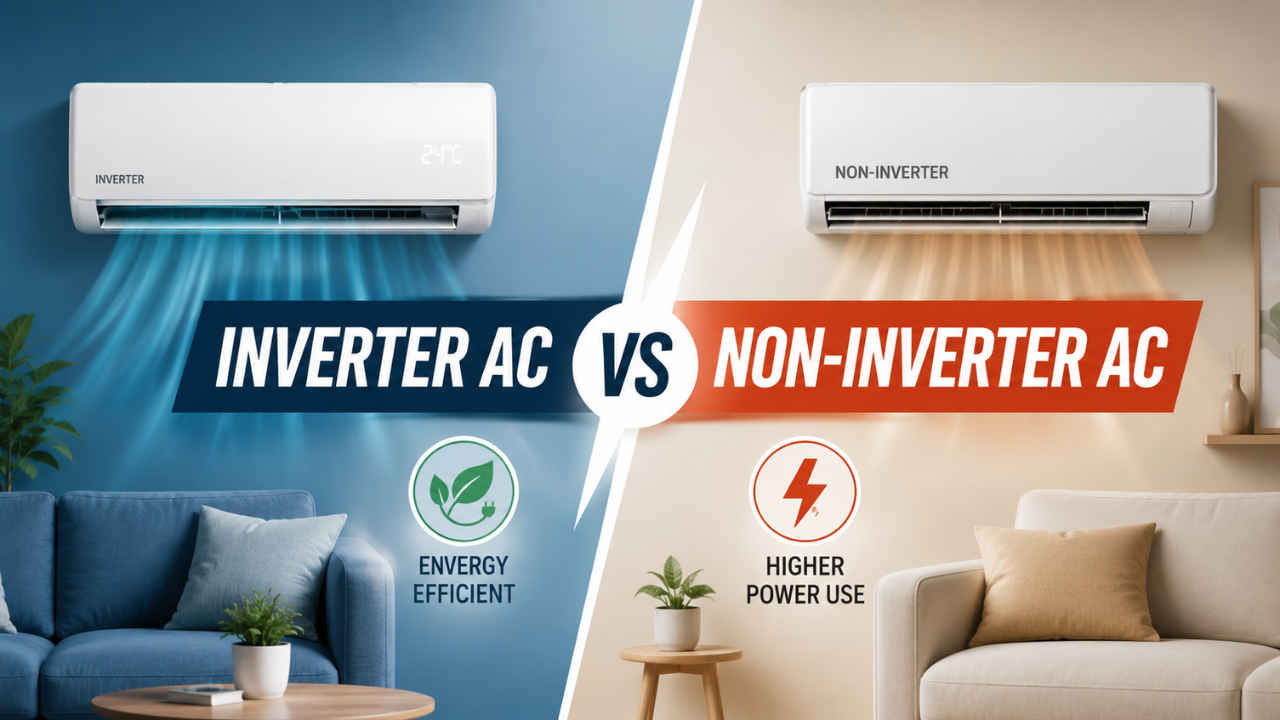

Buying an air conditioner is no longer just about cooling. With rising temperatures and electricity costs, the real question has shifted to what kind of cooling actually fits your daily life. On the surface, both inverter and non-inverter ACs look similar. There is no design difference, and they even have similar price ranges in certain situations. However, once you use both in real life, you will notice the actual difference, especially in comfort, noise levels, power consumption, and cost. One is designed to give effective cooling at a lower upfront price, while the other focuses on maintaining a steady temperature and reducing electricity bills. Follow along with the article to learn the key difference between an inverter AC and a non-inverter AC.
 Survey
Inverter AC vs non-inverter AC: Performance
The fundamental difference between these two units is in the nature of the compressor’s operation. The former operates strictly on the start/stop principle, meaning that it is either running at full capacity, thus making a room cool until the compressor stops working completely, or starts again with a noisy hum upon warming.
Conversely, the latter boasts a highly advanced and sophisticated compressor system that adjusts its performance according to the changing conditions, keeping the room at the same comfortable temperature continuously without creating any cold or warm spots.
Also read: OpenAI CEO Sam Altman says AI unlikely to cause jobs apocalypse, here is why
Inverter AC vs non-inverter AC: Cost of running and maintaining
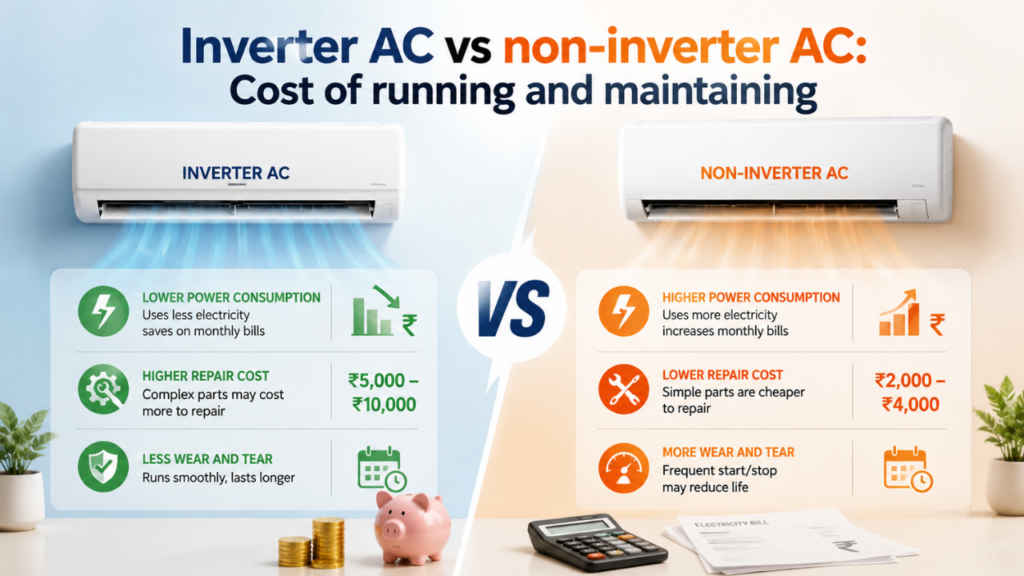
Non-inverter ACs tend to use the same amount of power every time they start up because they use maximum power. If you were to run an ordinary non-inverter for eight hours each day, the power bill might come to around Rs 2,600.
In contrast, the smooth speed adjustments of an inverter model lower the monthly electricity bill to roughly Rs 1,900. While you save money on bills, keeping the machine running over time brings another factor. Repairing the complex electronic circuit board of an inverter model can cost between Rs 5,000 and Rs 10,000, while simpler non-inverter repairs cost only Rs 2,000 to Rs 4,000.
Also read: Vivo X500 Pro specs leak online: Display, camera, processor and other details revealed
Inverter AC vs non-inverter AC: Pricing in India
Price is directly proportional to the quality of the technology used. The non-inverter model is an affordable option suitable for temporary use, costing anywhere between Rs 25,000 and Rs 35,000. Nevertheless, the inverter AC requires an initial investment. The cost may vary from Rs 30,000 to Rs 45,000. But still, it is certain that after only two summers of use, the additional expenses can be recovered easily.


