
Why your next smartphone will likely be Made in India, and not Vietnam
 Follow Us
Lower US duties on Indian exports give India a clear cost advantage over Vietnam and Bangladesh, making it cheaper to build premium smartphones in India.
Apple and Samsung are now producing high-end models in India, with the entire iPhone 17 lineup made locally for global export.
India already makes about 25% of the world’s iPhones, with smartphone exports to the US surging as ‘Make in India’ gains momentum.
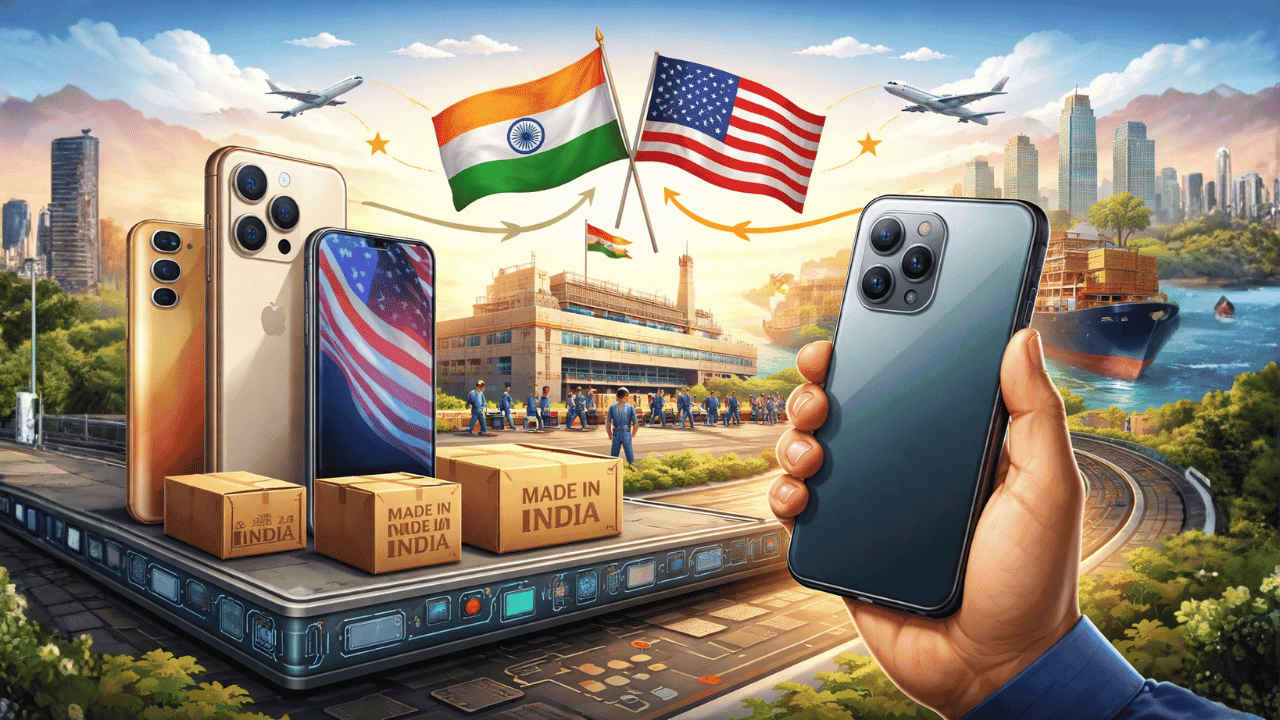

The Indian and US governments have recently signed a new trade agreement that lowers duties on Indian exports, making them cheaper than goods from rival Asian producers and further cementing India’s position in global manufacturing. The tariff cuts have redrawn the map of smartphone production. By reducing duties on Indian goods to 18%, the US has given India a clear cost advantage over hubs such as Vietnam and Bangladesh, removing a major economic barrier to relocating premium electronics manufacturing. For companies shipping tens of millions of high-end devices, a two-percentage-point tariff gap can mean hundreds of millions of dollars in savings. This shift is structural, moving smartphone production to India.
 Survey
Under the new agreement, the US reduced its reciprocal tariff on Indian goods from the previous 25% and well below the temporary 50% duty imposed during recent trade tensions. With this move, a primary economic barrier to relocating advanced electronics manufacturing out of Southeast Asia has largely been removed. The new tariff cuts have given India a clear cost advantage against other manufacturing countries like Vietnam and Bangladesh, where goods exports are typically taxed at 20%.
Also read: Apple iPhone Fold design, specifications, launch timeline, price and all other leaks
At first, a two-percentage-point difference may look small, but in the smartphone industry, it matters a lot. For companies that ship tens of millions of high-end phones each year, that small gap can mean saving hundreds of millions of dollars every year. These savings can change where premium smartphones are made.
Until recently, India’s main role was to serve as an assembly point for budget smartphones, while flagship models were largely produced in China or Vietnam. Although companies like Apple and Samsung had increased their presence in India in the past few years, the uncertainty about US-India trade relations had been a constraint.
Also read: Apple blocks iOS 26.2 downgrade, shuts rollback window for iPhone users after iOS 26.2.1 update
However, with this new agreement, the situation has been reversed. India has now moved from a secondary assembly centre to a primary hub for advanced electronics production. As of 2026, Apple is manufacturing all four models of the iPhone 17 series in India for global export, the first time an entire new generation has launched with such a significant Indian production share, with a focus on the US market to reduce China-related trade risks. Samsung has also scaled up production of its Galaxy S25 Ultra and foldable devices at its Noida facility, its largest global plant.
Furthermore, India now accounts for approximately 25% of global iPhone output, marking a milestone in its manufacturing ascent. The trade deal is expected to further accelerate the shift from basic assembly to full-scale manufacturing, providing a major boost to the government’s ‘Make in India’ initiative. Smartphone exports from India to the US have already tripled over the past year to more than $12 billion, and officials project that total electronics exports could approach $100 billion in the coming years.


