
Get a free student laptop? Beware of this WhatsApp scam, here is how to stay safe
 Follow Us
Government has flagged the viral free laptop WhatsApp message as fake.
Scam links may be used to collect personal and financial details.
Verify schemes through official sources before applying or sharing information.
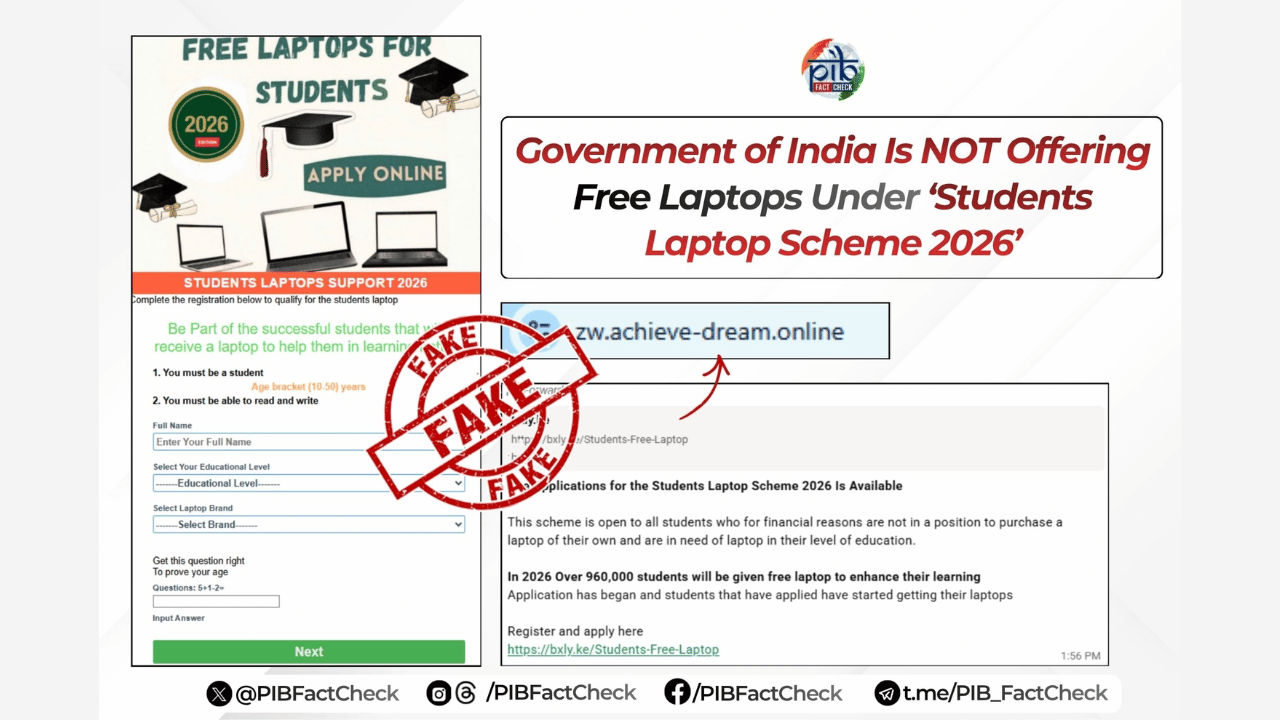

Are you someone who has also received a WhatsApp message claiming that the government is now accepting applications for the Student Laptop Scheme 2026? If yes, then your bank account may get empty as soon as you fill in the form. The government’s fact-check agency has recently confirmed that this message is completely fake and has warned people to stay alert. They have also been asking people to report such messages. Follow along with the article to learn more about this WhatsApp student laptop scam and how you can stay safe against it.
 Survey
Free laptop scam on WhatsApp
Students all around the country have received WhatsApp messages stating that the government was now accepting applications for free laptops under the scheme known as ‘National Student Laptop Scheme 2026’. However, according to the latest announcement made on the government’s official X (formerly Twitter) account by PIB, this is nothing but a scam. The agency clarified that the Government of India has not launched any scheme offering free laptops under this name.
Also read: Is Apple really planning to launch iPhone Ultra? Here is what iOS 27’s early build suggest
The authorities also shared a screenshot of a WhatsApp message that says:
‘Applications for the Students Laptop Scheme 2026 are now open.
This scheme is available to all students who, due to financial constraints, are unable to purchase a laptop and require one for their education.
In 2026, over 960,000 students will receive free laptops to enhance their learning.
Applications have begun, and students who have applied are already receiving their laptops.
Register and apply here.’
💻 Free laptops for students?
— PIB Fact Check (@PIBFactCheck) June 14, 2026
A WhatsApp message is circulating claiming that the Government is accepting applications for free laptops under the ‘National Student Laptop Scheme 2026’.#PIBFactCheck:
❌ This claim is #FAKE.
✅ The Government of India has NOT announced any… pic.twitter.com/fv2fwU9VLU
Following the message there is a link that redirects students to a website where they are asked to provide personal and academic information. Although authorities have not yet clarified exactly how the scam operates, such websites typically seek sensitive financial information, including bank account details. In some cases, they may ask students to pay a refundable processing fee in order to claim the device.
Officials have warned that fake government schemes frequently circulate online and are designed to create a sense of urgency, prompting people to act without verifying the information.
Also read: Samsung Galaxy Z Fold 8 vs Galaxy Z Flip 8: India price, camera, display and other expected details
How to be safe
While the WhatsApp scams related to government schemes are on the rise, it’s easy to stay safe against them. All you need to do is follow the simple tips below:
- Always double-check the schemes via official government websites or X handles.
- Never click on the links you receive from unknown or unverified users on WhatsApp.
- Check the message you received for grammar inconsistencies.
- If there is a website link attached, then check if it ends with ‘.gov’ as most of the government sites have the same URL extension.


