
Mini LED vs OLED vs QLED vs Micro LED: TV display technologies explained
 Follow Us
TV technologies differ fundamentally between backlit panels and self-emissive pixels.
Mini LED offers the best balance of contrast, brightness, and affordability.
OLED provides infinite contrast but carries a minor risk of burn-in.
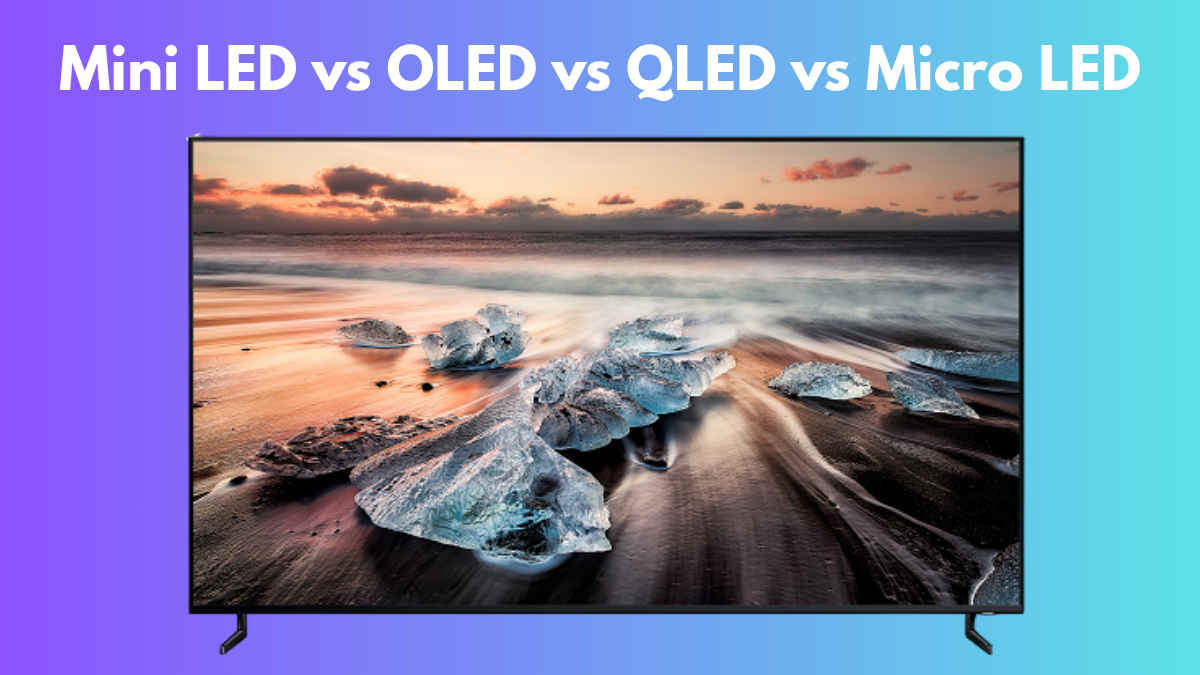

If you’re in the market to buy a new TV in 2026, I’m sure you’ve been stuffed between all the different types of technologies available in the market. There are types with Mini LED, OLED, QLED, and Micro LED panels, and each of these technologies promises the best picture; however, they work very differently from each other.
 Survey
So here is a straight breakdown of what each actually means, so you can decide which panel type suits your living room and your budget. Without wasting much time, let’s get right into it.
How each TV panel tech works
Let’s first start with the most basic one, which in this case is QLED. This is Samsung’s branded term for LCD panels, but rather than being normal, they’re enhanced with a quantum dot filter. Because of this, there is an improvement in colour volume and brightness; it’s important to know that the display still relies on a traditional LED backlight. It is not really a fundamentally new display type; however, it’s just a slightly better LCD panel.
After QLED, we move on to Mini LED, which takes the foundation of LCD, but it replaces the standard backlight with thousands of much smaller LEDs grouped into local dimming zones. The more zones here mean that the panel has finer control over which parts of the screen light up. In practice, this helps in dramatically improving the contrast. Most brands today have completely switched over to Mini LED on some of their entry-level premium lines.
Moving onto the more premium segment, we have OLED, which works entirely differently. In these types of panels, each pixel generates its own light, and the biggest advantage of this is that it can be switched off completely, delivering perfect blacks and infinite contrast ratios. Most of the popular TV brands in the market today have TVs with OLED panels in their premium line of TVs.
Last but not least, Micro LED is rather a new technology, and because of this, it is much rarer and more expensive. It is self-emissive like OLED but built from inorganic LEDs instead of organic compounds. It combines OLED-level contrast with significantly higher brightness and no organic degradation risk. Currently, Samsung’s The Wall and other select ultra-premium models only use this technology.
Head-to-head comparison: OLED vs QLED vs miniLED vs micro LED
Let’s do a head-to-head comparison on various parameters to understand the difference even further:
Contrast and blacks: OLED wins here, as the individual pixel dimming means that it can deliver true blacks that no backlight-based panel can match. While mini-LED can close the gap significantly over standard QLED panels, blooming remains a limitation depending on the zone count. The only close thing to OLED is Micro LED; however, it is again out of reach for most.
Brightness: Micro LED blows every other panel out of the park. However, this might surprise a lot of people; technologies like QLED and Mini LED pull ahead of OLED. The peak brightness on high-end Mini LED panels can easily exceed 2,000 nits, making them better suited to bright Indian living rooms. While it’s safe to say OLED panels have improved considerably, QLED and Mini LED still lead the brightness department.
Burn-in: The biggest practical concern with OLED, though, is burn-in. Early adopters of the technology have faced this issue significantly, and while the situation has genuinely improved over the years, for most, it remains an area of concern. On the other hand, technologies like QLED, Mini LED, and Micro LED have no burn-in risk.
Price and availability in India: The most basic QLED TVs offer the best value proposition, as they can be picked up for the cheapest. After which, Mini LED comes in. While the technology was a bit expensive at first, with more brands pushing this tech, the pricing has dropped significantly. OLED remains mostly a premium tech, typically starting above a lakh rupees for the basic models. Micro LEDs, on the other hand, are effectively inaccessible to most consumers as they start at 30 to 50 lakh rupees and are sold in very limited configurations.
Which one should you buy?
Now that you know which technology works in what ways and which one is suited under different parameters, the biggest question that arises is, ‘What type of TV do you actually need to buy?’
Well, for most buyers looking to purchase a TV in India, a Mini LED currently takes the spot as the ideal choice. It hits the best balance of contrast performance, brightness, and price. For those who watch a lot of cinema in a controlled light environment and can manage to pay the premium, then OLED remains the gold standard. While technologies like QLED are the sensible choice for a bright room on a tighter budget. Micro LED is a technology to watch out for, but currently, it’s out of the equation as there are no affordable options.
With that said, I hope this guide helped you in deciding what kind of TV technology you should buy in 2026. For more such informative reads, keep on reading Digit.in
Also Read: Samsung launches 2026 TV lineup, Mini LED TVs price in India starts at Rs 42990


