
OnePlus 15 vs iQOO 15 vs Realme GT 8 Pro battery drain test: 6 hours, 3 flagships, 1 winner
 Follow Us

Battery life is no longer just a spec you glance at and forget. In today’s flagship phones, displays are already excellent, performance is more than sufficient for almost everyone, and cameras have reached a point where real differences only become apparent in very specific situations. What actually affects everyday use is much simpler: how long your phone lasts when you stop babying it and start using it properly. To find that out, we put three of the most powerful Android flagships of 2025 through a controlled six-hour battery drain test: the OnePlus 15, the iQOO 15 and the Realme GT 8 Pro. All three devices are powered by the Snapdragon 8 Elite Gen 5 chip, all sit in the same premium price bracket, and all promise top-tier performance. The real question was which one could hold on the longest once the workload became serious.
 Survey
Also read: OnePlus 15 review: Power over panache
Test conditions
To ensure fairness, all three phones were connected to the same Wi-Fi network. Display brightness was calibrated to 500 nits using a lux metre, screen colour mode was set to Natural, resolution was locked to FHD+, and refresh rate was set to Adaptive. Audio volume was fixed at 50%, and each device was fully charged to 100% before testing. All phones were running their latest Android 16-based software builds.
Prices in India
OnePlus 15: Rs 72,999 (12 GB + 256 GB), Rs 79,999 (16 GB + 512 GB)
iQOO 15: Rs 72,999 (12 GB + 256 GB), Rs 79,999 (16 GB + 512 GB)
Realme GT 8 Pro: Rs 72,999 (12 GB + 256 GB), Rs 78,999 (16 GB + 512 GB)
Key specifications at a glance
The OnePlus 15 features a 6.78-inch LTPO AMOLED display with a 1.5K resolution (1272 x 2772) and a 165Hz refresh rate. It peaks at 1,800 nits in high brightness mode and is protected by Gorilla Glass Victus 2. It runs OxygenOS 16 based on Android 16 and houses a 7,300mAh battery with 120W wired and 50W wireless charging.
The iQOO 15 uses a larger 6.85-inch LTPO OLED panel with a QHD+ resolution (1440 x 3168) and a 144Hz refresh rate. It is the brightest of the three at 2,600 nits HBM. It runs OriginOS 16 atop Android 16 and packs a 7,000mAh battery with 100W wired and 40W wireless charging.
The Realme GT 8 Pro comes with a 6.79-inch LTPS AMOLED display at QHD+ resolution (1440 x 3136) with a variable 60-144Hz refresh rate. Peak brightness is rated at 2,000 nits (HBM). It runs Realme UI 7.0 based on Android 16 and also has a 7,000mAh battery, with 120W wired and 50W wireless charging.
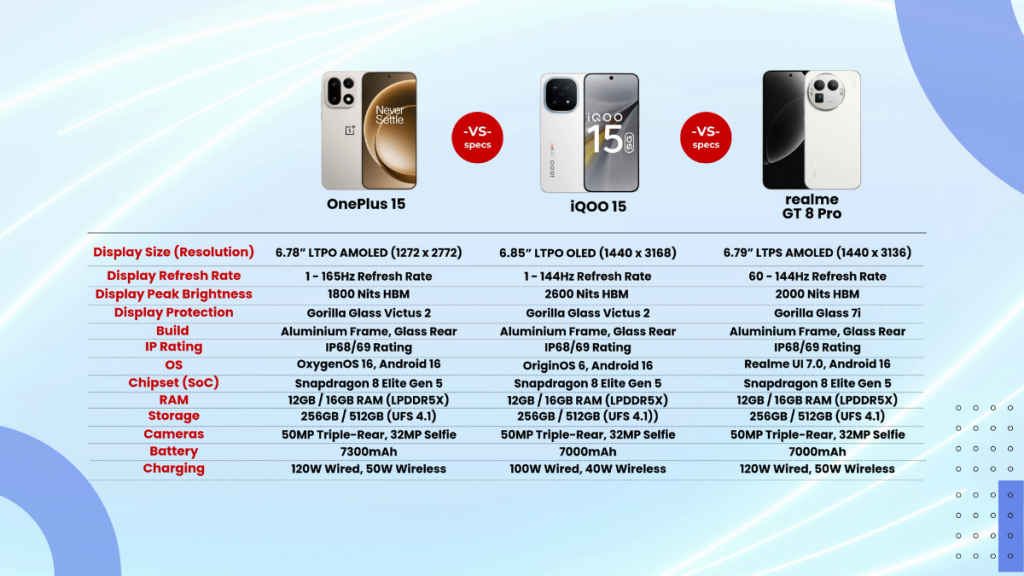
All three phones use the Snapdragon 8 Elite Gen 5 chip, up to 16 GB LPDDR5X RAM and 512 GB UFS 4.1 storage, aluminium frames, glass backs and IP68/69 dust and water resistance.
2 hours of YouTube video playback
We began with two hours of continuous YouTube video playback. Despite differences in resolution and refresh rate, all three displays looked excellent in real-world viewing. The Realme GT 8 Pro leaned towards a more natural, balanced colour profile. The OnePlus 15 also delivered pleasing colours, and its 1.5K panel clearly helped with efficiency.
The iQOO 15 stood out visually. Its panel was noticeably brighter, with stronger highlights and punchier colours that held up better outdoors. All three performed well under direct sunlight, but the iQOO had the most visual impact.
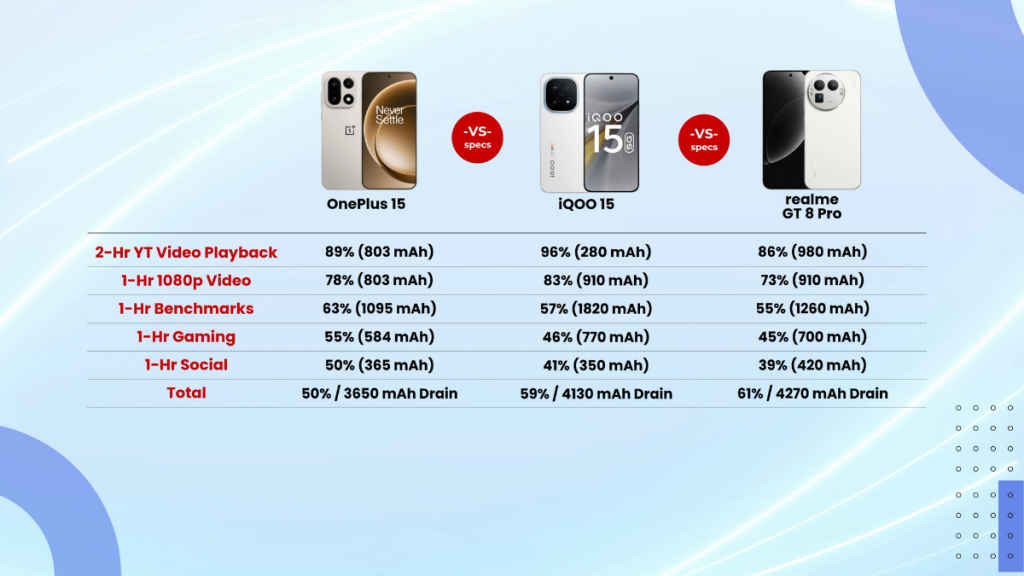
After two hours, the iQOO 15 led comfortably with 96% battery remaining. The OnePlus 15 followed at 89%, while the Realme GT 8 Pro dropped to 86%.
1 hour of 4K video recording
Next came an hour of 4K video recording, split evenly between rear and front cameras.
All three phones offer 50MP triple rear camera setups paired with 32MP selfie cameras. Video support is identical on paper, with up to 8K 30fps from the rear and 4K 60fps from the front. The only notable difference is the Realme GT 8 Pro’s 200MP periscope camera, compared to 50MP periscopes on the other two.
During the rear camera recording, thermals varied slightly. The OnePlus 15 handled heat best initially, peaking at around 35.5°C. The Realme GT 8 Pro topped out at roughly 38°C, while the iQOO 15 reached about 39°C.
Interestingly, this flipped during front camera recording. The iQOO 15 ran cooler at around 37°C, the Realme stayed close at 38°C, while the OnePlus 15 became the warmest at 39°C.
At the three-hour mark, battery levels stood at 83% for the iQOO 15, 78% for the OnePlus 15 and 73% for the Realme GT 8 Pro.
1 hour of benchmarks
The benchmark round revealed the biggest differences between these phones.
In Geekbench 6, the OnePlus 15 was marginally ahead in single-core performance and held a clearer lead in multi-core scores. However, Antutu told a different story. The OnePlus 15 crashed near the end of the test and failed to register a score, while both the iQOO 15 and Realme GT 8 Pro completed the run with excellent results. The Realme GT 8 Pro actually posted the highest overall score.
3DMark stress testing further exposed thermal behaviour. The OnePlus 15 repeatedly crashed and could not complete the test. To keep things fair, it was instead run through a 30-minute CPU throttling test. The iQOO 15 delivered the highest peak performance in 3DMark, though stability sat at 79.9%. The Realme GT 8 Pro surprised with a perfect 100% stability, holding a steady frame rate throughout, albeit at lower performance levels.
Under sustained CPU load, the iQOO 15 again stood out with the highest average GIPS and strong stability. The Realme GT 8 Pro prioritised stability over output, while the OnePlus 15 lagged behind both.
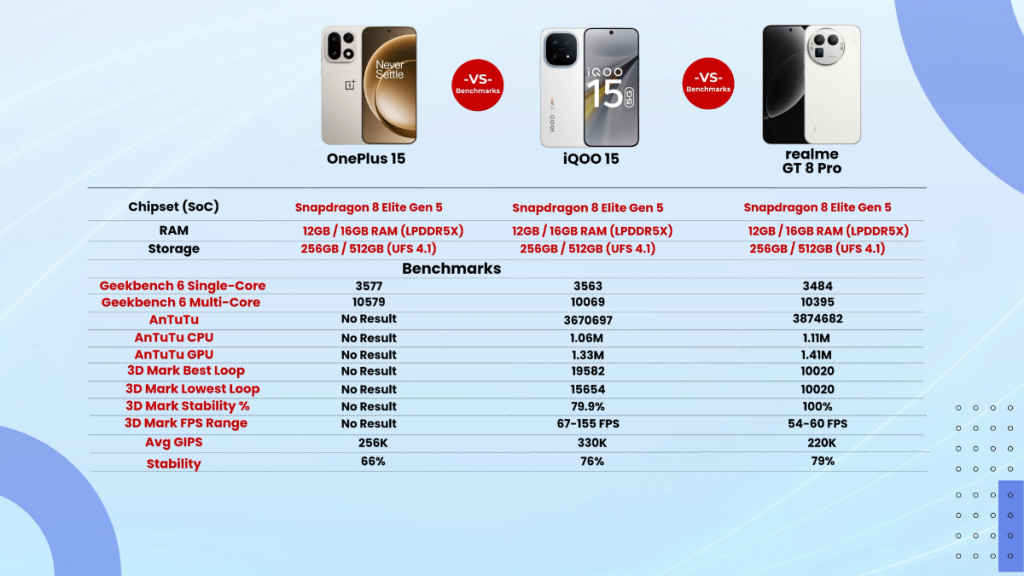
By the four-hour mark, the OnePlus 15 appeared to lead with 63% battery remaining, but this came with an important caveat. It did not complete the same benchmark workload as the other two, giving it an unintended advantage.
1 hour of gaming
Gaming performance is where the iQOO 15 clearly separated itself. All three phones ran titles like BGMI, COD: Mobile and Asphalt 9: Legends smoothly at up to 120 fps, but the iQOO delivered the strongest sustained performance with the least throttling. It did warm up quickly, peaking at around 39°C, but thermal management remained well balanced.
The Realme GT 8 Pro focused on consistency, staying slightly cooler but sacrificing raw output. The OnePlus 15 handled real-world gaming well, but its benchmark crashes raise concerns for power users.
After gaming, battery levels dropped to 55% on the OnePlus 15, 46% on the iQOO 15 and 45% on the Realme GT 8 Pro.
1 hour of social media
The final hour consisted of continuous Instagram usage. By the six-hour mark, the OnePlus 15 finished with 50% battery remaining. The iQOO 15 wrapped up at 41%, followed by the Realme GT 8 Pro at 39%.
Total battery drain after 6 hours
OnePlus 15: 50% remaining (3,650mAh drained)
iQOO 15: 41% remaining (4,130mAh drained)
Realme GT 8 Pro: 39% remaining (4,270mAh drained)
Conclusion
On paper, the OnePlus 15 wins this test by finishing with the most battery left. However, that result needs context. The phone crashed during both Antutu and 3DMark, meaning it did not endure the same workload as the other two devices. While it ran an extra CPU throttling test, that does not match the intensity of full GPU stress testing.
The Realme GT 8 Pro emerged as the most stable and consistent performer. It rarely spiked in temperature, completed every test, and delivered predictable results, though it lagged behind in raw performance.
The iQOO 15, however, proved to be the strongest all-rounder. It delivered the best sustained performance, the brightest display, excellent efficiency during video playback, and the most dominant gaming results. Yes, it drained more battery during benchmarks, but that was the cost of pushing higher performance without crashing.
Long story short, if your priority is maximum battery percentage at the end of the day, the OnePlus 15 looks impressive. If you value stability and consistency, the Realme GT 8 Pro makes a strong case. But if you want the best balance of power, thermals, display quality and real-world performance, the iQOO 15 is the phone that truly stands out in this three-way battle.
Also read: iQOO 15 review: From flagship killer to full-fledged flagship


