
Expanding beyond PCs, Make in India, AI PCs and the Acerpure bet: Sudhir Goel of Acer India
 Follow Us
Acer says more than 80 per cent of the products it sells in India are now manufactured locally.
Sudhir Goel believes AI PC adoption remains at an early stage, with enterprise security concerns slowing some deployments.
Acerpure is expanding into larger appliances, with Acer targeting broader service coverage across India over the next year.

Acer is looking beyond its traditional identity as a personal computing company. That transition was particularly visible as the company announced actor Akshay Kumar as its brand ambassador, bringing Acer’s computing portfolio and the growing Acerpure home appliance business together under what it calls the “House of Acer”.
 Survey
The announcement comes as Acer marks 50 years globally and 27 years in India. The House of Acer concept brings PCs together with televisions, air conditioners, washing machines and other home products, reflecting the company’s ambition to establish itself across a much wider consumer technology ecosystem.
“My life is always moving. There is work, travel, fitness and family, and when I come home, I want things to be simple. Technology should make life easier, not add more to your list,” Akshay Kumar said while announcing the association.
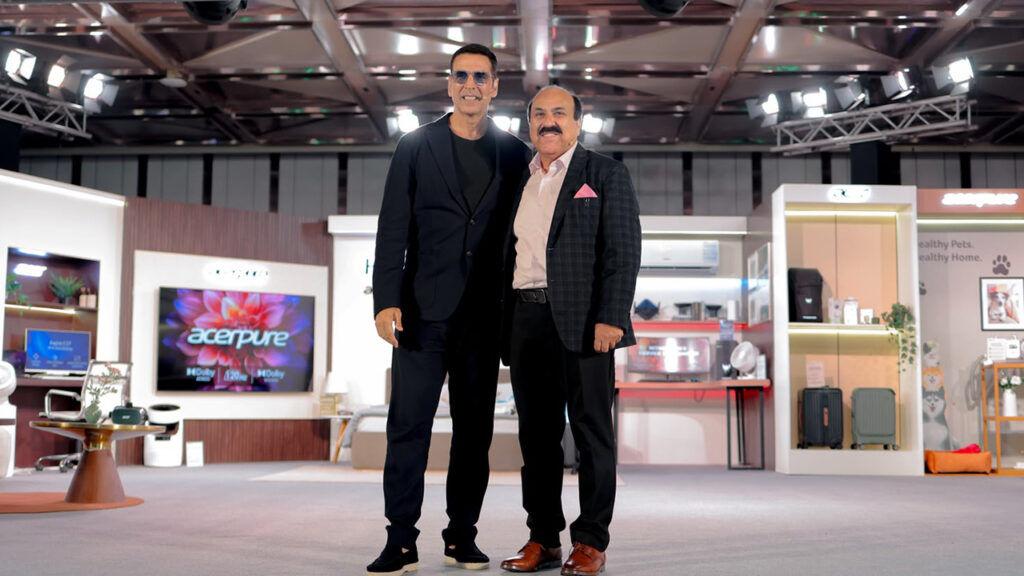
Speaking to Digit on the sidelines of the announcement, Sudhir Goel, Chief Business Officer at Acer India, said the move into consumer electronics is an extension of the company’s existing technology philosophy rather than a departure from computing.
“From a pure PC company, we have been working on expansion to other areas which overlap in terms of technology and solutions, keeping the core strength of Acer of fresh technology at affordable prices,” Sudhir said.
That expansion led Acer to establish Acerpure as a separate entity focused on consumer electronics and appliances. Keeping the businesses organisationally distinct, according to Sudhir, was important to prevent the appliance operation from becoming secondary to Acer’s much larger PC business.
Acer sees a much larger opportunity beyond the PC
Sudhir described Acerpure as an experiment that has gradually evolved into a significant business. “We said we have such a huge consumer base who are satisfied with using PCs as a technology and as a solution,” he said. “If you have that in a home today, whether it is a television, an air conditioner or a washing machine, ultimately these have evolved towards technology.”
For Acer, there are overlaps not only in technology but also in components, product design and, crucially, the customer buying the devices. “If the consumer is satisfied with Acer PC as a product, then why not this?” Sudhir said. Acer consequently established Acerpure around two-and-a-half to three years ago. “Why a separate company? Because we wanted to be focused,” he explained. “Otherwise, it gets mixed into the PC category and then it loses its focus.” That decision appears to be translating into a more aggressive expansion of the portfolio. Sudhir said Acerpure has already seen growth of more than 100 per cent over the previous year in installed base and revenue.
“We are adding newer categories,” he said. “This calendar year 2026, we added air conditioners. We will be adding washing machines. So we are adding newer, larger appliances as a solution.” The company expects that portfolio to continue expanding. “For us, Acerpure growth has been doubling or maybe tripling year on year in terms of volumes and revenue,” Sudhir said. The broader objective, he added, is similar to Acer’s strategy in PCs. “We want to make sure that even the middle segment of the pyramid of our population is able to enjoy the latest technology and it is not only limited to the top.”
That same thinking, Sudhir argued, should eventually apply to AI PCs. “People are talking about AI notebooks, AI notebooks. But ultimately AI is still considered premium,” he said. “As more content creation takes place, as people do more search, why not make the AI notebook a mainstream product? We have got to offer the right kind of solution.”
More than 80 per cent of Acer products sold in India are locally manufactured
While Acer expands into new categories, manufacturing remains another major pillar of its India strategy. Sudhir said Acer’s interest in manufacturing locally predates the government’s Production Linked Incentive schemes by decades. “Since its inception in 1999, we have been very clear that we have to have local manufacturing for various reasons,” he said. “We wanted to be closer to the market. We could offer products with a shorter lifecycle or logistics cycle. We can have specific solutions which meet the customer requirement. And, of course, we want to participate in India’s manufacturing story.”
PLI came considerably later. “Our focus on manufacturing as a core business practice has been in existence for the last 27 years,” Sudhir said. “When the PLI came, it obviously endorsed our thought process.” Acer participated in both the first iteration of the scheme and PLI 2.0. Sudhir said the company is working with multiple Indian electronics manufacturers across different categories. “We have Dixon, we have Zetwerk, we have many of these companies,” he said. “Today, I am proud to say that at least three or four of them, we have partnered with them to participate in PLI 2.0.”
Acer provides manufacturing partners with business volumes, processes, access to the component ecosystem and quality-control expertise. “What we provide is definitely the business. We provide the processes. We provide them access to the component ecosystem,” Sudhir said. Supply-chain disruption has, however, complicated the ramp-up. “The last one year has been a lot of disruption in the supply chain, shortages, memory, storage, CPU, etc. So there have been some delays.”
Despite that, Sudhir said Acer now manufactures more than four-fifths of the products it sells in India locally. “Today, more than 80 per cent of the products which we sell in India are actually manufactured in India,” he said. That encompasses monitors, desktops, all-in-ones, laptops and interactive flat panels, although low-volume configurations may still need to be imported.
Localisation has to happen in stages
Sudhir cautioned against viewing manufacturing localisation as something that can happen immediately. “You can’t say suddenly start zero, nothing will happen,” he said. Instead, products progressively move from assembly through SKD and CKD stages before potentially reaching deeper levels of localisation. “From pure assembly to the SKD to the CKD as a process, and then going beyond that to even the PCB level or to that level of design, is going to take some time,” Sudhir said.
The particularly short lifecycle of PCs creates another complication. “You start with maybe SKD, maybe the next lot or the next cycle you will bring it CKD, maybe the next cycle you will bring in more localisation,” he explained. “That’s how the challenge comes in the PC, because the product lifecycle is short, not more than one-and-a-half to two years.” That means manufacturers need to work through these localisation stages before the platform itself is replaced.
“Today, a lot of assemblies have moved towards CKD. A lot of these components are today manufactured in India, whether I talk about memory, whether I talk about SSDs,” Sudhir said. Some components, most notably processors, are unlikely to be produced domestically in the immediate future. Sudhir nevertheless believes the ecosystem is progressing. “There is willingness of many of these manufacturing players to do the investment. And it’s just a question of time,” he said.
Comparisons with China, he added, need to acknowledge how long that ecosystem itself took to develop. “We have to understand that even China took more than 10 to 15 years to reach that stage. We expect it to be done in five years,” he said. “Yes, it’s wishful thinking. We should try for that. I’m sure it’s in the right direction.”
Enterprise AI PC adoption is being held back by security questions
AI PCs are another area where Sudhir sees significant interest, but not necessarily equally rapid adoption. “While there is a desire, the adoption has been a bit slower because of these challenges which are not actually originating from India,” he said. He pointed to geopolitical instability, supply-chain disruptions, component shortages and higher prices as factors that have led enterprises to delay hardware refreshes. But there is another issue specific to AI PCs: security. “I would say there are two contradictory thoughts in the enterprise,” Sudhir said. Some organisations remain cautious about what introducing AI capabilities could mean for sensitive company data. “Many of them still are not comfortable with the security features,” he said. “They feel that by deploying this, will their enterprise security become affected?”
The industry, Sudhir suggested, still has work to do when communicating how on-device AI and NPUs interact with enterprise data. “Many of the technology players are not able to explain to them that it does not impact their data security,” he said. That has resulted in some buyers taking a wait-and-see approach. “There is still one school of thought who are still evaluating, saying, ‘No, I don’t want NPU now. It might result in some data breach.’ Because data security for these enterprises is very, very important.” Others are already preparing to move towards AI-enabled machines, particularly as use cases improve. “It will evolve with more models, evolving towards the AI, more use cases coming into that AI, and then people adopting it faster,” Sudhir said. “It is still in the evolution stage.”
He expects enterprises ultimately to adopt a combination of cloud, on-premises infrastructure and local processing rather than settle on a single model. “A few years back, we even started talking about cloud, saying that things should be cloud, that’s the best way of doing it,” he said. “Today, people have started talking about on-prem.” “Ultimately, it will be a mix of the various models.”
Acer is rebuilding its server and workstation focus through Altos
The AI infrastructure boom is also pulling Acer deeper into enterprise computing. Sudhir pointed to Altos, Acer Group’s server and workstation business, which has historical roots in the Indian market. “In the early 2000s, when the Indian banking system was going for the first level of computerisation by total branch automation, more than 70 per cent of the servers which were sold in the public-sector banks were Altos,” he said.
Acer subsequently concentrated more heavily on client computing, although Altos continued to appear in areas such as high-performance computing. “In 2015-16, we did installations of many HPCs in very prestigious institutions like the IITs and Indian Institute of Science,” Sudhir said. The AI infrastructure opportunity prompted Acer Group to place renewed emphasis on servers and workstations. “The organisation realised that if you have to put the right focus, because it is an AI boom which is taking place, there is a big market, we have a lot of technology strength, we decided to form this as a separate organisation so that there is a complete focus,” he said.
Altos India was established around three years ago, according to Sudhir. The existing Acer customer base helps lower the barriers for the enterprise business. “When there is an enterprise who is engaged with us as Acer, for him, obviously, the entry barrier for Altos is very low,” he said. “We have the same set of customers, same set of people, same set of technology, same set of solutions.” Local manufacturing is another advantage. Sudhir said the company can manufacture systems ranging from 1U servers to configurations containing four GPUs in India. “That gives us an edge over some of the competition,” he said.
Retail growth is increasingly coming from Tier 2 and Tier 3 India
Acer is simultaneously trying to ensure that customers can buy its products through whichever channel they prefer. “The ultimate objective as a brand is that we want our product to reach the customer,” Sudhir said. “Reaching the customer is a choice of which particular platform he wants to buy.” Acer currently spans traditional dealers, branded stores, large-format retailers, third-party e-commerce and its own online store. “If he wants to walk into the store and have a look and feel, he can go to the large-format retail or our own branded retail stores,” Sudhir said. “For the new-generation people who are more comfortable buying from the e-commerce platform, we are giving that.”
Acer’s own e-store came partly from customers wanting the reassurance of buying directly from the manufacturer. “A lot of customers we have seen want to buy the Acer product, but they prefer to buy if it is coming from Acer,” he said. The next major retail opportunity may increasingly be outside India’s largest cities. “We have seen most of these new buyers are actually coming from the Tier 2, Tier 3 towns,” Sudhir said. “How do we increase our footprint in those is something which is part of our programme.”
Appliances have forced Acer to rethink after-sales service
The move into large home appliances has also exposed Acer to a very different service challenge. “We initially thought that we could use the same service infrastructure,” Sudhir said. That assumption did not survive contact with the realities of the appliance business. “Over a period of time, we realised that actually the service requirement, the service infrastructure, the service-level acceptance of a home appliance is a huge difference from the PC,” he said.
An air conditioner cannot simply be carried into a service centre, and a consumer buying an appliance online expects installation wherever that appliance is delivered. “With e-commerce, you are not able to control where or which pin code your product will reach. So it was a big challenge for us,” Sudhir said. Acer initially tried relying on its existing network. “We started using our own existing infrastructure, realised it is not sufficient enough,” he said. “Not from the skills side, but I would say from the response and the process side it’s not good enough.”
The company has consequently spent the past several quarters expanding appliance-specific service coverage. “In the PC, it took us about five years to ensure that we are present in 95 per cent of the pin codes,” Sudhir said. For Acerpure, the immediate goal is similarly ambitious. “Our endeavour is that we should reach that stage by next year where at least 80 to 90 per cent of the pin codes we have a service presence,” he said. “Because unless it’s a localised service presence, you will never be able to meet the customer requirement.”
The Akshay Kumar partnership therefore arrives as Acer is attempting something considerably broader than adding a celebrity face to its marketing. The company is trying to extend a brand built largely around PCs into appliances, enterprise infrastructure and a wider technology ecosystem, while simultaneously deepening manufacturing and distribution in India.
As Sudhir put it while describing Acerpure’s philosophy, the underlying ambition remains straightforward: “They should get the latest technology, they should get the best technology, but should be able to afford that.”


