
Same strategy, new category: Hisense CEO Pankaj Rana on entering India’s washing machine market
 Follow Us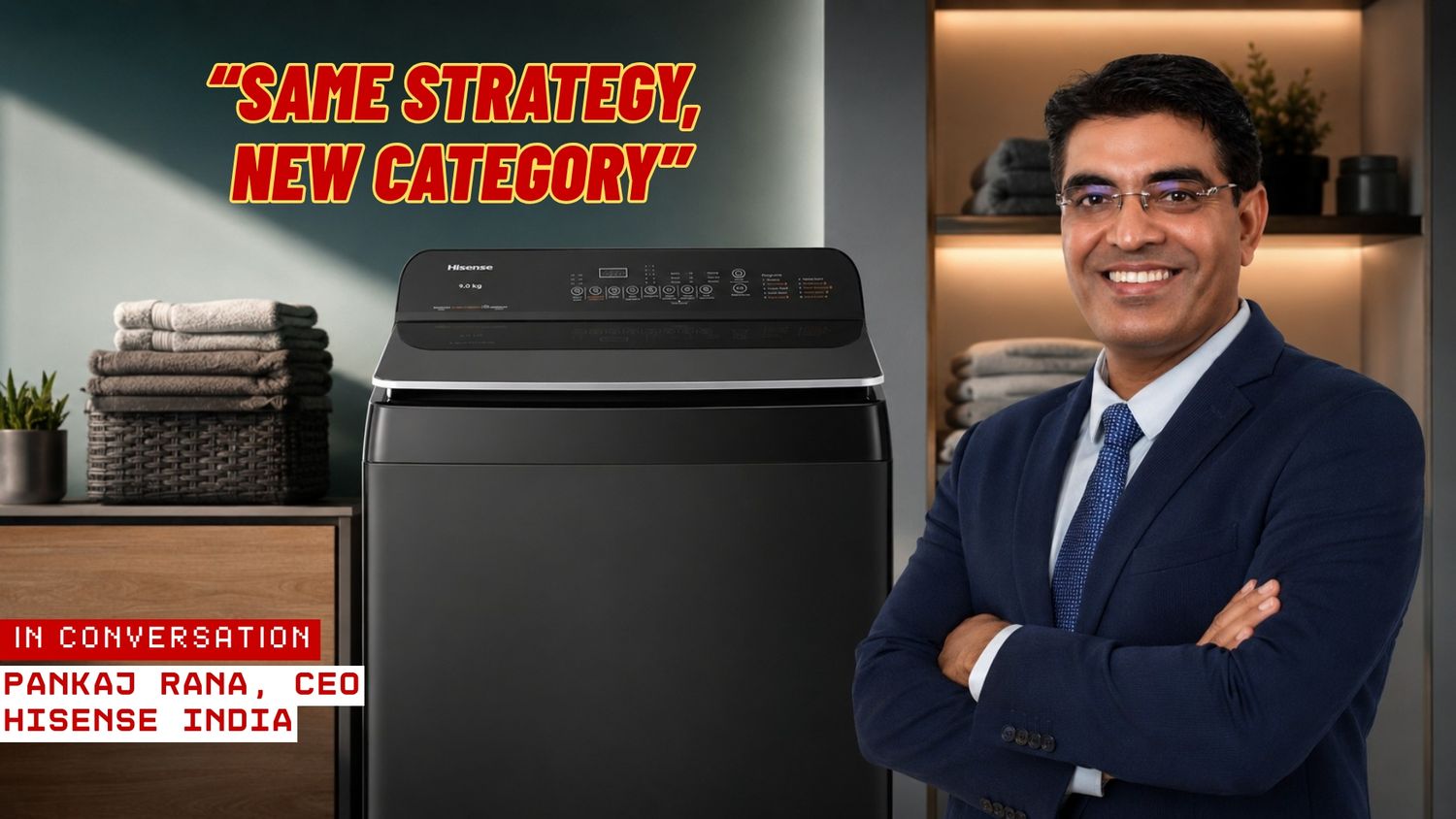

When Hisense entered India’s television market, it went after LG and Samsung directly. When it launched air conditioners, it benchmarked itself against LG and Daikin. Now, as it steps into washing machines in July 2026 with the announcement of its laundry lineup, the strategy is the same. Price it a little lower, add a little more, and build the kind of channel trust that takes years to establish but tends to stick once it does.
 Survey
The Hisense washing machine lineup includes Top Load models in capacities up to 12 kg and Semi-Automatic models up to 14 kg. The prices start at Rs 11,999 for the Semi-Automatic range and Rs 17,999 for the Fully Automatic Top Load. Products will be available across Amazon, Flipkart and Reliance Digital, with retail availability beginning 25 July. In addition, front-load washing machines are expected to launch between October and December.
“Washing machine penetration in India is very small — maybe 25 percent — and for front-load washing machines, the penetration is not even double digit,” Pankaj Rana, CEO of Hisense India said in an interview with Digit on the sidelines of the launch. “In washing machines, there are maximum seven or eight brands which are very active, including strong Indian brands like IFB or Godrej, and then three or four big companies like LG, Samsung and Whirlpool. We see a huge scope.”
Adapting to the Indian needs
Rana took us through several specific adaptations his team made to the global Hisense laundry lineup before it was ready for the Indian market.
The first issue was staining. “Most of us eat Indian curries, which at times put stains on clothes, irrespective of the colour. So we developed a soap function in our washing machine which will tackle the stubborn stains and remove them a little faster compared to the global lineup,” he said. The Semi-Automatic range’s Soak Function is a result of this finding.
The second was fabric intelligence. “For women specifically, we have sarees, we have suits and the fabrics are very different — it can be silk, it can be cotton, and many more. Based on the fabric type, the machine defines the temperature, the cycles, and the water usage.” Rana acknowledged this is a first iteration and it will keep improving with customer feedback.
Power reliability was the third adaptation. “India has a lot of power fluctuations — from high voltage to low voltage — so the way we designed our power supply, we had to change it for all products in India, including TV and AC. The same goes for washing machines.” For the Semi-Automatic range specifically, the engineering team also reinforced the heating element and PCB to handle the kind of extended continuous use that Indian households sometimes demand. “The product needs to be a little more durable. The usage here can be two or three hours continuously, so the heating element and the power supply PCB need to be more reliable,” he said.
The fourth change was cosmetic as the team introduced a glass lid and a premium design aesthetic after feedback from channel partners on the shop floor. “The channel will be the first customer who will go to sell it,” Rana explained. “They are definitely asking, what is different in your machine compared to the eight or ten brands operating in the market?”
The pricing equation
Hisense’s strategy across all three categories in India follows the same principle: benchmark against the segment leader, price 5 to 8 percent below and deliver more on specifications at that price point. “LG is the undisputed leader in the washing machine segment, followed by Samsung,” Rana said frankly. “We are positioning our washing machine slightly lower compared to Samsung and LG. But while I am operating at a lower price, I am trying to give slightly more features and a little more benefit to the consumer.”
The specific advantages he cited include drum depth saying, “If a leading brand is using a 450 mm depth drum, I am using 480 mm so my machine will be slightly bigger in size. If they are offering a non-Wi-Fi function at a certain price point, I am trying to give Wi-Fi function at that same price point”. Whether these advantages translate to real consumer preference in a category where LG’s brand equity is deeply entrenched is the harder test and Rana was under no illusion about that. “We are able to build that kind of positioning in TV,” he said. “In air conditioner, I should say it is work in progress — it might take another year. But somehow we are able to create that in TV at this moment.”
The larger strategy
Washing machines are the third Hisense category in India after televisions and air conditioners and Rana is explicit about where the business is headed. This year, he estimates television will account for roughly 70 percent of revenue, air conditioning around 20 percent and washing machines the remaining 10 percent. “Next year, I want to change this to 50-50: 50 percent from TV and 50 percent combined from AC and washing machine.” He also flagged small domestic appliances, kitchen appliances and refrigerators as categories under evaluation, with concrete timelines to follow once the front-load washing machine launch is settled.
Rana is confident about the rate of growth if not the absolute scale of the India business. “From the last two years, every year we are growing in revenue by minimum 50 percent,” he said, adding that he prefers to grow sustainably rather than through aggressive discounting. “Our major focus is to give better consumer experience rather than fighting on price and on numbers.”
A TV market reshaped by memory prices
Speaking about Hisense’s television business, where the ongoing memory chip shortage has had a visible impact. “The price in January this year for a 32-inch TV was operating at Rs 12,990 and is now Rs 16,990. The cost to the end consumer has increased by around 25 percent,” Rana said. “For 75, 85, and 100-inch TVs, the impact is much lower, maybe 5 to 8 percent and for 100-inch I did not increase my price at all from January to July.”
Counterintuitively, the pressure on entry-level prices has been good for Hisense’s large-screen business. With FIFA World Cup 2026 driving demand for bigger screens in the evening hours, the company has seen sales of 75-inch and above TVs grow sharply. “If I was having 200 TVs of 100 inch last year in June, this year I did maybe 350 to 360, which is more than 60 percent growth,” he said. The company is also preparing a new RGB MiniLED lineup in 55, 65 and 75-inch sizes for the India market later this year.
For now, though, the focus is on the launch of washing machines. Forty-two SKUs across Semi-Automatic and Top Load categories will hit shelves between July and September, followed by the front-load range in the fourth quarter. It is an ambitious rollout for a brand that had no laundry presence in India twelve months ago. Whether Hisense can do to washing machines what it has done to televisions is the question the next twelve months will answer.


