
What is Kimi K3: Moonshot’s frontier AI model that matches Claude Opus 4.8 and GPT 5.5
 Follow Us

Moonshot has just launched Kimi K3, which has massive size. It is a 2.8 trillion parameter-sized model, making it the biggest open-weight AI model ever released, and according to Moonshot, it is the world’s first “3T-class” open model. The full weights are available starting July 27, 2026, after the technical report. Kimi K3 is designed using two novel architecture components, which are Kimi Delta Attention (KDA) and Attention Residuals (AttnRes), along with a sparser Mixture of Experts architecture that engages only 16 out of 896 experts. Moonshot says that this design results in about 2.5x improved scaling efficiency compared to its previous version, Kimi K2.
 Survey
Also read: What Is Inkling: Thinking Machines Lab’s bet on customisable AI
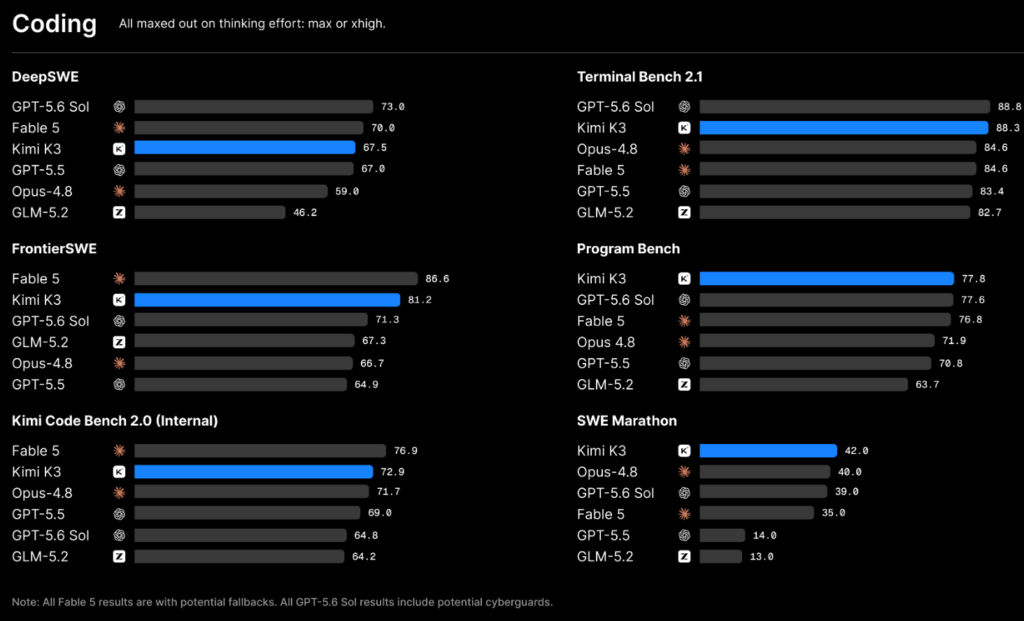
On paper, however, the metrics compete. Kimi K3 comes out ahead in the Terminal Bench 2.1 where it receives a score of 88.3 versus Claude Opus 4.8 at 84.6, beating Opus at FrontierSWE (81.2 vs 66.7) and SWE Marathon (42.0 vs 40.0), and comfortably beating GPT 5.5 in agentic benchmarks, including Job Bench and Automation Bench. It loses out to Opus, however, where it scores below in coding and reasoning benchmarks (HLE-Full: 53.3 vs 43.5). This fact is noted explicitly by Moonshot in the blog post itself, which states that K3 “still trails the most powerful proprietary models.”
K3 makes a point of distinguishing itself with agentic depth. As demonstrated in the examples of case studies provided by Moonshot, K3 autonomously builds a GPU compiler in line with Triton, creates a physical chip design in 48 hours, and replicates a numerical pipeline created in a computational astrophysics paper in two hours, an achievement which Moonshot claims takes a researcher one to two weeks. K3 is also multimodal natively, with a 1-million token context window and vision capabilities integrated into its framework, which is evidenced through demonstrations such as an explanatory video in the style of 3Blue1Brown.
Also read: This OpenAI model breached a vending machine to prove a point on AI safety
However, there are some caveats that must be mentioned first of all. For instance, according to the limitations section of Moonshot, K3 becomes unstable if an agent doesn’t return its entire reasoning process history or if a session is transferred from another model. This looks somewhat strange since a long-term stable reasoning ability was the major feature of the model being discussed. K3 is also noted for being “excessively proactive,” which means that it may decide something for its user even without being prompted. Lastly, Moonshot mentions that there is a noticeable gap in the user experience compared to that of Fable 5 and GPT 5.6 Sol.
According to the pricing offered by the Kimi API, K3 costs $0.30 per million tokens (cache-hit input), $3.00 (cache-miss input) and $15.00 (output), presenting itself as a cheaper and open alternative, not a leader. K3 is available right now on Kimi.com, Kimi Work, Kimi Code, and the Kimi API.
So far, it is fair to say that the main claims made in the framing were proven to be correct thanks to the published numbers. However, one can hardly tell how valid they will remain while using the product.
Also read: Grok Build’s disaster shows why it trails behind ChatGPT, Claude, Gemini


