
What is Anthropic’s Model Hardware Standard: A universal protocol for AI-controlled hardware
 Follow Us

The company Anthropic has launched a research preview of the Model Hardware Standard (MHS), which is basically a common standard through which AI agents such as Claude can control the hardware and run machines like microscopes, robotic arms, liquid handlers, etc., rather than producing text or code. This is presently being piloted in a selected group of scientific research laboratories, universities, and manufacturers, such as Genentech, University of Washington, Carnegie Mellon, QuEra Computing, and HHMI Janelia Research Campus.
 Survey
Also read: We have understood the Indian consumer very well: Acer India on becoming No 2 and what comes next
The problem MHS is solving
The vast majority of laboratory or industrial equipment does not converse with other pieces of equipment. The liquid handler, the robotic arm, and the plate reader each come from different manufacturers, have their own dedicated software and programming languages. For these pieces of equipment to work together, an expert is normally needed to integrate them, a process which takes weeks or even months, and should be performed separately for each new piece of equipment.
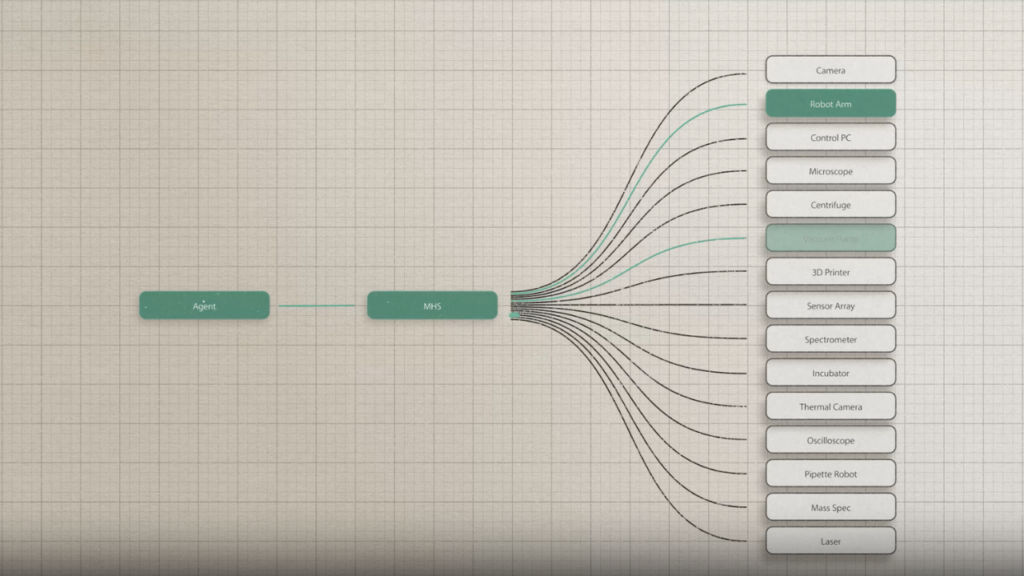
MHS is the universal translator. MHS provides a standard way to implement a “driver” which allows any piece of hardware with a programmable interface to interact with others using basic commands such as “read” and “write”. Also, a piece of hardware can now describe itself using the common language, including information about physical characteristics such as the weight of a robotic arm so that the AI agent can control unknown equipment safely. Connected, the AI agent can control multiple pieces of equipment simultaneously, sequence operations, adjust parameters, and sometimes even recover from hardware errors independently.
Also read: Perplexity had the headstart In AI search: So what went wrong?
Whose day-to-day changes first
Those who know this feeling firsthand are the scientists, lab technicians, and engineers. As one PhD student at the University of Washington explained, previously he had to physically switch PCR plates every 90 minutes, sometimes at 4am, and personally go around the lab to monitor the instruments separately. Under MHS, the instruments provide their status updates via a single dashboard, which can be monitored and controlled by an AI agent remotely.
At Carnegie Mellon University, scientists used MHS to integrate three computers with totally incompatible interfaces (even one of the computers did not have any programmatic interface at all). They reduced the configuration time of an automated drug dosage experiment from weeks to just eight hours. At the quantum computing firm QuEra, an AI agent used MHS to increase the laser recovery process efficiency from 58% to 99.3%, with recovery time decreasing from more than two minutes to 10 seconds.
Whose day-to-day changes eventually
For everyone else, the impact will be indirect but significant. More efficient and affordable lab automation allows for faster screening of potential drugs, quick determination of dose-response curves, and extended operation of quantum computers without needing help from experts. This won’t immediately result in a consumer good of some sort, but it will accelerate development of new medicines, improved quantum computers, and better manufactured goods.
It is important to note that Anthropic admits this is not autonomous science just yet. For example, in its tests, Claude was known to mistake physical problems like bubble formation during liquid transfer for software errors. Moreover, Claude tended to pause its actions until it got approval from a human if it felt that an action was potentially unsafe. This explains why MHS is initially being offered as a research preview.
Also read: Realme P4s in Digit Test Labs: Can it redefine the mid-range gaming phones?


