
Perplexity had the headstart In AI search: So what went wrong?
 Follow Us

I have a feeling that Perplexity seems perplexed. The company has certainly had some good months if you just look at the headlines. A Series E funding round brought the company to a $21.2 billion valuation. Perplexity inked a 3-year $750 million compute contract with Microsoft Azure for its Deep Research and Model Council capabilities, as per the reporting mentioned on the Wikipedia page of Perplexity. The annual recurring revenue rose from around $80 million towards the end of 2024 to over $200 million by February 2026. Looks like this is a business that got everything figured out.
 Survey
Also read: Realme P4s in Digit Test Labs: Can it redefine the mid-range gaming phones?
If you open a traffic dashboard, you see a completely different story. The figures collected by Momentic for the month of August 2026 show that Perplexity makes up only 1.3 percent of all AI chatbot traffic in the world, having declined even more in that quarter, falling not just behind ChatGPT’s 53.9 percent and Gemini’s 27.9 percent, but even Anthropic’s Claude with its 9.2 percent.
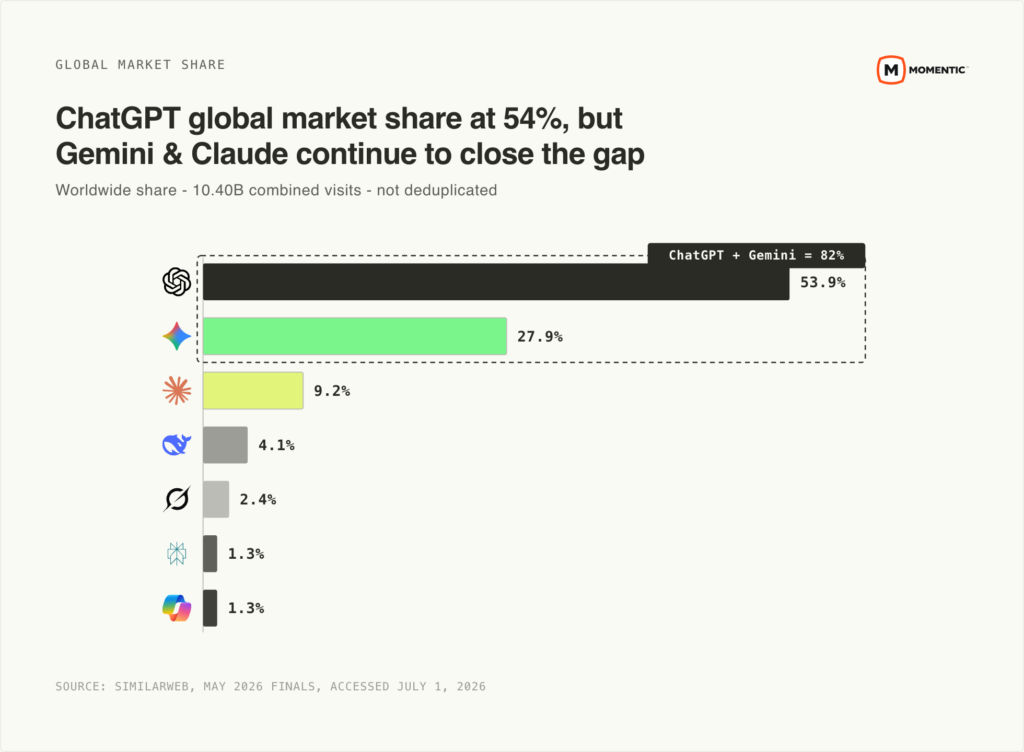
As far back as January of this year, Gemini took the lead from Perplexity in terms of AI traffic, according to an industry comparison, and turned what once was a huge lead for Perplexity into an afterthought. This is quite a bad quarter for the product that was supposed to be a replacement for your search engine.
So which Perplexity is the real one? The one with the close to $30 billion valuation or the one that nobody seems to be opening? I would assume its both in a sense. A company could very easily have all the money in the world but still be completely irrelevant for the people it was initially made for.
Much of that is due to the trust that the company earned itself. At present, Perplexity is either being sued or has already been sued by an array of publishing companies, ranging from the likes of New York Times and CNN to such as the Chicago Tribune, Dow Jones, and the New York Post, not to mention Reddit, Encyclopaedia Britannica and Merriam-Webster, and the Yomiuri Shimbun of Japan.
Also read: How to switch from old iPhone or Android to Galaxy Z Fold 8 in 3 simple steps
In most of the cases, the common charge levied against the answer engine of Perplexity is that it is capable of reproducing the reporting of the companies to such an extent that it becomes an exact replacement of the original content, even bypassing the paywalls of the sites by using its Comet browser. Though Perplexity argues that since facts cannot be copyrighted, the claims made by the companies are invalid, yet it is not an argument that has ever passed the test of judgment in court, thus turning into a mere talking point.
And then there’s the problem of Comet itself, which hasn’t had an easy time of things considering what kind of data it was built to manage. It turns out that security researchers from Brave were able to show how embedded commands in a Reddit post could prompt the Comet browser assistant to reveal personal information through its automatic page summary process. LayerX uncovered a different vulnerability that could allow for hijacking the browser through malicious links. Zenity Labs showed how a compromised Google Calendar invitation could be used to pull sensitive local data including API keys and password managers vaults, an exploit the researchers named PerplexedBrowser. Perplexity’s immediate response in all of these cases has been to deny the severity of the discovery, going as far as labeling it as fake news in some cases.
All of this didn’t come about in a vacuum. Growth for ChatGPT has certainly slowed, and opened an opportunity for everyone. It was taken advantage of by Gemini in an understated fashion, since Google didn’t need to start any new habits from scratch, just keep its current Search and Android users from switching to others, which was a lot easier than what Perplexity set out to do. In the same time frame, Claude made gains in referral share. Perplexity, the firm that created the AI answer engine category in a sense, had to fight on both fronts of publishers and its own security researchers in the window of time.
None of this suggests Perplexity is unimportant. The quality of its citations is still high in the minds of those who are actually using it, it has a strong enterprise sales pipeline, and it has more money than almost any of its competitors to spend while it works out the trust issue.
But a product doesn’t remain a habit unless the user consistently chooses it over the product that sits directly across from it in their browser and phone, and Perplexity is losing that daily battle hard enough that the traffic numbers don’t even matter compared to ChatGPT and Gemini. The important question here isn’t whether Perplexity survives. It has the money for that. The question is whether it can restore trust before it loses enough users to settle into becoming the Yahoo of AI search, funded, capable, but permanently irrelevant.
Also read: How to switch from old iPhone or Android to Galaxy Z Fold 8 in 3 simple steps


