
Moon vs Space: Why Elon Musk thinks SpaceX is better than Blue Origin
 Follow Us
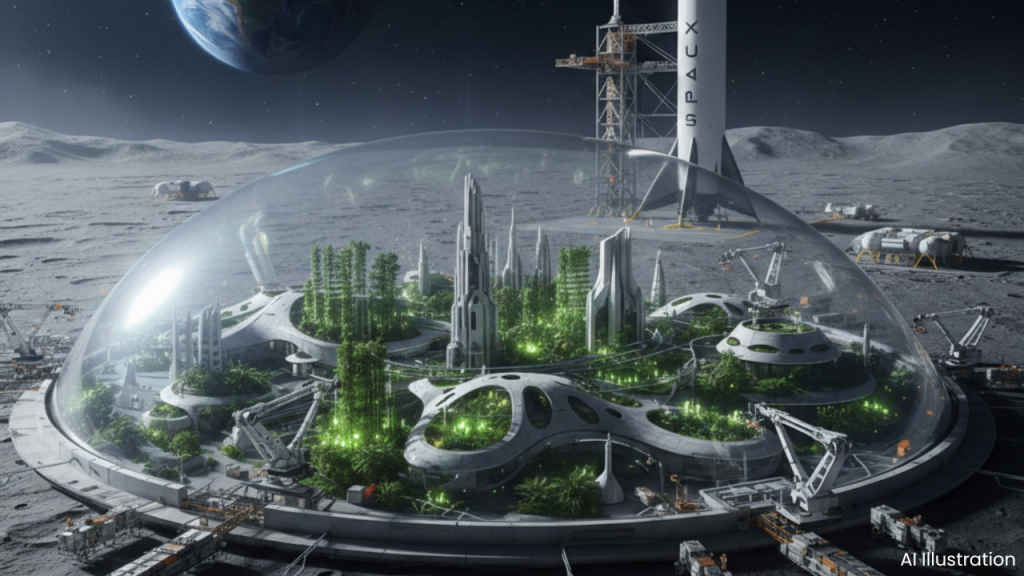
SpaceX pivots to Moon city vision for massive lunar logistics
Elon Musk prioritizes landing millions of tons over being first
Starship vs Blue Moon: Musk bets on scale for superiority.


The rivalry between SpaceX and Blue Origin has reached a critical inflection point as the 2026 space race moves toward the lunar south pole. In a recent high-profile exchange, Elon Musk addressed the growing competition with Jeff Bezos by reframing the metrics of success for space exploration. While Blue Origin has long championed a methodical, incremental approach to lunar landing, Musk’s recent pivot suggests that SpaceX is playing a different game entirely. For Musk, the superiority of SpaceX is not merely about reaching the lunar surface first, but about the sheer industrial scale and logistical frequency that only his company can provide. He recently emphasized that while a single landing is a historic milestone, the ability to build a self-sustaining settlement requires a massive shift in how we think about mass-to-surface capabilities.
 Survey
Also read: Elon Musk says SpaceX can build a self-growing Lunar city on the Moon in less than 10 years
Musk’s confidence stems from a strategic recalibration that has moved the “Moon city” vision to the forefront of SpaceX’s immediate priorities. In his view, the Moon offers a unique laboratory for rapid iteration that Mars currently lacks due to planetary alignment. By focusing on the Moon, SpaceX can take advantage of launch windows that open every ten days, whereas a Mars mission is restricted to a narrow window once every twenty-six months. This logistical reality allows SpaceX to refine its technology at a much higher cadence than its competitors. Musk has signaled that the objective is no longer a symbolic “flag-planting” mission but rather the delivery of millions of tons of equipment to the lunar surface. This focus on heavy-lift logistics is where he believes SpaceX remains unmatched, regardless of which company achieves the next individual soft landing.
Also read: NVIDIA CEO says AI datacentre will create India job boom: Hype vs reality?
The logistics of a lunar settlement
The technical gap between the two companies is most apparent in the payload capacity of their respective landing systems. SpaceX’s Starship is designed to be a heavy-lift freight elevator to space, aiming to transport upwards of one hundred metric tons to the lunar surface in a single mission. In contrast, Blue Origin’s Blue Moon Mark 1 lander is a smaller, more precision-focused craft designed to deliver roughly three metric tons of cargo. While Blue Origin’s approach is seen as a safer, more methodical path for scientific missions, Musk argues that it lacks the sheer power required for true colonization. He believes that building a self-growing city requires an unprecedented amount of infrastructure that can only be facilitated by the gargantuan scale of the Starship architecture.
Strategic path to 2027
To accelerate this vision, SpaceX has informed its investors of a significant shift in its development timeline, targeting an uncrewed lunar landing for March 2027. This move aligns the company more closely with current national space policy, which has seen a renewed emphasis on lunar exploration over immediate Martian colonization. By prioritizing the Moon, Musk is effectively positioning SpaceX to dominate the supply chain for NASA’s Artemis program while simultaneously building the foundations of a commercial lunar economy. He has even displayed a rare moment of public sportsmanship, stating he would be among the first to congratulate a competitor for landing first. This suggests that Musk is no longer competing for a headline, but for the long-term logistical dominance of the Earth-Moon transit system, which he believes SpaceX is uniquely built to command.
Also read: Elon Musk’s SpaceX acquires xAI with plans for AI data centres in space


