
Interstellar Visitor Spotted by Astronomers: What Is It?
 Follow Us
Interstellar comet 3I/ATLAS offers rare insights into icy bodies from distant star systems.
Discovered by Chile’s ATLAS telescope, 3I/ATLAS could be the largest interstellar object observed.
Hurtling at 60 km/s, 3I/ATLAS brings astronomers a precious glimpse of alien solar chemistry.

In the predawn hours of July 1, 2025, a faint streak of light caught the attention of astronomers peering through data from a telescope in Chile’s Atacama Desert. This was no ordinary celestial body, it was 3I/ATLAS, the third confirmed interstellar object to grace our solar system, following the enigmatic ‘Oumuamua in 2017 and the comet-like 2I/Borisov in 2019. Named after the Asteroid Terrestrial-impact Last Alert System (ATLAS) that discovered it, 3I/ATLAS, also cataloged as C/2025 N1, is a cosmic traveler from beyond our stellar neighborhood, offering a rare glimpse into the mysteries of distant star systems.
 Survey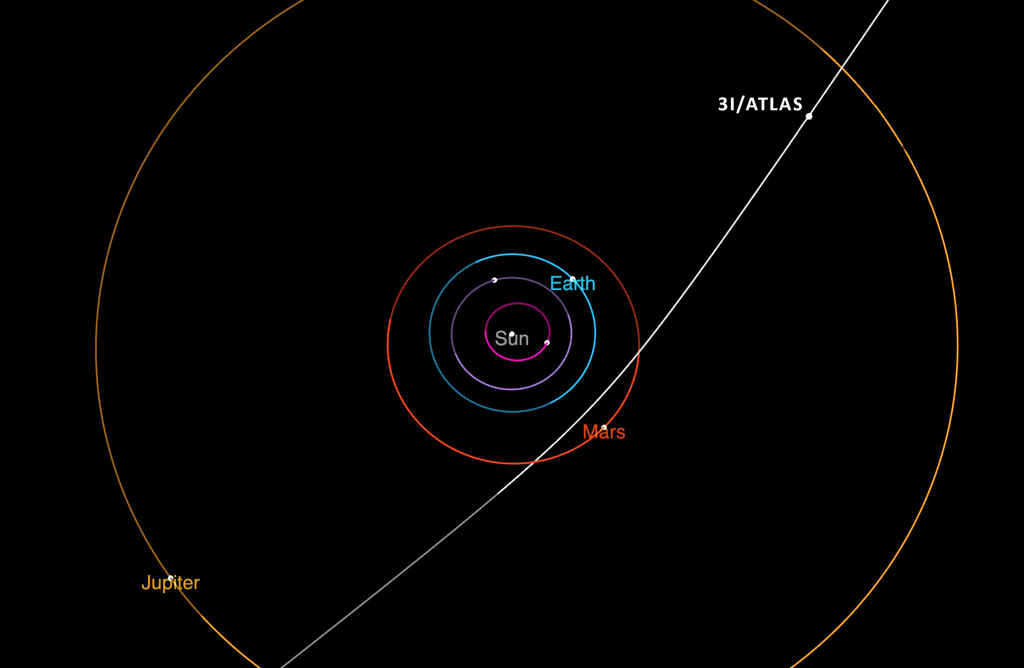
Also read: Netflix to stream NASA rocket launches and spacewalks live this summer for free
Unlike the rocky, cigar-shaped ‘Oumuamua, which sparked wild speculation about alien origins, 3I/ATLAS appears to be a comet, its faint tail and hazy coma, a cloud of gas and dust, betraying an icy composition. Spanning an estimated 10 to 20 kilometers in diameter, it could be the largest interstellar visitor yet observed, dwarfing its predecessors. Hurtling through space at a blistering 60 kilometers per second, its hyperbolic orbit is a path too extreme to be bound by the Sun’s gravity which confirms its origins lie far beyond our solar system. It was discovered some 416 million miles from the Sun, near Jupiter’s orbit. It will swing closest to our star on October 29, 2025, passing between the orbits of Mars and Earth but remaining a safe 150 million miles from our planet. As it nears the Sun, astronomers expect its brightness to increase, potentially making it visible to backyard telescopes by late 2025 or early 2026.
Unlocking Secrets of the Stars
The discovery has set the astronomical community abuzz. This is like receiving a postcard from another star system. Interstellar objects like 3I/ATLAS carry clues about the chemical makeup and physical conditions of their home systems, offering a snapshot of processes that may mirror or differ from those that formed our own planets. Unlike ‘Oumuamua, which was spotted on its way out, 3I/ATLAS was caught early, giving researchers months to study it with powerful instruments like the James Webb Space Telescope or the upcoming Vera C. Rubin Observatory. Already, the Virtual Telescope Project hosted a livestream on July 3, 2025, allowing enthusiasts worldwide to glimpse this cosmic wanderer.
The ATLAS telescope in Chile, stationed at the El Sauce Observatory in the Atacama Desert, was the eagle-eyed sentinel that first spotted 3I/ATLAS. Part of a NASA-funded network designed to detect near-Earth objects, this robotic telescope scans the sky every few nights with a wide-field view, excelling at catching fast-moving anomalies. Its location in the arid, high-altitude desert ensures pristine observing conditions, while its automated systems swiftly identify and track objects, making it a cornerstone of both planetary defense and unexpected discoveries like this interstellar comet.
Also read: Oldest galaxy in universe: James Webb Space Telescope discovery to rewrite cosmic history?
For astronomers, 3I/ATLAS is more than a fleeting visitor, it’s a reminder of how connected our solar system is to the broader cosmos. Interstellar objects may pass through more often than we think, with estimates suggesting several per year go undetected. Each one carries stories of distant stars, and 3I/ATLAS is no exception. As it arcs through our skies, scientists are racing to decode its composition, shape, and rotation. Is it a pristine relic from a young star system, or a battle-scarred survivor of cosmic collisions? The answers could reshape our understanding of how stars and planets form across the galaxy. For now, 3I/ATLAS continues its lonely journey, a silent ambassador from the stars, inviting us to look up and wonder what else lies beyond.


