
I experienced the Optoma UHR90DV projector and this isn’t meant for your living room
 Follow Us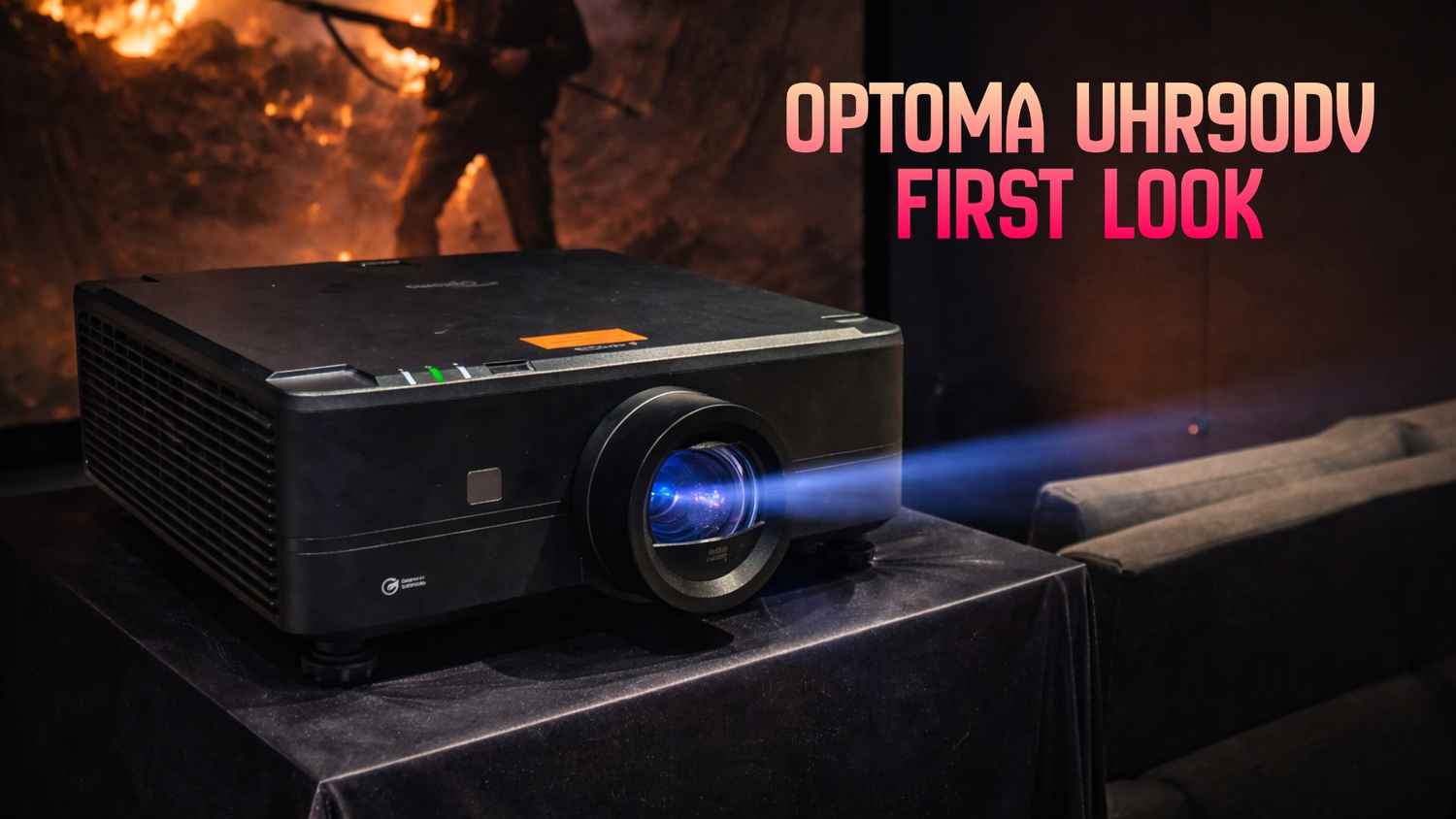

The Optoma UHR90DV is, without question, the most ambitious projector the company has ever built. I was invited to an exclusive showcase hosted by Optoma and Listening Lab at MCBEE Studios in New Delhi where the company officially launched this 15.9-lakh rupees behemoth of a projection system that’s as flagship as cinema projectors go. For starters, the UHR90DV is the only triple-laser RGB projector in India of its kind to receive both Dolby Vision and IMAX Enhanced seal of approvals. This essentially means you can take its name in the same breath as a professional cinema equipment.
 Survey
The flagship has arrived
Before I even walked into the demo room, Vijay Sharma, Managing Director of Optoma India briefed the gathering about what this projector meant for Optoma, saying, “When we talk about Optoma projectors, we talk about colour accuracy, we talk about contrast and we talk about the cinematic experience. The new lineup we are launching is more in line with the cinema industry, basically bringing the professional cinema to the fore.”
Sharma showed us a slide during his presentation with charts mapping the apparent decline in lamp-based home cinema projectors. The chart shows sales dropping from roughly 17.9 thousand units in 2022 to a projected 10.3 thousand by 2025. At the same time, solid-state projection systems, particularly laser models, witnessed a sharp rising trend. It climbed from about 0.4 thousand units in 2021 to an estimated 8.8 thousand units by 2025.
“With lamp projectors, the consumable is the lamp. Every one or two years people had to change it. With solid-state you don’t have to worry about the light source for five or ten years,” he added.
The UHR90DV runs three laser light sources, red, green and blue, to achieve 96% coverage of the BT.2020 colour space, a standard typically associated with mastering suites and professional grading monitors and not living rooms. It pumps out 5,000 ISO lumens, claims a contrast ratio of 4,500,000:1 and backs all of it with Filmmaker Mode, HDR10+, motorised lens control with memory and a 30,000-hour light source rated to last decades of regular use.
Nishant Padhiar of Listening Labs and one of the premier voices in the Indian Hi-Fi space also shared his experience of the UHR90DV, saying that, “the one thing that I like about this projector is, apart from all the great things like the color fidelity, the contrast, is the brightness, the 5000 lumens. Optoma is not kidding around with that. It genuinely is 5000 lumens and that really gives you that headroom for HDR that makes it look wow. The moment you switch on even an Apple TV home screen, the way it just captures you know your imagination, your eyeballs. It’s truly incredible.”
How is the experience like?
On a screen stretched wide enough to swallow your peripheral vision, the UHR90DV was given content worthy of its capabilities including curated sequences from IMAX Enhanced material, presented on the 120” screen in the correct IMAX aspect ratio, alongside scenes from films such as 1917, The Batman, Ready Player One, chosen specifically to stress-test contrast, colour, and motion.
The first thing that stands out on the UHR90DV is how vibrant the image looks without feeling exaggerated. Laser projectors sometimes push colours into territory that feels overly saturated, particularly with reds and greens. In this case, the reds and greens had clear intensity, but they stayed within a believable range. Skin tones held up well too, even when scenes shifted between bright daylight and darker interiors.
In the night window scene from Sam Mendes’ 1917, the trench is lit up in bursts of orange flares and then sinks back into darkness. There are sudden flashes of brightness, deep shadows, smoke, texture on mud walls, MacKay’s face lit unevenly by firelight. This nightmarish sequence conjured by ace cinematographer Roger Deakins is enough to stress even the best of displays, let alone projections. But on the Optoma UHR90DV, you get everything without compromise.
Colour balance remained consistent across different sequences. In several scenes the blacks appeared deeper than the grey cinema bars on the screen. There was perceivable depth to scenes, as dark scenes retained dimension and texture rather than collapsing into flat planes of near-black.
The projector’s rated output of 5,000 lumens gives it enough headroom for those highlights and during the demo the image stayed clearly visible even when lights were turned on in the room. Colours held together reasonably well under ambient lighting. That said, the projection still looked most convincing once the lights went off.
The 4K DLP projection system also delivered a very crisp image. Fine details such as hair strands, clothing fabric, text and environmental textures remained visible even on a large screen. The sharpness did not look artificially boosted, which can happen when image processing becomes too aggressive.
Motion processing features were largely disabled during the viewing session, yet fast sequences still looked stable without noticeable blur or judder.
One small detail worth noting is that high-brightness laser projectors of this calibre sometimes rely on aggressive cooling systems that become noticeable during quiet scenes. But in this case the UHR90DV remained effectively silent throughout the viewing session.
Is there a market?
While the UHR90DV represents the high end of Optoma’s home cinema lineup, it doesn’t exist in a vacuum. The company also acknowledged that the broader projection market is dealing with a different challenge.
“When we launched our laser TV projector in 2019, we thought it would kill the living-room television market. Unfortunately that didn’t happen. Panel prices for 100-inch TVs have dropped drastically,” Sharma accepted.
But Optoma now sees a different kind of growth opportunity in India with dedicated home cinema rooms that according to Sharma, are becoming more common outside the largest metro cities.
“In tier-2 and tier-3 cities people have large houses, and many are building dedicated home cinema rooms. This market is going to evolve,” he added. Ludhiana, Phagwara, Bareilly, Nashik are markets that would have had no system integrators a decade ago and now have dealers catering to homeowners building proper screening rooms.
Whether the price tag finds its audience will depend on factors beyond any projector’s control. But this machine itself is hard to argue with.


