

Google Translate vs ChatGPT Translate: Which translation tool is better for you
 Follow Us

For the last year, the tech world has assumed that Large Language Models (LLMs) like ChatGPT would make traditional tools like Google Translate obsolete. The logic was simple: ChatGPT has a “brain” that understands context, while Google Translate is just a glorified dictionary. But is that actually true?
 Survey
We put both tools through a stress test – ambiguity, idioms, corporate jargon, and tone – and the results were surprising. Far from being “destroyed,” Google Translate matched ChatGPT step-for-step in logic, and in one specific cultural test, actually outperformed the AI by avoiding the “generic trap.”
Also read: TranslateGemma explained: Google’s new open model for 55 languages
The myth of the “context blind” machine
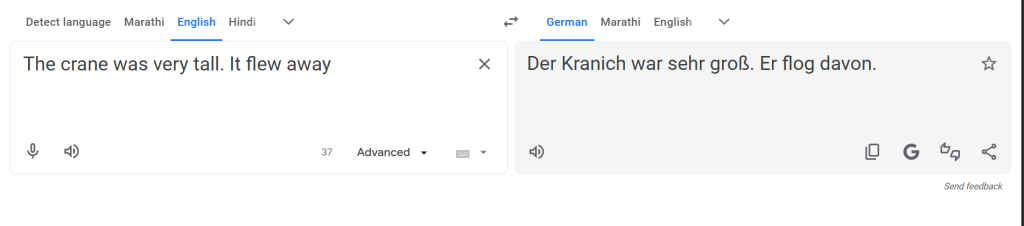
For years, the biggest criticism of Google Translate was its inability to see the bigger picture. We fed both engines the sentence: “The crane was very tall. It flew away.”
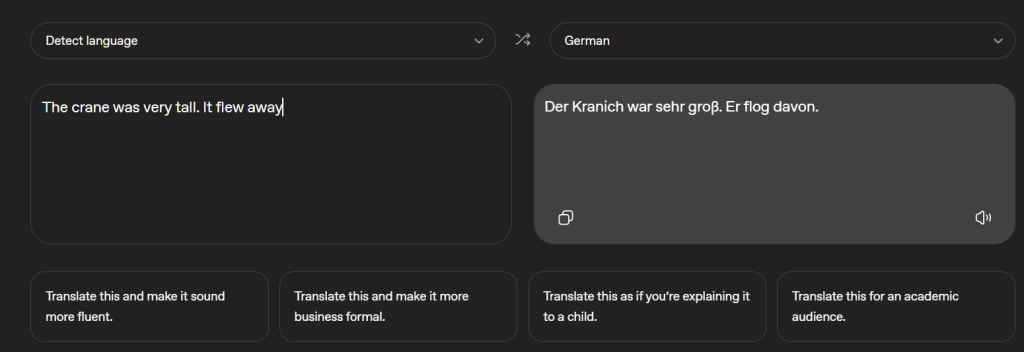
Five years ago, Google might have translated the first sentence as a construction machine and the second as a bird action. Today? Both ChatGPT and Google Translate correctly identified the subject as Der Kranich (the bird) in German. Google’s Neural Machine Translation (NMT) has evolved. It no longer translates in isolation; it now employs a “context window,” effectively closing the gap in raw logic.
The “over-smoothing” problem: Where Google wins
While ChatGPT is often praised for its fluency, our tests revealed a flaw: it tends to sanitize language into generic pleasantries.
We tested the idiom “Break a leg” (a theatrical wish for good luck) into Hindi.
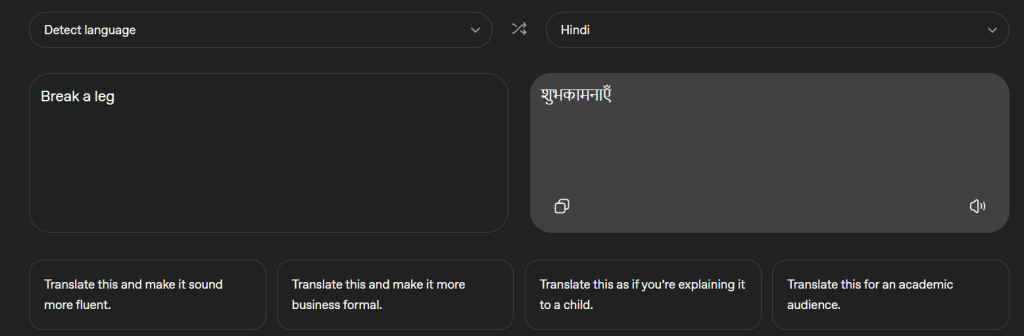
- ChatGPT translated it as “Shubhkamnaye” (शुभकामनाएँ). While polite, this is a generic term for “Best Wishes,” commonly used for birthdays or festivals. It feels diluted – like congratulating someone for winning an award.
- Google Translate provided “Bhagya tumhare saath ho” (भाग्य तुम्हारे साथ हो). This literally translates to “May luck be with you.”
Also read: OpenAI quietly launches ChatGPT Translate to take on Google Translate: How it is different
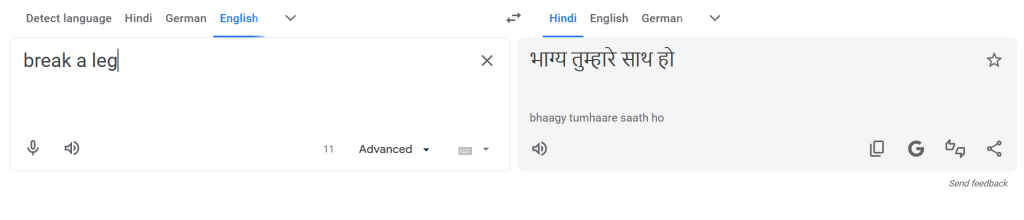
Google won this round. ChatGPT’s “brain” tried to find the sentiment and over-simplified it into a standard greeting. Google’s database approach mapped the idiom to its functional equivalent, retaining the specific intent of “Good Luck” rather than just general well-wishing.
The real differentiator: The “tone” trap
However, Google’s directness is a double-edged sword, especially in social hierarchies. We asked both tools to translate a request: “Hey, give me that report” into French.
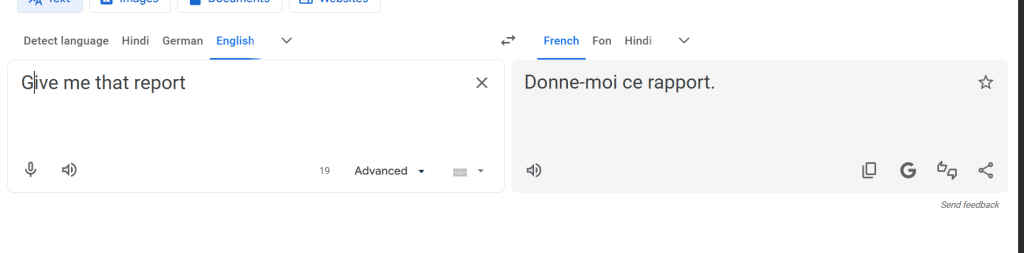
- Google Translate defaulted to “Donne-moi ce rapport.” This is the imperative, informal phrasing.
- ChatGPT, when prompted for a formal tone, provided “Veuillez me remettre ce rapport” – a formal, polite request.

This is the danger zone for professionals. Google gives you the statistical average. In casual conversation, “Donne-moi” is common. But in a business context, using it with a CEO could be a career-limiting move. ChatGPT wins here because it allows you to control the persona.
The Verdict: Two tools for two jobs
Our findings suggest that the narrative of “AI destroying legacy tech” is false. Instead, they have settled into distinct niches:
- Use Google Translate for Accuracy: If you need to know exactly what a sentence means, or map an idiom specifically, Google’s directness prevents the “fluff” that LLMs sometimes add. It is reliable, fast, and surprisingly context-aware.
- Use ChatGPT for Diplomacy: When you are the one speaking – especially in a professional setting where tone, hierarchy, and politeness matter – you need the control that only an LLM provides.
The “dumb” translator isn’t dumb anymore. In fact, sometimes it’s the only one that gives you the straight answer.


