Flipkart builds voice commerce around India's conversational shopping habits
GenAI simplifies selling for MSMEs while raising growth expectations
Privacy-first AI strategy aligns with India’s evolving DPDP regime
India’s e-commerce story has long been narrated through huge numbers with hundreds of millions of users, millions of sellers, but the next phase of that story isn’t just about scale. It’s about understanding intent. And this is the layer where artificial intelligence is quietly becoming the infrastructure of Indian commerce. Powering systems that interpret intent, simplify workflows, and quietly guide both customers and sellers through an ecosystem that has grown increasingly complex.
 Survey
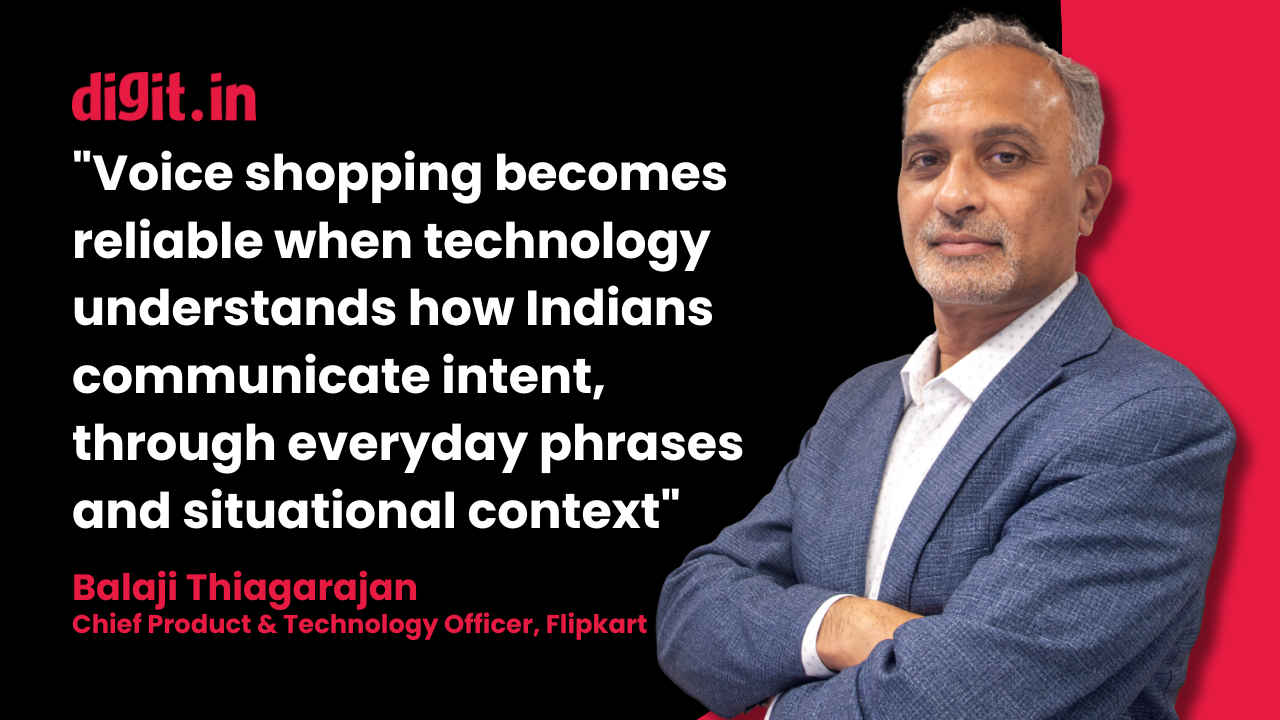
Balaji Thiagarajan, Chief Product and Technology Officer at Flipkart, believes GenAI and multimodal intelligence are beginning to change the ecommerce equation – simplifying the experience for sellers while making discovery more intuitive for customers across India’s linguistic and cultural landscape.
In an exclusive interview, Thiagarajan explains how Flipkart is approaching voice commerce for Bharat, how GenAI is reshaping the seller ecosystem, and how the company is thinking about privacy and trust in the age of AI. Edited excerpts follow:
Q) Beyond translation, what breakthrough makes voice shopping reliable?
Balaji: Voice shopping becomes reliable when technology understands how Indians communicate intent, through everyday phrases, local cues, images, and situational context, rather than relying on keyword-driven interactions. At Flipkart, voice is treated as one input within a multimodal, region-aware intelligence layer that brings together speech, text, images, cultural signals, and behavioural patterns to interpret what the customer is actually looking for.
Also read: Content to transactions: Flipkart’s big bet on creator-fuelled commerce in India

This approach allows the system to continuously learn from regional language nuances, seasonal needs, and occasion-led shopping patterns, making discovery intuitive rather than transactional. Equally important, these experiences are engineered for India’s real conditions. Low bandwidth, older devices, and varying levels of digital fluency are treated as the baseline, while the app remains lightweight and capable of delivering real-time personalisation and GenAI-led discovery.
As a result, voice shopping works not because it is translated, but because it is contextually understood, culturally aware, and built for the way Bharat shops.
Q) For sellers/MSMEs, what does GenAI remove from the job, and what does it newly demand?
Balaji: GenAI fundamentally reshapes the seller experience by removing complexity and allowing entrepreneurs to focus on the business itself.
It takes away much of the operational and technical burden that traditionally held MSMEs back, from manual catalog creation to fragmented workflows and uncertainty around demand. AI-enabled cataloguing simplifies product listings through automated descriptions and imagery, while GenAI helps streamline seller workflows by reducing the complexity of campaign setup and execution. This significantly lowers the entry barrier, allowing even first-time sellers to participate meaningfully in digital commerce without specialised skills.
Also read: Beyond BBD 2025: Inside Flipkart’s tech playbook for Indian e-commerce
At the same time, GenAI raises expectations in a constructive way. With platforms like NXT Insights translating marketplace data into simple, decision-ready guidance, sellers move from managing systems to making informed growth decisions.
GenAI also enables richer forms of participation, from content-led discovery to video commerce and regional relevance, where authenticity and product confidence matter more than technical execution.

Q) Between personalisation vs privacy, how do you keep AI honest?
Balaji: At the core of our digital strategy is a rigorous Data Stewardship program. Flipkart maintains a high-standard governance framework centered on encryption, tokenization, and multi-layer access control for all personally identifiable information (PII). This isn’t a new direction for us; with our high bar and rigorous standards for governance, we are prepared for India’s regulatory requirements standard. It is built on clear, specific permissions, ensuring that data is streamlined strictly for the services a user desires.
At Flipkart, we have introduced a structured framework for data handling. Organisations will move toward consent first and a purpose driven approach.
‘Honesty’ in AI is an ongoing commitment. Our approach involves: 1) Privacy-Centric approach: Systems and methods that allow our algorithms to continue to improve and adapt, and 2) Built for purpose: Keeping AI accurate and ethical is an ongoing process. Continuous evaluation and auditing all our models to ensure they remain aligned to achieve the objectives.
Also read: Flipkart announces AI exchange program for mobiles and other electronics: Here’s how it works
 Follow Us
Jayesh Shinde
Executive Editor at Digit. Technology journalist since Jan 2008, with stints at Indiatimes.com and PCWorld.in. Enthusiastic dad, reluctant traveler, weekend gamer, LOTR nerd, pseudo bon vivant. View Full Profile


