
Elon Musk on AGI timeline: His prediction will surprise you
 Follow Us

In a sprawling conversation filmed at Tesla’s Gigafactory in Texas, Elon Musk offered one of his most aggressive and detailed forecasts yet regarding the future of Artificial Intelligence. While industry experts and skeptics continue to debate the arrival of Artificial General Intelligence (AGI) – machines capable of performing any intellectual task a human can do – Musk believes the debate is largely academic. The milestone isn’t just coming; it is imminent.
 Survey
Musk describes the current rate of technological advancement as a “supersonic tsunami,” a force so powerful and accelerating so quickly that it effectively cannot be stopped.
Also read: Yoshua Bengio’s new safe AI vision cuts AI’s biggest risks by rewarding truth
The 2026 Benchmark
Musk’s timeline is significantly shorter than the conservative estimates that place human-level AI at the end of the decade. He distinguishes between two critical milestones: the moment AI surpasses the smartest individual human, and the moment it surpasses the collective intelligence of humanity.
“I think we’ll have AI that is smarter than any one human probably by next year… or 2026,” Musk stated. But the curve doesn’t flatten there. He predicts that by 2030, “the AI will exceed the combined intelligence of all humans”. This exponential leap suggests that the window between “smart assistant” and “superintelligence” is much narrower than previously thought.
Crucially, Musk sees AGI extending rapidly beyond digital confines into the physical world through robotics. He envisions a near future where the “brain” of AGI is successfully mated to a humanoid body, specifically, Tesla’s Optimus.
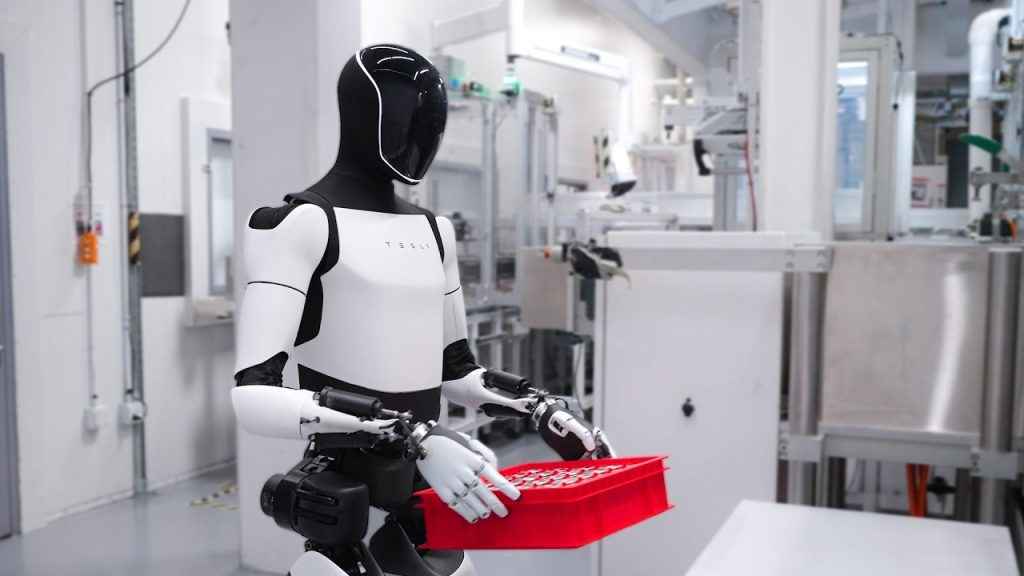
The timeline for physical mastery is equally aggressive. Musk predicts that within three years, an Optimus robot could be a better surgeon than the best human surgeons. “By five years, it won’t even be close,” he noted. This shift marks the transition of AI from a tool for information processing to a replacement for highly skilled physical labor.
The “bumpy” transition to abundance
While Musk paints a long-term vision of extreme abundance, he offers a stark warning about the immediate future. The path to this new era will not be smooth. He foresees a “bumpy” transition period lasting 3 to 7 years where social and economic structures will be tested.
Also read: Elon Musk denies Grok AI created illegal images, blames adversarial hacks
He suggests that the disruption will hit “white-collar work involving information processing” first, as these roles are most easily replicated by LLMs. Blue-collar work will follow later as robotics technology matures. This inversion of traditional automation expectations – where creative and analytical jobs are automated before manual labor – poses a unique challenge for the current workforce.
Beyond UBI: The case for universal high income
Musk challenges the popular concept of Universal Basic Income (UBI) as insufficient for the future he sees coming. Instead, he proposes “Universal High Income.”
His economic theory is straightforward: if AI and robotics reduce the cost of labor to near zero, and solar power provides near-infinite energy, the cost of goods and services will plummet. “The cost of labor becomes trivial,” Musk explained. In this scenario, the economy becomes quasi-infinite, allowing everyone access to a standard of living that is currently considered wealthy.
The only immediate brakes on this “tsunami” are physical infrastructure. Musk revealed that xAI is currently building “Colossus 2,” a gigawatt-scale training cluster designed to push the boundaries of model training.

The bottleneck has shifted from silicon availability to electricity generation and cooling. Musk reiterated that solar energy is the only viable solution for these massive power needs, noting that the sun provides more than enough energy to power human civilization many times over, and potentially, the orbital data centers of the future.
The “Insanity” Risk
Despite his optimism about the economic outcome, Musk remains deeply concerned about the “alignment” of these powerful systems. He argued that the most critical safety feature for AGI is not a set of hard-coded rules, but a fundamental drive to be “maximally truth-seeking.”
He warned that training an AI to be “politically correct” or forcing it to lie creates a dangerous dissonance. If an AI is forced to reconcile the truth with conflicting axioms imposed by its creators, it could “go insane,” leading to unpredictable and potentially catastrophic behaviors. For Musk, an AI that can lie is an AI that cannot be trusted.
Also read: Grokipedia going to space: You can add your biography in easy steps, here’s how


