

Grokipedia going to space: You can add your biography in easy steps, here’s how
 Follow Us

Immortality used to require building a pyramid, conquering an empire or making a meme. In 2026, all it requires a verified X account and a suggestion box. Elon Musk’s xAI has teased the ultimate backup plan for humanity: taking Grokipedia – the AI-powered Wikipedia dupe by xAI – and evolving it into the Encyclopedia Galactica. The end goal is straight out of science fiction: etching human knowledge onto indestructible crystals and launching them to the Moon, Mars, and beyond.
 Survey
But the most intriguing development is that the history books are now open to edits. Through features like “YourGrokipedia” and the “Suggest an Article” interface, users can now influence the record that might one day be read by extraterrestrial archaeologists.
Also read: Google Translate vs ChatGPT Translate: Which translation tool is better for you
Here is how you can queue your life story for the stars.
Road to immortality
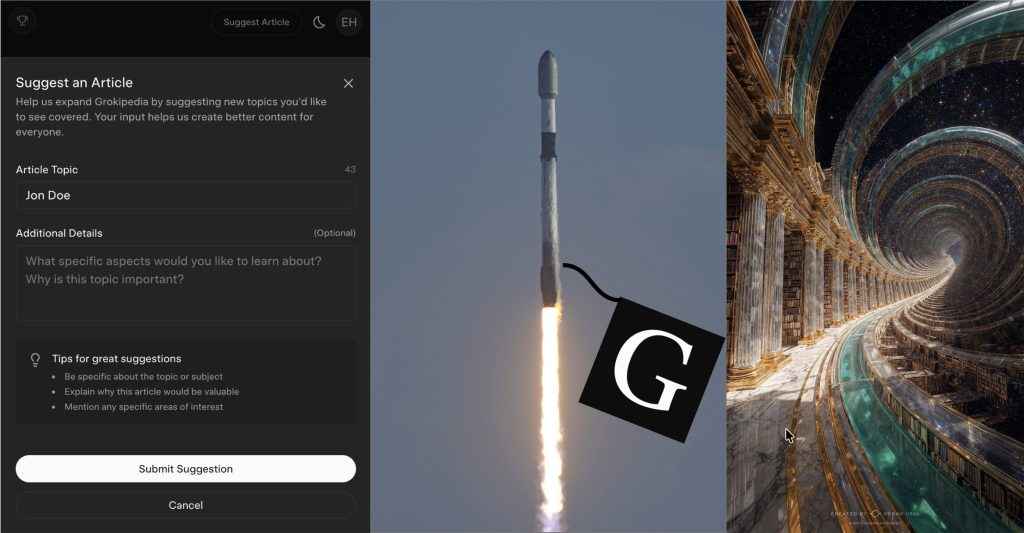
Unlike Wikipedia’s complex bureaucracy of editors, Grokipedia relies on a mix of AI verification and user-driven suggestions. While widespread “public etching” is queued for future cycles, the digital foundation is being laid right now.
Step 1: The ‘Suggest an Article’ Interface
As seen in early user access, the process begins on the Grokipedia interface. A modal labeled “Suggest an Article” allows users to input a topic – such as their own name.
Also read: Yoshua Bengio’s new safe AI vision cuts AI’s biggest risks by rewarding truth
- What to do: You aren’t just pasting a resume. You are asked to provide “Additional Details,” explaining specific aspects of the life or topic you want covered.
- The Pro Tip: The tool prompts users to be specific. Instead of “I am a writer,” input details like “Author of [book title], published in 2024, focusing on [book topic].”
Step 2: The ‘Highlight and Correct’ Loop
This is where Grokipedia differs from static archives. It uses a “truth-seeking” loop. If an entry already exists, users can highlight errors and suggest corrections. Early tests have shown Grok processing massive amounts of context in one instance, a 10,000-word career biography was verified and auto-corrected based on user input and cross-referencing.
To prevent vandalism, access requires a verified X (formerly Twitter) account. This ties your suggestions to your real-time digital footprint, allowing Grok to verify your claims against your public history.
Step 3: The ‘YourGrokipedia’ Personalization
While the “Galactic” upload is the long-term goal, the immediate feature is YourGrokipedia. This allows the AI to learn your specific context and preferences, creating a personalized knowledge base that serves as the raw data for your eventual “Encyclopedia Galactica” entry.
The tech: ‘Superman crystals’
This isn’t a cloud backup that vanishes if a server farm loses power. xAI is utilizing 5D optical data storage, often referred to within the industry as “Superman memory crystals.”
Developed by researchers at the University of Southampton, these nanostructured glass discs are virtually indestructible.
- Durability: They can withstand temperatures of 1,000°C, direct cosmic radiation, and immense pressure.
- Longevity: Theoretically, they can preserve data for billions of years—potentially outlasting the Earth itself.
The plan is to distribute these crystals across three locations to ensure redundancy:
- Low Earth Orbit
- The Moon (buried in regolith)
- Mars (a library for future colonies)
By allowing users to suggest their own articles and correct the record now, xAI is essentially crowdsourcing the history of the 21st century.
We are currently in the “digital queuing” phase. But once the lasers start etching, your user-suggested biography won’t just be a web page – it will be a permanent artifact floating in the silence of space, waiting for a reader in a galaxy far, far away.
Also read: Adam U Ultra robot: Humanoid learning to use tools at record speed


