

Anthropic’s data shows AI will be a teammate, not replace humans at work
 Follow Us
Anthropic data shows AI supports workers as teammates not replacements
Economic Index finds AI augments jobs while humans retain control
AI at work grows through collaboration not mass job displacement

The debate over whether artificial intelligence will steal jobs or enhance them has raged for years. Now, real-world data from millions of AI interactions suggests the answer is more nuanced—and more optimistic – than many feared.
 Survey
Anthropic’s latest Economic Index report, analyzing over 1 million conversations with its Claude AI system, reveals that collaboration, not replacement, is emerging as the dominant pattern of AI use in the workplace. The data shows that 52% of interactions now involve “augmentation” – where humans and AI work together iteratively – compared to 45% classified as full automation where tasks are delegated entirely to the system.
“This represents a reversal from just three months earlier,” notes the report, when automation briefly overtook collaboration. The shift back suggests that as AI becomes more sophisticated, workers are discovering its greatest value lies not in replacing human judgment, but in amplifying it.
Also read: Grokipedia going to space: You can add your biography in easy steps, here’s how
The reality of AI at work
The study tracked five core dimensions of AI usage, what researchers call “economic primitives”: task complexity, skill levels, use cases, AI autonomy, and task success rates. Together, these metrics paint a picture of AI as a powerful assistant rather than an autonomous replacement.
Consider the success rates. While Claude performs well on straightforward tasks, achieving 70% success on work requiring less than a high school education, that rate drops to 66% for college-level work. More tellingly, as task complexity increases, AI struggles more. Tasks estimated to take humans over five hours see success rates fall to around 45% in automated settings.
This reliability gap explains why collaboration persists. Workers aren’t simply handing off entire jobs to AI. Instead, they’re engaging in what the report calls “task iteration” – a back-and-forth process where AI drafts, humans refine, and both learn from the exchange.
Which jobs are really affected?
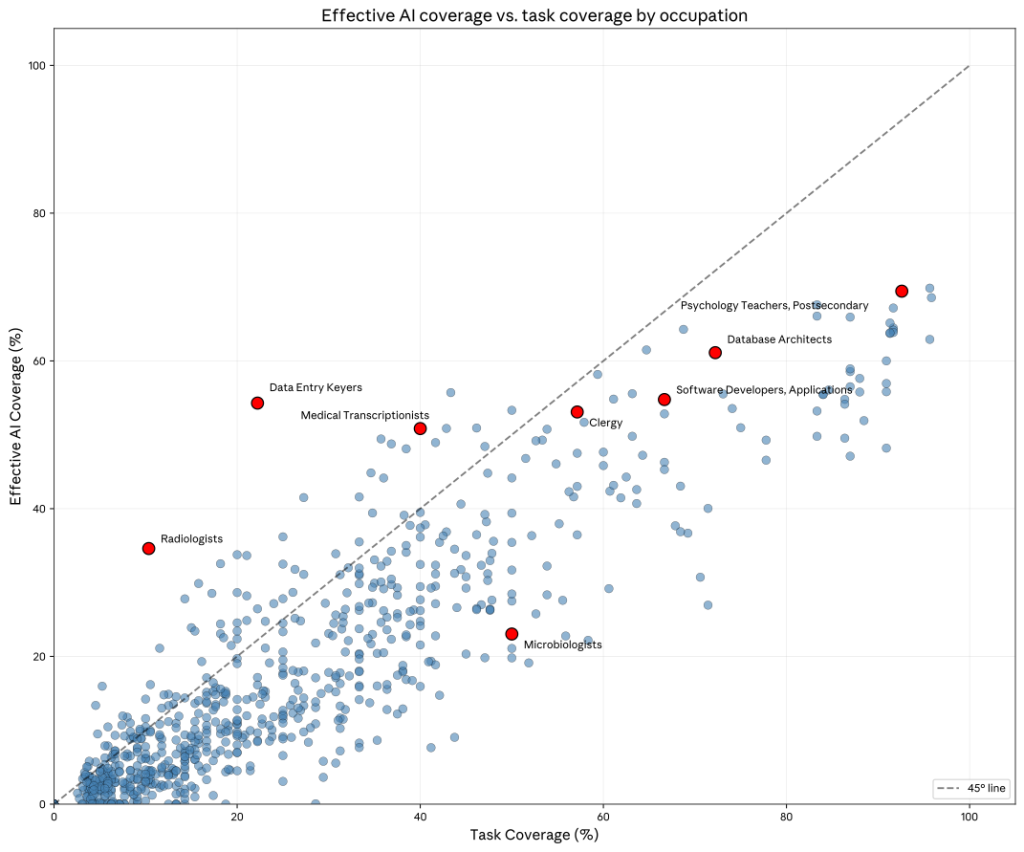
The data also challenges assumptions about which professions face the greatest AI impact. When researchers factored in both task coverage and success rates, they found surprising results.
Also read: Google Translate vs ChatGPT Translate: Which translation tool is better for you
Data entry workers and radiologists show high “effective AI coverage” – meaning AI can successfully handle large portions of their time-intensive work. For radiologists, AI excels at their core tasks: interpreting diagnostic images and preparing reports. Yet this doesn’t necessarily mean job losses. Instead, it suggests these professionals may shift toward higher-level decision-making and patient interaction.
Meanwhile, teachers and software developers – despite seeing AI used across many of their tasks—show relatively lower effective coverage. The human elements of their work, classroom management, creative problem-solving, stakeholder communication, remain stubbornly difficult to automate.
The deskilling concern
Not all findings are reassuring. The research reveals that AI tends to handle the more complex, higher-education tasks within jobs, potentially creating a “deskilling” effect. Travel agents, for instance, lose tasks like planning itineraries and computing costs, leaving behind routine ticket purchasing. Technical writers similarly see AI take on analysis and review work while basic documentation remains.
However, this pattern isn’t universal. Some professions, like real estate managers, experience the opposite – AI handles routine record-keeping while humans focus on negotiations and stakeholder management.
Productivity without displacement
Perhaps most significantly, the data suggests substantial productivity gains without wholesale job elimination. Even after adjusting for AI’s reliability issues, researchers estimate labor productivity could grow by an additional 1.0 to 1.2 percentage points annually over the next decade – a return to the robust growth rates of the late 1990s.
This productivity boost comes not from AI working alone, but from human-AI partnerships that reduce time on routine tasks while preserving human oversight on critical decisions.
The research underscores a crucial point: AI’s impact depends on how we choose to deploy it. The prevalence of augmentation over automation isn’t inevitable, it reflects choices by workers and organizations to maintain human judgment in the loop.
As AI capabilities continue advancing, these patterns may shift. But current evidence suggests the future of work isn’t humans versus machines. It’s humans with machines, combining artificial efficiency with human wisdom – a partnership that may prove more powerful than either could achieve alone.
Also read: TranslateGemma explained: Google’s new open model for 55 languages


