Oppo is sharpening colour science and skin tone accuracy through data-driven tuning and precise measurement across the Find X9 series.
New hardware like the 200MP periscope telephoto and Hasselblad-backed colour pipeline brings more realism and control to portraits and zoom.
Oppo sees AIGC as the next major shift in smartphone imaging, enabling advanced reconstruction and future AI-driven photo generation.
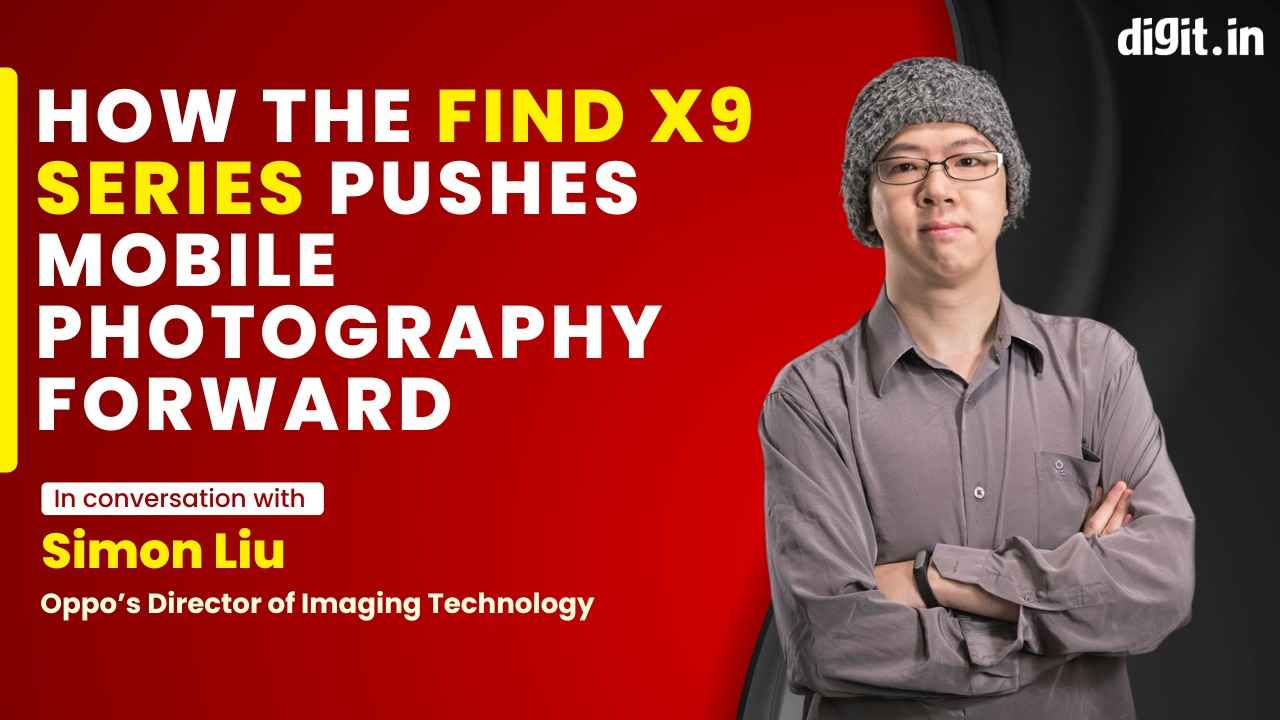
When it comes to the best camera phones, Oppo has undoubtedly established itself as one of the leading smartphone camera manufacturers today. Over the past few years, the brand has built a strong reputation for taking mobile photography seriously, investing in specialised hardware and long-term partnerships to improve image quality across different conditions. And now, with the launch of the Find X9 and Find X9 Pro in India, the company has taken one step further, thanks to larger sensors, an improved 200MP periscope lens on the Pro, and software optimisation.
 Survey
On the sidelines of the launch, we spoke with Simon Liu, Oppo’s Director of Imaging Technology, who gave us insights into how the company is rethinking colour science, skin tones, camera accessories, and, most importantly, the upcoming wave of AIGC-driven imaging. Our conversation touched on why colour accuracy matters more than ever in an era where AI-assisted photography is becoming the default, how Oppo evaluates human-centric photography across different regions, and what the brand believes will define the next generation of computational imaging.
Why Oppo wants photos to look more like you
While the Oppo Find X9 series builds on the groundwork of last year’s Find X8, Liu pointed out that the focus was never on fixing something that was ‘wrong’. Instead, the goal was to push photographic realism further, especially in terms of how people perceive themselves.
Liu says early in the conversation, ‘Absolutely, fix assumes something is wrong.’ Oppo has spent the past year focusing on improving one of the most important aspects of smartphone photography: skin tone accuracy.
According to Liu, the company shifted from broad ‘looks’ to data-driven colour precision.
‘Everybody has a different skin colour and a perfect image of themselves in their mind. We invite groups of users, take pictures, gather feedback, and then everything becomes numeric. Once you fall within a defined circle of accuracy, users feel satisfied,’ he said.
‘This scientific approach is a step forward from the more subjective tuning Oppo previously relied on, helping the Find X9 series deliver more consistent results across lighting conditions and skin types,’ he added.
Also read: Moto G57 Power launched with big 7000mAh battery in India: Check price, specs
Bringing more precision to colour tuning
Liu claims Oppo’s colour pipeline is becoming more quantifiable. Brightness, DG (Delta-Gamma) values, and colour channels are now precisely measured, logged, and adjusted. ‘It’s more than just a feeling. We calculate brightness numbers and colour values for each area and adjust based on precise metrics rather than saying something is too dark or too red,’ he said.
This approach has reflected the shift in the X9 and X9 Pro, which benefit from Hasselblad’s ongoing collaboration, particularly in portrait processing and the telephoto pipeline, he stated.
Also read: Best Phones Under 20000
Why Hasselblad teleconverter blocks other lenses
The new teleconverter kit generated interest, but it physically blocks the other cameras when mounted. Liu makes it clear that the decision was completely intentional.
‘When you use a converter, you want to achieve a high zoom ratio. It makes sense to stack it on the camera with the highest ratio, which is the telephoto,’ he said. Allowing users to mount it over any other lens, he claims, would result in confusion and degraded output.

With the complete teleconverter kit, case plate, and tripod collar, the Find X9 Pro approaches the territory of a mirrorless camera. Was there an internal debate over how far is too far? Liu shakes his head.
‘There was no such debate. These are accessories; users can choose whether to purchase or use them,’ he explained.
Also read: OpenAI vs Google: Why Sam Altman fears ChatGPT might be losing the AI race
Image tuning is an ongoing process
According to Liu, Oppo’s imaging work doesn’t end when a phone hits the market; in fact, that’s when an important part of the fine-tuning begins. He explained that the company continuously monitors real-world feedback, evaluates edge-case scenarios, and adjusts the imaging pipeline long after the device is on shelves.
Liu pointed out that even older models like the Find X8 are still receiving fixes and refinements, which shows how Oppo treats imaging as an evolving product rather than a one-time release. The X9 series, therefore, will likely continue receiving imaging improvements well into its lifecycle.
Which is better for travel, street, and video: The Find X9 or X9 Pro?
When asked which model is best suited for various shooting styles such as travel photography, street photography, or video, Liu offered straightforward advice. He claims that, while the Find X9 Pro naturally has an advantage due to its higher-end camera hardware, particularly the upgraded telephoto system, the real choice depends on how the phone feels in your hand.
‘I would always go for the higher spec, the X9 Pro. But it comes down to what feels handy. If your hand is smaller, choose the X9. You need to feel comfortable when creating something you’re proud of,’ he said.
Also read: Samsung Galaxy S26 Ultra tipped to get bigger battery and faster charging than S25 Ultra
The next big leap: AIGC-powered imaging
Throughout the conversation, one theme has resurfaced: AIGC (AI-generated content) and its close connection to computational photography. Liu provides the clearest indication yet of where smartphone cameras are headed.
‘The next big frontier for smartphone imaging is AIGC. A large portion of what you see is already recovered or generated by trained databases. In extremely dark conditions, the phone guesses and reconstructs what’s there,’ he explained.
‘Imagine you push this to the very, very far limit. You actually totally cover the lens. The phone just knows where it is. It’s going to still give you something at some point,’ he further hinted at what the future can be.
 Follow Us
Ashish Singh
Ashish Singh is the Chief Copy Editor at Digit. He's been wrangling tech jargon since 2020 (Times Internet, Jagran English '22). When not policing commas, he's likely fueling his gadget habit with coffee, strategising his next virtual race, or plotting a road trip to test the latest in-car tech. He speaks fluent Geek. View Full Profile


