
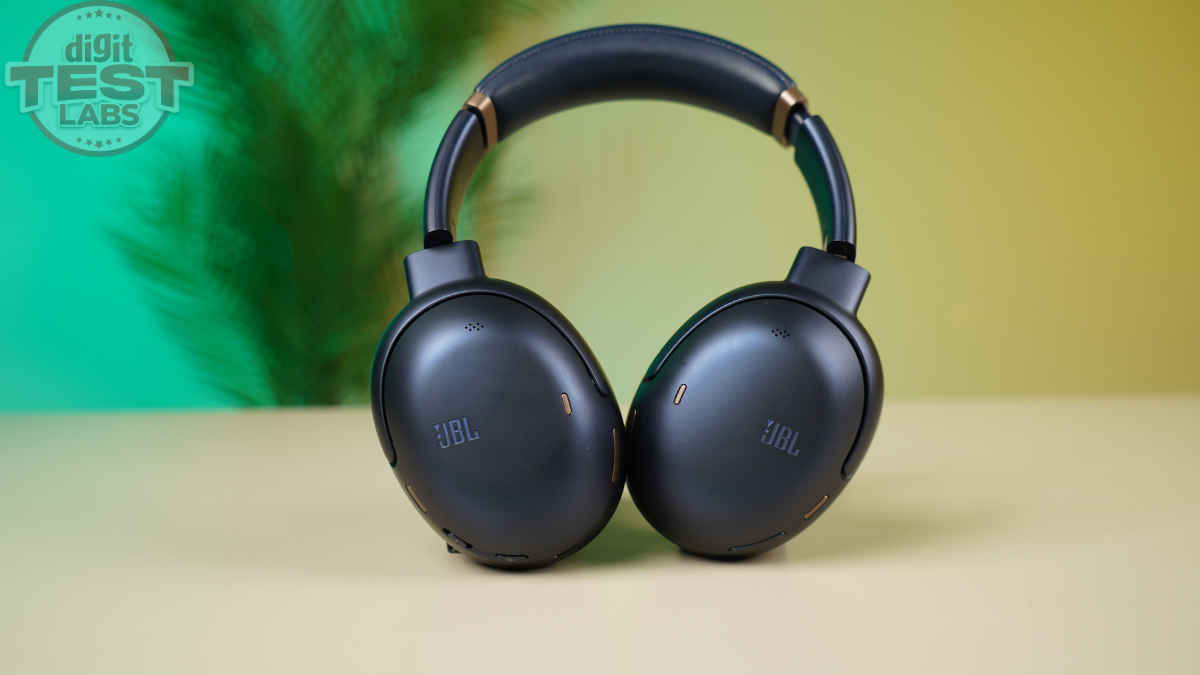
While picking a high-end headphone, you know you can expect a certain quality of audio and a set of features. With the JBL Tour One M3, too, you get hi-res LDAC wireless audio, lossless sound via USB-C cable, Spatial 360 sound with Head Tracking, 8-mic-powered adaptive noise cancelling, smart ambient modes, a very long battery life claim, and a very similar appearance to the previous Tour One. But to jazz up things, JBL also bundles an intriguing piece of hardware with its new Tour headphone, dubbed Smart TX. It is a Bluetooth transmitter with a screen that lets you quickly control several features of the headphones. So, while I started reviewing the headphones to test how useful Smart TX is, I enjoyed using the product for reasons beyond that.
JBL Tour One M3 review verdict
The JBL Tour One M3 brings fun-neutral sound with notable bass, high-res LDAC support, excellent ANC, solid call quality, reliable battery life, a feature-rich app and a very familiar and functional design at Rs 26,999. The ambient mode and fit could be better, but they are good enough for you to consider the headphones. The Smart TX variant adds broader device support and Auracast convenience, but at a higher price. And as a bundle, the Tour One M3 Smart TX variant makes sense only if you value the transmitter’s extra flexibility.
Familiar and functional design
The regular JBL Tour One M3 arrives in Black, Mocha, and Blue colours. The Smart TX edition ditches the Mocha variant. Our review unit is the blue Smart TX one. The colour of the box matches the colour you pick, along with some signature orange accents. Inside, there is a similarly coloured hard-shell carry case that is pear-shaped. It is compact and sturdy enough to be durable and portable. It has a standard zip, which feels reliable even if it lacks the magnetic closing you see on some higher-end models like the Sony WH-1000XM6 (review).

Opening the case shows earcups that rotate and fold flat. The box includes a USB-C to USB-C cable, a 3.5 mm audio cable, and, if you buy the Smart TX bundle, JBL’s Smart TX transmitter with a USB-A to USB-C converter. The Smart TX unit weighs 34.5 g, has a small rectangular body, and fits in your palm. You turn it on with a button on top. A single tap on this button switches the screen on or off. It has USB-C ports on both ends, one for charging and the other for a wired connection to a source device. Unlike a simple USB dongle, it includes a compact touchscreen that lets you adjust playback, ANC, EQ, calls, and other headphone settings without using your phone. It also works as a USB-C or 3.5 mm transmitter that can broadcast audio over Auracast to compatible devices.
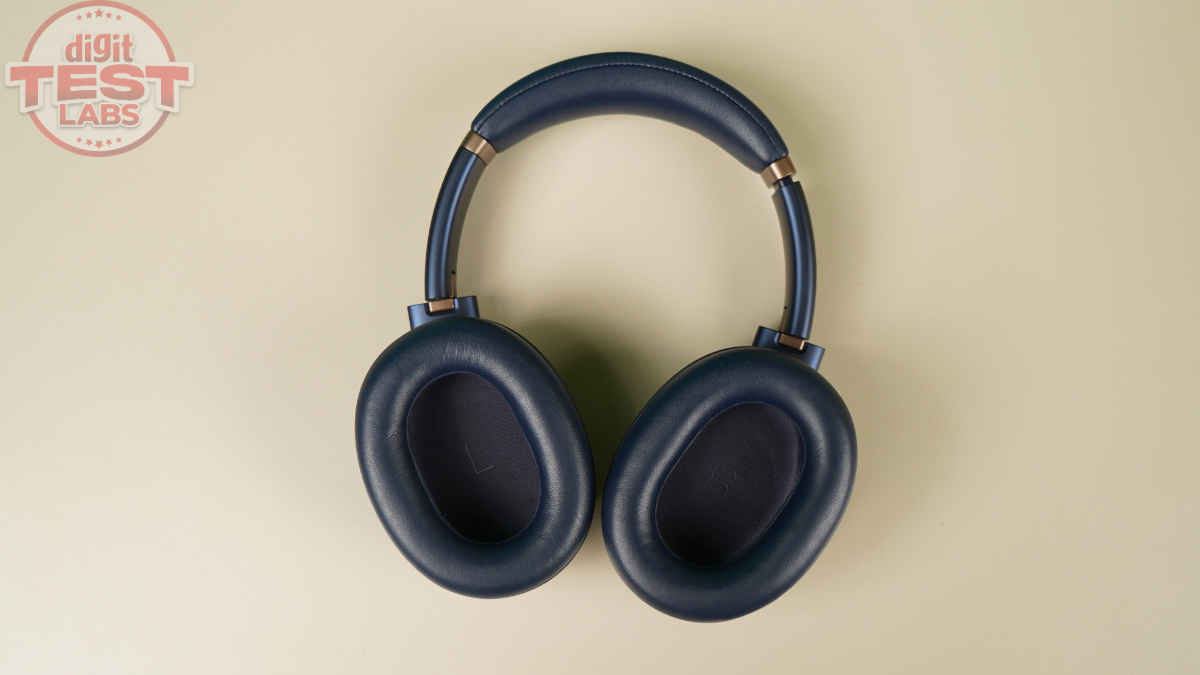
As for the headphones, they take the Tour One M2 design and refine it. They have a matte finish that looks clean without trying too hard. Build quality is solid, using reinforced plastic with metal inside the headband. At 278 g, they feel light and mostly comfortable. The padding is soft, and the clamp is mild, but the oval pads and the fit can start to feel uneasy during long sessions.
Controls are a mix of buttons and touch gestures. The buttons/slider for power and pairing work fine, and I always appreciate the tactility of physical controls. The touch panel responds well to your commands as well. You can’t remap or change these control functions, but JBL gives you options to toggle them off completely.
Feature-rich and flexible connectivity
The pairing process is smooth with Android thanks to Google Fast Pair, and standard Bluetooth pairing works without fuss on other platforms. Once paired, download and open the JBL Headphones app. The app takes a second to connect to the device, but once it does, you get a feature-rich and easy-to-use UI.
This is the app to control the settings of both the One M3 and Smart TX. The app gives access to Personi-Fi 3.0 for hearing-based tuning, a customisable 10-band EQ, the option to toggle LDAC, Smart Talk (that lowers playback volume when you start speaking), spatial sound with head tracking, ANC controls, auto play/pause, voice-aware settings, multipoint, and even a Relax Mode (that plays relaxing mixes of sounds like waves, bonfire, wind, trees rustling, etc).
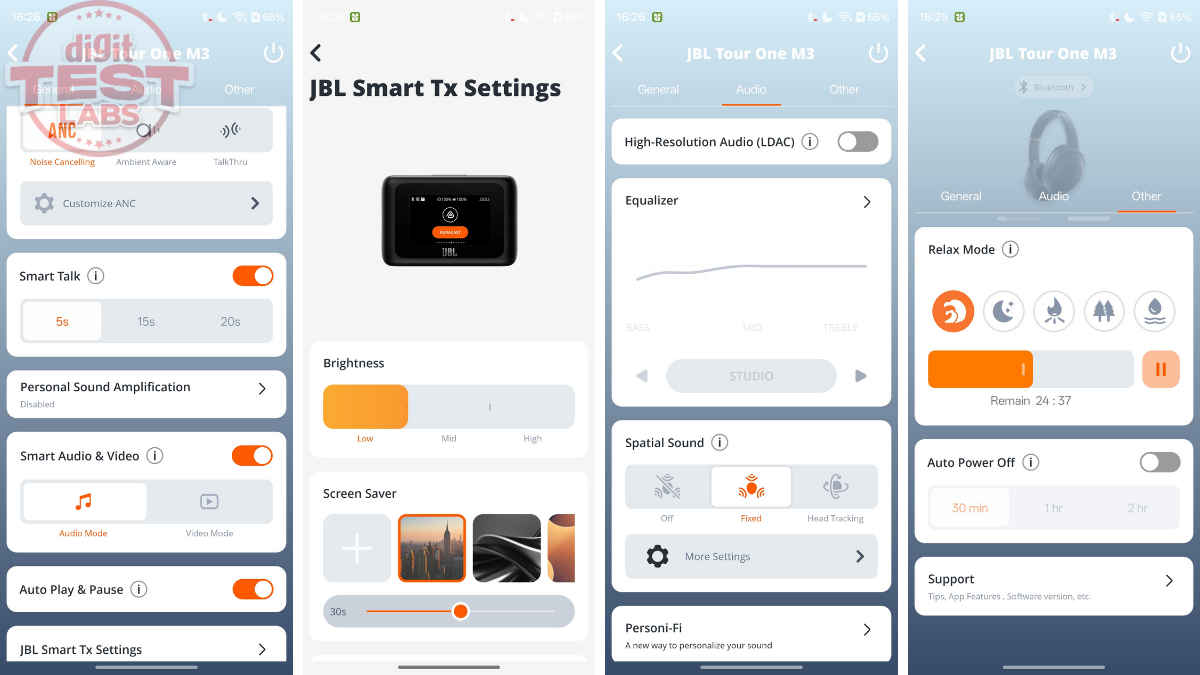
The app also lets you manage the Smart TX transmitter. It connects to most devices through USB-C or 3.5 mm, including in-flight screens, older laptops, consoles and TVs. It supports Bluetooth LE Audio, LC3 and Auracast, so that it can send higher-quality audio with lower latency than many built-in Bluetooth chips. You can control volume, noise cancellation or ambient mode, Spatial Sound, the equaliser, the timer and LDAC directly from the touchscreen on the dongle when your phone is not nearby. You swipe between screens and tap to confirm a setting.
Fun, clear, and consistent audio
The Tour One M3 uses 40 mm Mica Dome drivers and supports LDAC, LC3, AAC, and SBC. I was listening at 60-80% volume, with LDAC on and no equaliser. The JBL tuning offers a good oomph in lower frequencies. The bass in Bad Guy by Billie Eilish was stronger and more rumbly than the similarly priced and more neutral-sounding Sennheiser Momentum 4 80th Anniversary Edition. The mids sound clear, but don’t have a centre focus that some neutral-leaning headphones offer. For instance, vocals on Easy On Me by Adele sound clear and defined. Stevie Nicks’ voice and instruments on Dreams by Fleetwood Mac sound separate with good presence. The upper mids also see a decent rise, resulting in a lively experience in pop and rock tracks. Treble extension is also good but controlled: the melancholic violin in Stumble Then Rise… by Silver Mt Zion sounds crisp but not sharp.

Overall, the Tour One M3 sits in that middle ground where bass has authority, mids stay clear but not full, and the top-end has detail without sharpness. Compared to flagship models like the Sony WH-1000XM6, it feels less impactful, though.
Spatial 360 with head-tracking is cool to have. JBL gives easy access, which some of its competitors don’t. This adds width and positional cues, especially for movies, though it introduces extra processing that music purists may want to avoid. Also, LDAC and Spatial Audio don’t work together.
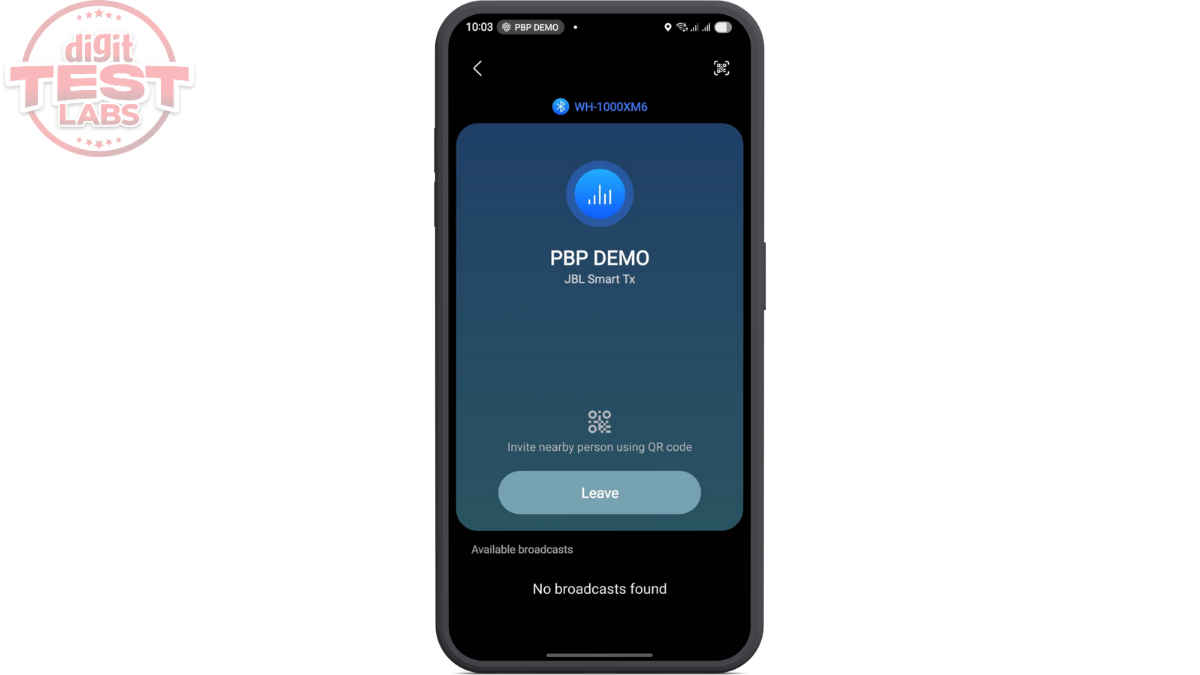
Finally, using the Smart TX transmitter improves consistency on devices with weak Bluetooth stacks. It lowers latency, keeps codec performance stable (LC3) and produces marginally cleaner mids and highs compared to SBC/AAC, but the overall tonal character stays the same. You just need to ensure you have Auracast-compatible devices and have enabled Bluetooth LE Audio on these devices for the Auracast stream to work. It needs work, but once everything is set up, it is a cool feature to have.
Also Read: Sennheiser BTD 700 review: Can make wireless listening better, but with caveats
Excellent call quality and noise cancellation
JBL markets its system as True Adaptive Noise Cancelling 2.0, powered by an 8-mic array. It does a fantastic job at cancelling low-frequency fan noises from an air purifier nearby, better than the Sony WH-1000XM6 I have. Perhaps this is because of the clamping force of the JBL headphone. But when it comes to background voices/chatter, they do a comparable job. Some voices, albeit dulled, do leak through.
Transparency mode is good, but not the most natural. It lifts ambient sounds clearly but adds a slight digital edge. Sony WH-1000XM6 does a better job. Apple remains the benchmark here.
Call quality, however, is excellent. The beamforming mic array keeps your voice clean, even outdoors. There are some party tricks like tweaking your voice, sound’s bass, treble, etc, and the VoiceAware feature, which lets you hear yourself to avoid speaking too loudly.
Long reliable battery life
Battery life is a major selling point. The Tour One M3 reached up to 29.5 hours with ANC on, continuous music playback at 80% volume, and LDAC on. The company’s claims are a little overpromising. But what matters is that I could get through an entire work week without charging.
It took me 2 hours and 40 minutes to charge from 10 percent to 100 with a 25 W PD charger. The company claims this can be done in 2 hours. Regardless, the presence of a wired listening option means you don’t need to have battery anxiety using this pair.

Should you buy the JBL Tour One M3?
The JBL Tour One M3 aims to offer a flagship-like experience at a more approachable price of Rs 26,999, and it gets several things right. The sound is lively and engaging with stronger bass than mid-range rivals, a clear upper-mid focus and a crisp treble lift, making it engaging for most genres without drifting into harshness. Noise cancellation is one of the best, call quality is good, and LDAC support gives Android users better wireless audio than the usual SBC/AAC combination. Although the battery life in our testing did not match the company’s optimistic claims, it still remains strong enough for daily use without forcing frequent top-ups.
The trade-offs are modest, too. Ambient mode is still not as natural as what Sony or Apple offer; the fit can feel uneasy during long sessions, and some of the features, like the call-related sound tweaks, feel more like extras than everyday essentials.
So, if you want a premium ANC headphone that sounds good, has strong ANC, decently long battery life, a feature-rich app, and a functional and sturdy design, the JBL Tour One M3 is an easy recommendation.
Now, that’s not the end of it. What lifts the Tour One M3 above many alternatives is the Smart TX transmitter. It offers a consistent audio experience across almost any device, adds a touchscreen interface for quick controls and brings Auracast support for low-latency, stable audio broadcasts. This Smart TX variant costs Rs 32,990, and the level of extra flexibility it offers is something even more premium rival flagships don’t offer. Whether it’s worth the higher price tag, though, depends on how much value you see in the transmitter’s versatility and convenience.
Keep reading Digit.in for similar reviews.
Also Read: Sennheiser HDB 630 review: Faithful sound meets functional design
JBL Tour One M3 Smart Tx Key Specs, Price and Launch Date
| Release Date: | |
| Market Status: | Launched |
 Follow Us
G. S. Vasan
G.S. Vasan is the chief copy editor at Digit, where he leads coverage of TVs and audio. His work spans reviews, news, features, and maintaining key content pages. Before joining Digit, he worked with publications like Smartprix and 91mobiles, bringing over six years of experience in tech journalism. His articles reflect both his expertise and passion for technology. View Full Profile


