
SpaceX Successfully Conducts Test Flight of Enhanced Starship for Lunar Missions
 Follow Us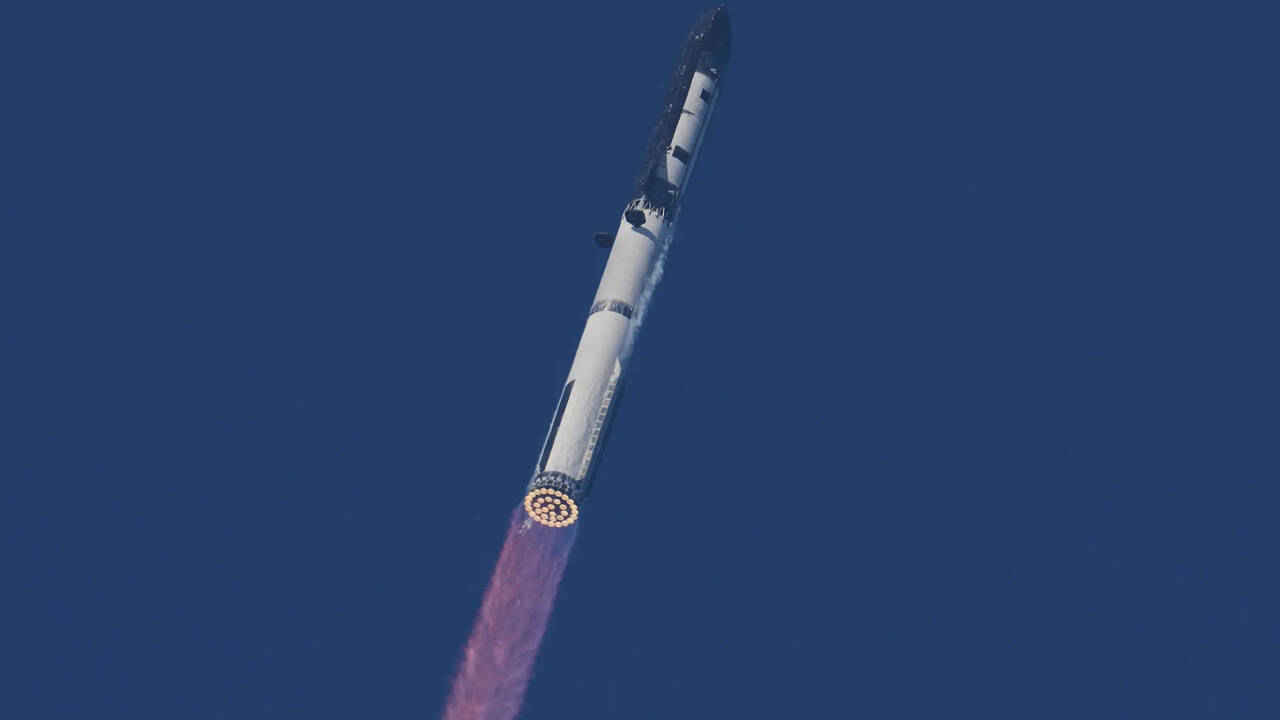

SpaceX launched its most powerful Starship yet on a test flight on Friday, a significant advancement that NASA plans to utilize for landing astronauts on the moon.
 Survey
The upgraded mega rocket lifted off from southern Texas, just two days after CEO Elon Musk announced plans to take the company public. The spacecraft carried 20 mock Starlink satellites, which were deployed during the hour-long flight that circled halfway around the globe.
Flight Details and Outcomes
The spacecraft reached the Indian Ocean despite experiencing engine issues and subsequently ignited upon impact, a result SpaceX anticipated.
Musk described the launch as “an epic” event, expressing pride in his team’s efforts. He conveyed his appreciation via X, stating, “You scored a goal for humanity.”
This flight marked the twelfth test for the Starship, which Musk envisions as a vehicle to transport humans to Mars, with the immediate goal of supporting NASA’s Artemis program for lunar exploration.
NASA’s Involvement and Future Missions
NASA Administrator Jared Isaacman attended the launch, noting that Starship is now closer to fulfilling its lunar mission objectives.
The latest model, designated V3, is taller than previous iterations at 407 feet (124 meters) and offers enhanced engine thrust. The booster features larger grid fins for improved steering during descent and a more robust fuel transfer system.
Technical Specifications and Performance
The flight encountered some challenges as not all engines ignited during the booster’s controlled return, yet the spacecraft maintained its trajectory at an altitude of 120 miles (194 kilometers).
For the first time, modified Starlink satellites equipped with cameras provided real-time views of the spacecraft in flight, showcasing significant technological advancements.
Future Prospects for SpaceX and Lunar Exploration
SpaceX is preparing for future lunar missions, with NASA investing billions in lunar landers from both SpaceX and Jeff Bezos’ Blue Origin. The competition between the two companies is intensifying as they strive to be the first to achieve lunar landings.
NASA is planning a docking trial run in orbit around Earth next year, with astronauts set to practice docking their Orion capsule with either Starship or Blue Moon, as part of the Artemis III mission.
The Artemis IV mission, which aims for a moon landing by two astronauts, could occur as early as 2028, marking NASA’s first crewed lunar mission since Apollo 17 in 1972.
Private Space Travel Initiatives
SpaceX is also taking reservations for private flights to the moon and Mars on Starship. Notable passengers include Dennis Tito, the first space tourist, who signed up for a lunar flight, and Chun Wang, a bitcoin investor, who plans to travel to Mars.
No specific timelines or costs for these private missions have been disclosed, highlighting the evolving landscape of commercial space travel.


