
Portable AC vs window AC: From price to cost and cooling, every aspect explained
 Follow Us
A window AC brings relief almost instantly, while a portable AC takes longer to make the room comfortable.
Window AC spreads cool air more evenly, but a portable AC may leave some parts of the room warmer.
Window AC is easier on your budget over time, while a portable AC can be heavier on both price and electricity bills.


Choosing the right air conditioner can make a big difference in how comfortable your home feels during hot days. Two of the popular options in the AC market involve the window AC and the portable AC. Each one of the two has its own advantages and disadvantages. A window air conditioner quickly and effectively cools a single room. On the other hand, a portable AC can be moved easily from one room to another, giving you more flexibility. While the choice of your AC usually depends on the room size and budget. In this guide we’ll talk about the technical aspects like the airflow, energy use, heat removal, and how fast the window AC or the portable AC cools so you can choose the right one.
 Survey
Window AC vs portable AC: Direct exhaust vs hose heat
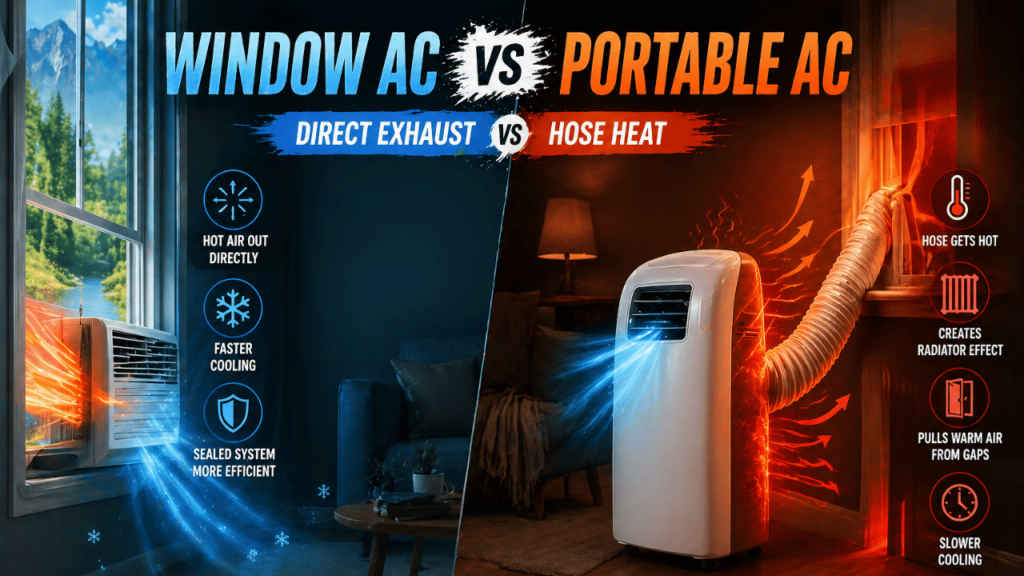
The primary reason a window AC cools faster is because of how it handles physics. A window AC sits directly in the frame of your window, allowing it to vent hot air straight outside as all its mechanical heat-producing parts are outdoors. Moreover, it is a sealed system that focuses entirely on dropping the temperature of your indoor air.
In contrast, a portable AC sits inside your room. While the AC unit blows cold air from the front, the back and exhaust hose of the portable AC unit get very warm. This further creates a radiator effect where the machine is typically fighting against the normal heat and the heat generated by the device itself.
Also read: Which smartphone does the world’s richest man, Elon Musk use? Here is what we spotted
Other than that, as the portable unit pushes air out the hose, it creates a negative pressure that often pulls warm air in from under doors or through cracks, slowing down the cooling process significantly.
Window AC vs portable AC: Power and air distribution
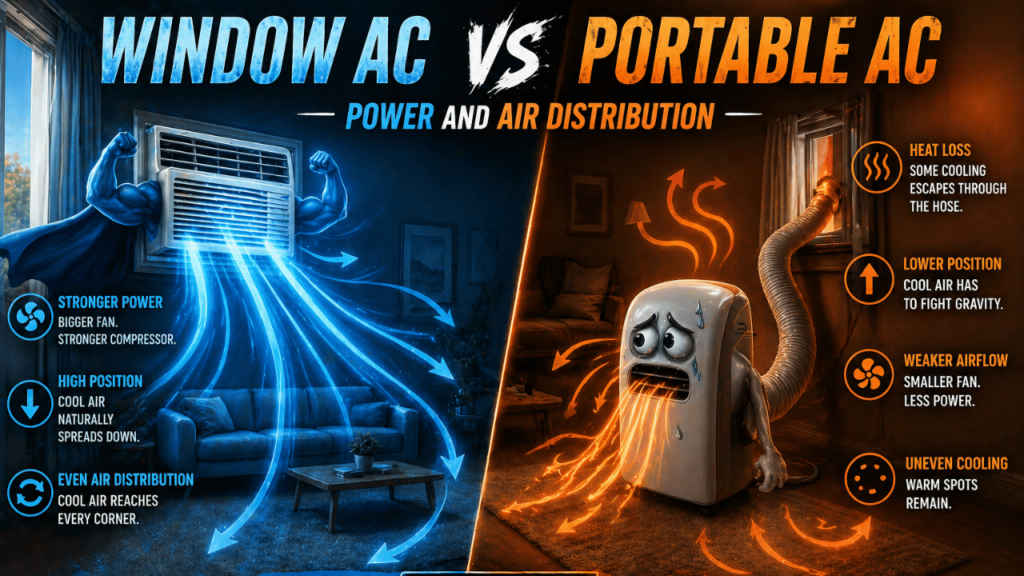
Window ACs are usually stronger because they are fixed in one place and are built to be more solid. Furthermore, they also have bigger fans and stronger compressors when compared to the portable AC. As a result of that, they can cool air faster and move more of it around the room. Other than that, they are also placed higher in a window, and as the cool air tends to move downwards, it uses the natural airflow that helps spread the cold air evenly.
The portable ACs sit on the floor, and as a result of that, they often have a harder time sending cool air up, as they don’t get help from the natural airflow and have to fight against the laws of nature. As a result of that, it usually leaves some warm areas near the ceiling. Moreover, they also usually have smaller fans and less powerful compressors; hence, the cooling can also feel slower.
Also read: Confused between replacing or repairing your old AC? Here is how you can make right decision
In addition to the above-mentioned, the portable AC units may also lose some cooling through the exhaust hose, especially if it’s not well sealed. All these issues have a negative impact on the efficiency of the AC.
Window AC vs portable AC: Speed

When it comes to raw speed, the window air conditioner is the clear winner against the portable air conditioner because it vents heat more efficiently and manages air pressure better; it can lower a room’s temperature in nearly half the time it takes a portable model of the same power rating. If you want instant relief the moment you walk through the door, the window unit is your best bet for a fast chill.
Window AC vs portable AC: Price and running cost
In India the window ACs generally cost between Rs 25,000 and Rs 40,000, making them more affordable upfront. However, the portable ACs are pricier, often ranging from Rs 30,000 to Rs 50,000.
In terms of the running costs, the window units are more efficient and cheaper to operate daily. Portable models consume more electricity because they struggle to exhaust heat effectively.


