

NASA Artemis II: Watch beautiful images of Earth, Moon and Milky Way Galaxy as mission nears end
 Follow Us
NASA’s Artemis II mission is now in its final phase as the crew returns to Earth.
The crew shared amazing space photos, including the Milky Way and close views of the Moon.
The mission is expected to end on April 10, 2026, after helping scientists learn more about the Moon.
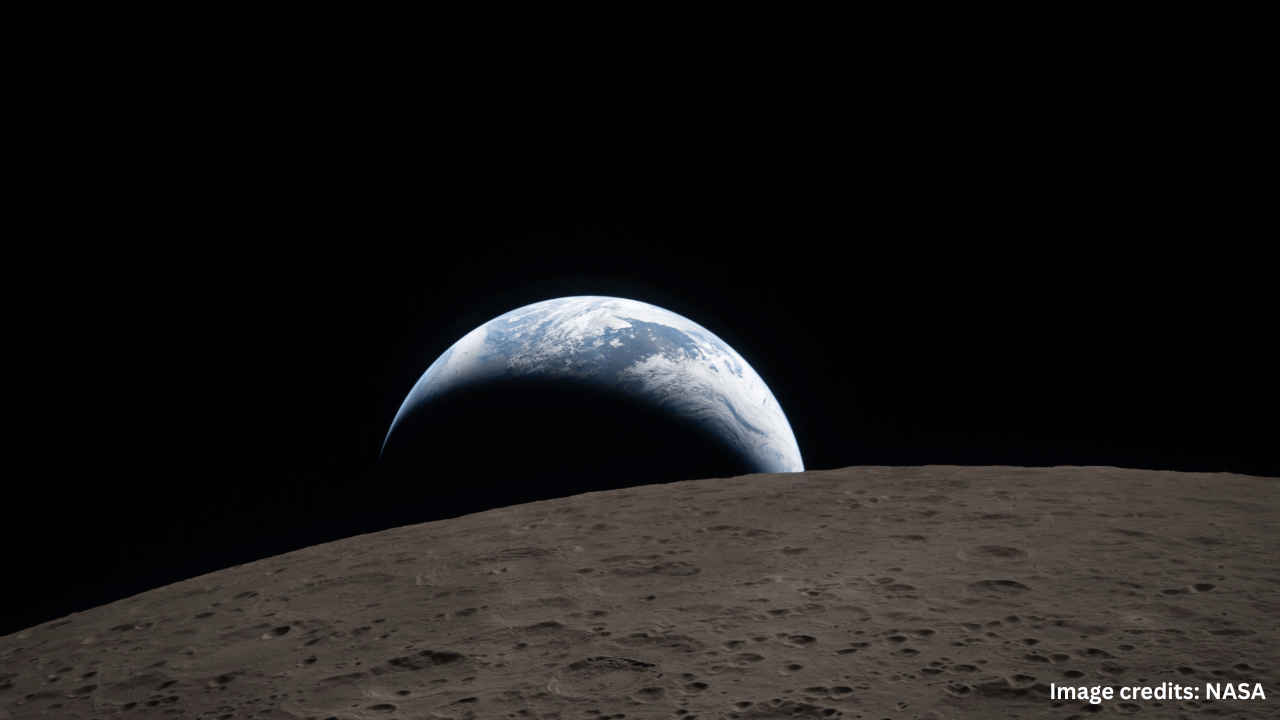

NASA’s Artemis II mission is reportedly entering its final phase, bringing an extraordinary journey around the Moon closer to its end. While the crew has begun its return to Earth, the success of the mission isn’t the only thing to appreciate here. The images shared are some of the most stunning space visuals one has seen in recent times. The Artemis II crew shared multiple glimpses from deep space that highlight the beauty and complexity of the universe. From deep space views of the Milky Way to detailed looks at the Moon’s rugged surface, each update has captured global attention. The outer space images shared by NASA have been captured using various devices, including the Apple iPhone 17 Pro Max, the GoPro camera, the Nikon D5, and others.
 Survey
During the movement around the far side of the celestial object, the astronauts managed to take some great images of the Moon. In contrast to the smooth round disc we observe from the Earth, here, it looks much more complex, having a number of craters overlapping each other, going deep into shadows.
It's not just a phase 🌕
— NASA (@NASA) April 8, 2026
Artemis II astronauts captured these views of the Moon as the Orion spacecraft flew around the far side of the Moon on April 6, 2026. pic.twitter.com/lT7245Gp28
Also read: Iran-linked hackers escalate attacks on US critical infrastructure, will it impact us?
In another series of visuals, the focus is on the Milky Way galaxy as it’s visible in the picture taken after the spacecraft flew past the Moon on April 7. It presents us with the galaxy that can be observed across the sky like we never saw before.
Sky full of stars.
— NASA (@NASA) April 8, 2026
Following a successful lunar flyby, the Artemis II astronauts captured this breathtaking photo of our galaxy, the Milky Way, on April 7, 2026. pic.twitter.com/pzqcLZNB71
Other than the above, the mission also used an onboard camera (GoPro) to capture a rare view of Earth and the Moon together in one frame. It also captured a solar eclipse from space in another shot, giving people a new perspective on something we usually see from Earth.
Hello, Moon. It’s great to be back.
— NASA (@NASA) April 7, 2026
Here’s a taste of what the Artemis II astronauts photographed during their flight around the Moon. Check out more photos from the mission: https://t.co/rzM1P0QbOl pic.twitter.com/6jWINHkDLh
Also read: Elon Musk seeks Sam Altman’s removal, OpenAI calls lawsuit a harassment campaign
These visuals are not only beautiful, but they also help scientists learn more about the Moon, especially its far side, which is still less explored. The images give useful information about surface patterns and past impacts.
Meanwhile, the mission has reached a key stage in its return. The Orion spacecraft has exited the Moon’s gravitational zone, meaning Earth’s gravity is now guiding it back. The crew will spend the next three days making small adjustments to stay on track. NASA is expecting the mission to end on April 10, 2026, with a splashdown near San Diego. Following that, NASA is said to move ahead with recovery and medical checks.


