
AC with stabiliser vs without stabiliser: Which option is actually better for your home?
 Follow Us
Most new ACs come with built-in voltage protection.
A stabiliser adds extra safety during power fluctuations.
The right choice depends on your area's electricity supply.
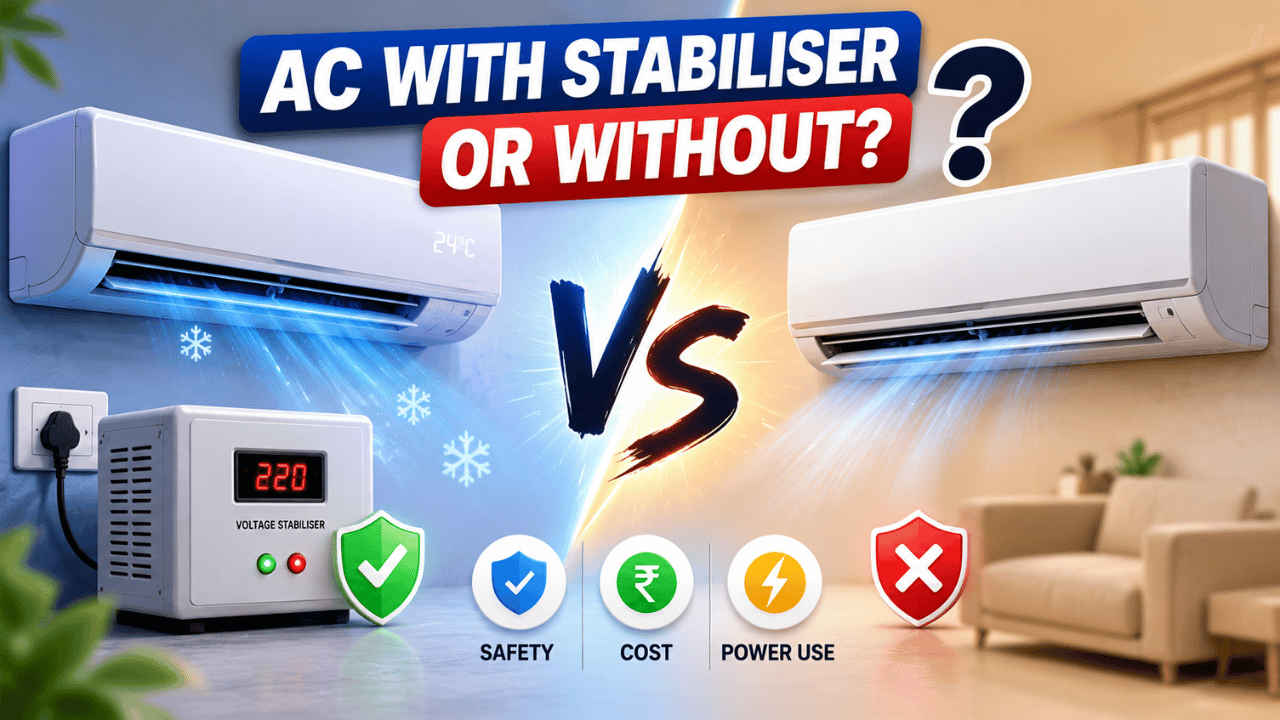

When buying a new air conditioner, people have a question of whether they will need a stabiliser. With the advent of the new generation of air conditioners with inverter technology, many people may not consider the need for the use of stabilisers, as nowadays many ACs contain voltage protection. However, depending on the quality of electricity, the type of air conditioner, and willingness to take risks with such expensive AC parts as compressors or circuit boards, one should make an appropriate decision. Knowing the differences and similarities in the usage of both AC with stabiliser and without stabiliser allows you to make a well-informed choice in the purchase of a new air conditioner for your home.
 Survey
AC with stabiliser vs without stabiliser: Hardware and voltage protection
Most modern inverter ACs already have built-in voltage protection and can safely work with voltage between about 160V and 290V without needing any extra device. This means you do not need to install a separate stabiliser on your wall, which keeps things neat and simple.
Older AC models or budget ones without this built-in protection are a different story. An external stabiliser can handle a wider voltage range, roughly 130V to 300V, and shields the AC from sudden ups and downs in power supply.
Your local power supply matters too. If voltage in your area often drops very low or spikes very high, a stabiliser gives you extra safety. This automatically disconnects power whenever danger arises and then restores the AC when the voltage returns to its normal level.
AC with stabiliser vs without stabiliser: Durability and maintenance
An AC without a stabiliser has fewer parts to worry about. But if a big power surge hits, the AC takes the full blow. Replacing a damaged circuit board can easily cost you a few thousand rupees.
The stabiliser acts like a shield because it is the one that receives the impact first and helps to safeguard the crucial components such as the compressor and circuit board.
Routine servicing costs remain roughly the same either way, usually between Rs 500 and Rs 1,500 depending on where you live and what work is needed.
AC with stabiliser vs without stabiliser: Power consumption
A stabiliser keeps running all the time and uses about 10 to 20 watts of electricity continuously, which slightly increases your monthly power bill. Without a stabiliser, no extra device is drawing power, so your setup is slightly more efficient.
Also read: Want to reduce your split AC’s power consumption? 5 simple ways to do so
AC with stabiliser vs without stabiliser: Cost comparison
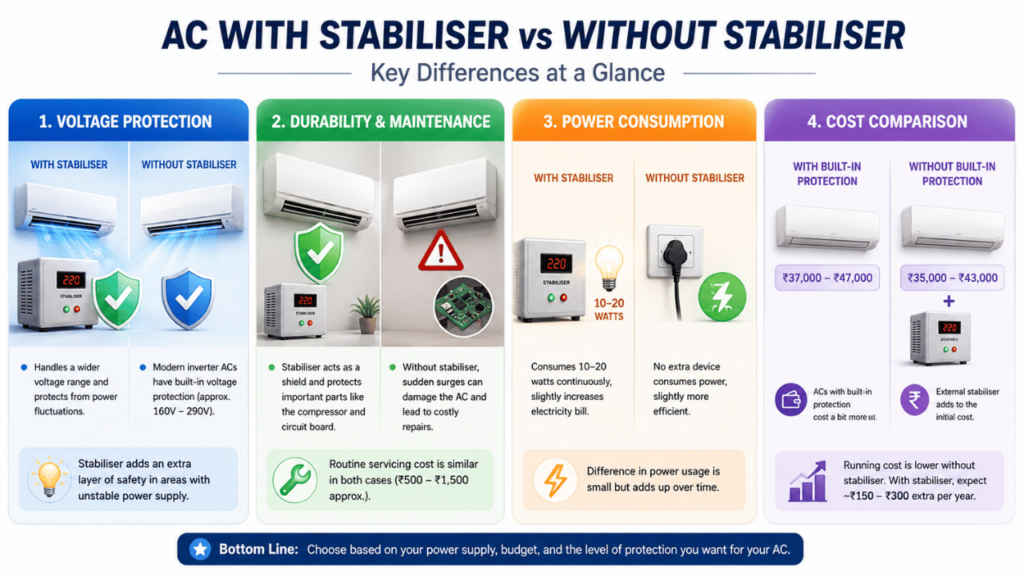
ACs with built-in voltage protection usually cost a bit more upfront. A 1.5-tonne model with this feature typically falls between Rs 37,000 and Rs 47,000. A similar model without it may cost Rs 35,000 to Rs 43,000, but you might still need to buy a stabiliser separately, which adds to the total.
Running costs are lower without an external stabiliser. If you do use one, expect to pay roughly Rs 150 to Rs 300 more on electricity each year.


