Astronomers spot twin tails and sudden brightening in interstellar object 3I/ATLAS after its solar encounter.
Scientists suspect the object exploded into pieces due to extreme heat and rapid mass loss.
Upcoming Hubble and James Webb observations may confirm if 3I/ATLAS is fragmented or intact.
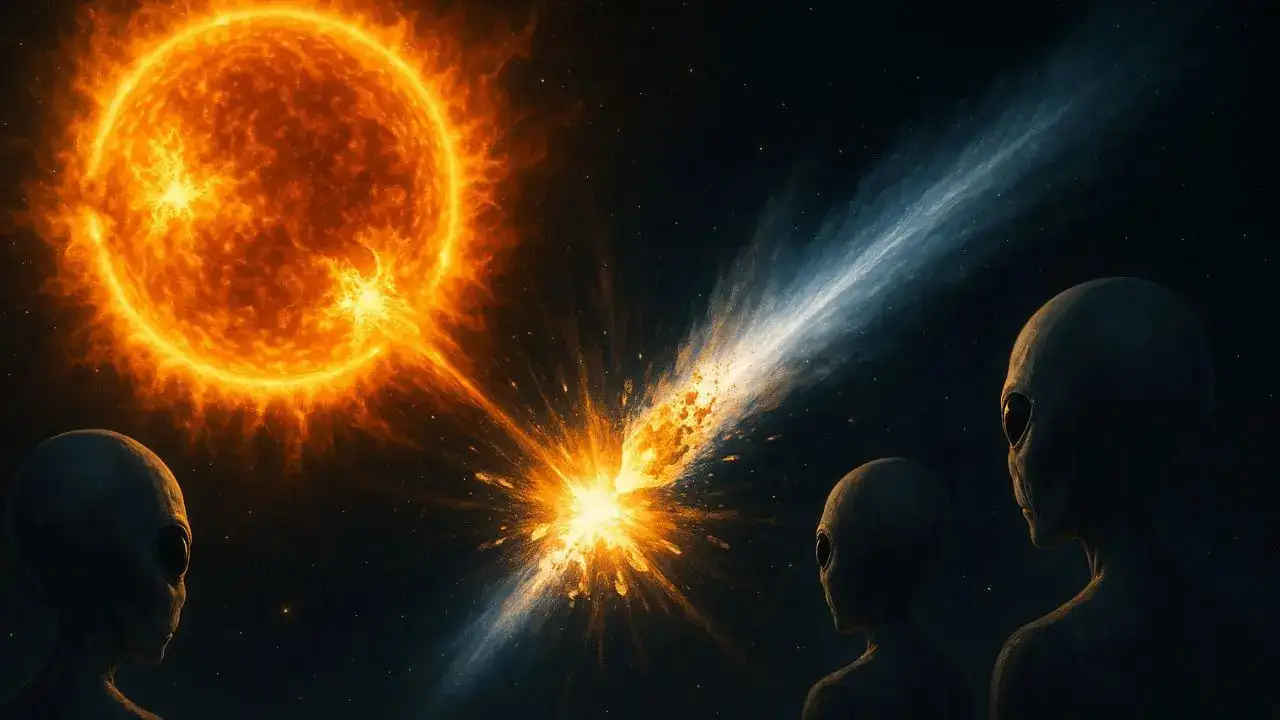
Recent post-perihelion images of 3I/ATLAS show an unusual brightening and an extended trail of gas and dust, raising questions about the object’s true nature. According to the reports, it dramatically brightened during its closest approach, a sign of rapid heating and intensive loss of material. Avi Loeb, an astrophysicist from Harvard, said such a breakup could have been caused by the intense heat of the Sun; the brightening likely appeared when the exposure of more surface area took place in that process. This hardly ever-seen event offers a great opportunity for scientists to study how interstellar objects behave when exposed to extreme conditions from the Sun, helping astronomers to further understand how materials from other star systems react within our solar environment.
 Survey
Why experts suspect 3I/ATLAS might explode
British astronomers Michael Buechner and Frank Niebling have taken new pictures of a space object called 3I/ATLAS. The photos show that it has formed a huge “anti-tail”, a tail that points toward the Sun, along with another long, smoky trail. One trail stretches about 10 lakh kilometres toward the Sun, and the other extends nearly 30 lakh kilometres in the opposite direction.


Also read: Google Gemini wants to help students ace their midterms with AI-powered study tools, here’s how
Scientist Avi Loeb explains that gas from a normal comet usually flows out at around 0.4 kilometres per second. If this is true for 3I/ATLAS, its gas jets must have been active for one to three months to create such long tails.
Loeb found something unusual, as the comet seems to be absorbing much more sunlight than expected for its size. The Sun gives about 700 joules of energy per square meter every second, which means 3I/ATLAS would need a surface area larger than 1,600 square kilometers equal to a sphere about 23 kilometers wide. That’s nearly four times bigger than earlier estimates.
Also read: OnePlus 15s design, specifications, colour options, specs and all other key details
Why astronomers believe that 3I/ATLAS exploded
The comet’s mass loss increased sharply from about 150 kilograms per second to nearly 20 lakh kilograms per second between August and its closest approach to the Sun. Loeb believes the most likely reason is that it broke into at least 16 pieces. “This means 3I/ATLAS exploded near the Sun, and we are seeing the aftereffects,” he said.
Loeb cautions that 3I/ATLAS might not be a natural comet at all if it didn’t disintegrate. He has even suggested it could be a technological object, possibly an alien spacecraft. He adds that if it were using thrusters, it would need much less fuel to create the same jets, especially if the exhaust came out at higher speeds, which would make the required fuel only a small part of the spacecraft’s total mass.
Also read: OpenAI working on group chat and DM features for ChatGPT: Here’s what we know
When will we find out whether or not 3I/ATLAS exploded?
As 3I/ATLAS makes its closest approach to Earth on December 19 and to Jupiter in March 2026, astronomers around the world are closely monitoring its journey. Upcoming observations with the Hubble and James Webb Space Telescopes could determine whether 3I/ATLAS has fragmented or remains a single, intact object that challenges existing theories.
 Follow Us
Bhaskar Sharma
Bhaskar is a senior copy editor at Digit India, where he simplifies complex tech topics across iOS, Android, macOS, Windows, and emerging consumer tech. His work has appeared in iGeeksBlog, GuidingTech, and other publications, and he previously served as an assistant editor at TechBloat and TechReloaded. A B.Tech graduate and full-time tech writer, he is known for clear, practical guides and explainers. View Full Profile


