
Samsung Galaxy XR vs Apple Vision Pro: Specs, features and key differences explained
 Follow Us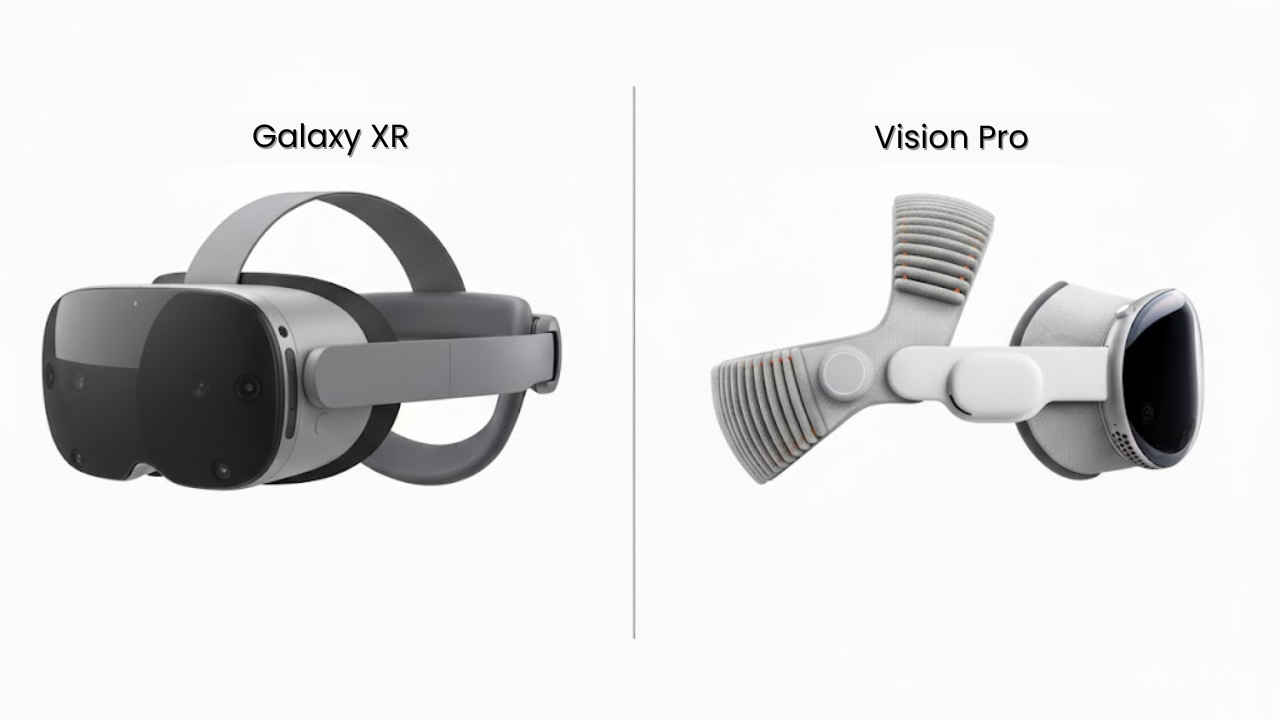

Samsung has officially entered the premium mixed-reality market with the launch of the Galaxy XR, developed in partnership with Google and Qualcomm. The headset takes direct aim at Apple’s Vision Pro, which brought mixed reality into mainstream discussion. But Samsung’s Galaxy XR costs nearly half of the Apple headset. So, if you are curious to know which headset delivers the better balance of performance, comfort, and ecosystem value, here we have laid out a spec-by-spec comparison of both headsets.
 Survey
Price and availability
The Galaxy XR is priced at $1,799 (about Rs 1,60,000), making it significantly cheaper than the Vision Pro at $3,499 (about Rs 3,07,000). Neither device is yet available in India. So, your access will depend on import/unofficial channels.
From a user perspective, the lower price of the Galaxy XR makes mixed reality more accessible. The Vision Pro remains a premium investment. But, for more context, read on:
Display and audio
Both headsets use Micro-OLED displays, which are known for deep contrast and colour reproduction. Samsung claims 95% DCI‑P3 coverage and Apple claims 92% DCI-P3 coverage. Samsung delivers a 3,552 × 3,840 resolution per eye, totalling roughly 27 million pixels, compared to the Vision Pro’s 23 million (3,660 × 3,200 resolution per eye). That means the Samsung headset could offer sharper visuals and clearer text.
The Vision Pro counters with a higher refresh rate of up to 120Hz, which could make motion and scrolling appear smoother, especially in games or fast-moving scenes. The Galaxy XR supports up to 90Hz only, but it should still be high enough for most experiences.
In real use, Samsung’s extra pixel density will likely benefit media consumption and creative works, while Apple’s higher refresh rate could help with augmented environments.
Besides that, Samsung claims a 109° field of view (FoV) horizontally and a 100° FoV vertically. Apple is said to offer a close to 100° FoV horizontally.
Both headsets support spatial audio, but Apple has a slight edge with its personalised HRTF (Head-Related Transfer Function) that tailors sound based on the user’s ear shape for accurate directional sound.

Design, weight and comfort
The Galaxy XR weighs about 545 g, making it lighter than both the original Vision Pro (600–650 g) and the newer Vision Pro M5 (750–800 g). The reason for Vision Pro’s heavier build is that it has a metallic chassis made of aluminium alloy, while Samsung has used lighter materials like plastic.
For fit and comfort, Samsung has used a dial-adjust strap, a cushioned forehead pad, and a removable bottom light seal to block glare. Apple, on the other hand, has used a Dual Knit Band with premium fabric.
In everyday use, the lighter materials and adjustable headband could mean you can use the Galaxy XR for longer sessions, whether for watching films, gaming, or virtual meetings.
Also, note that both use an external battery and so that’s one more thing to carry around.
Also Read: Sony BRAVIA 5 vs Samsung QN90F: Mini LED TV specs comparison
Controls and accessories
Apple’s Vision Pro introduced a controller-free experience out of the box, relying solely on eye and hand tracking. The inward-facing cameras detect eye movement, while outward-facing sensors read hand gestures. You can simply look at an app and pinch your fingers to select it. If you favour minimal hardware and want a gesture-based experience, you may like Vision Pro. It’s intuitive, but also limiting for gaming or creative applications that need tactile input.
Samsung matches Apple’s eye- and hand-tracking controls, and adds optional motion controllers, similar to those on the Meta Quest. This flexibility could allow both casual and advanced interactions like painting, 3D design, or VR gaming.
Samsung’s use of Gemini AI, Google’s advanced conversational assistant, takes interactivity further. Gemini is a generative AI model that can respond to contextual prompts, perform searches, and manage tasks using voice or visual input inside the headset. Siri on Vision Pro, meanwhile, remains limited to basic commands. Gemini is, therefore, currently more advanced than Apple’s Siri assistant in this respect.
Processor and memory
The Vision Pro (2025) is powered by Apple’s new M5 chip, featuring a 10-core CPU, 10-core GPU, and 16-core Neural Engine. It is a desktop-class chip capable of handling 3D rendering, spatial video editing, and hardcore multitasking.
The Galaxy XR uses Qualcomm’s Snapdragon XR2+ Gen 2 with a 6-core CPU, an 8-core GPU, and on-device AI support.
Most users won’t notice the gap during typical tasks like streaming, browsing, or casual mixed-reality gaming. But for professional workflows like spatial design or video editing, the Vision Pro’s performance advantage could show up.
Galaxy XR comes with 16 GB RAM and 256 GB storage. While Apple also offers 16 GB of unified memory (up to 153 GB/s bandwidth), the storage options are 256 GB, 512 GB, and 1 TB.
Battery life
Both devices use external battery packs, which connect via cable and clip onto clothing. Samsung’s battery weighs around 302 g, lighter than Apple’s pack (353 g).
The Galaxy XR claims to offer up to two hours of general use and 2.5 hours of video playback, while the Vision Pro is rated to run for 2.5 hours in general use and three hours for video.
The Galaxy XR uses USB-C for power and data, while the Vision Pro relies on Apple’s proprietary magnetic connector for its battery. Both devices can operate while charging, though, thanks to pass-through usage support.
In real terms, the difference is small. Users who plan to work or play for longer durations will need to keep them plugged in.
Software and ecosystem
Samsung’s Galaxy XR runs on Android XR, Google’s new mixed-reality platform. Like Android phone OS, this one is also designed to be open. So, apps developed for Android XR can be used on Galaxy XR and other Android XR-based headsets.

At present, native apps include YouTube, Google Maps (with immersive 3D navigation), Google Photos (for 3D photo viewing), and Adobe’s Project Pulsar for creative editing. The inclusion of a Netflix app, which is, by the way, absent on Vision Pro, is a notable entertainment option.
Samsung also offers a Galaxy Explorer Pack, which brings a bundle of one year of Google AI Pro, YouTube Premium, and a free season of NBA League Pass (in-arena streams).
Apple’s Vision Pro, on the other hand, runs on visionOS, tightly integrated with the Apple ecosystem. Like iPhones and other Apple products, this will be a walled garden. The closed ecosystem, however, has native apps like Safari, Keynote, and Apple TV+ that are dear to Apple users. Further, you can also sync it with your Mac or iPhone and extend the display into a 3D space. There are other features of visionOS 26, like Personas, Pinnable Widgets, and spatial photos, that may appear attractive. So, while it makes sense for Apple users, the lack of popular apps like Netflix, YouTube may disappoint some users.
Summing up
Purely on spec-based comparison, the Samsung headset appears to be ahead in terms of price, lightweight, sharper display, flexible controls, and an open app ecosystem. It offers nearly all the Vision Pro’s key features, adds practical touches like controllers and Netflix support, and costs nearly half as much. For most users dipping into mixed reality now, the Galaxy XR could thus be the more compelling choice.
For India and similar markets, Samsung’s open Android XR platform and accessible pricing could help mixed reality reach a much wider audience than Apple’s premium-first strategy.
However, if you’re already within the Apple ecosystem and need the best performance for professional creative work, the Vision Pro (M5) remains the superior device at a steeper price.
And for a recap, here are the key specs of both headsets at a glance:
| Feature | Samsung Galaxy XR | Apple Vision Pro (M5) |
|---|---|---|
| Price | $1,799 | $3,499 |
| Availability | Not yet available in India | Not yet available in India |
| Weight (Headset) | Approx. 545 g | Front-heavy, new strap improves fit but is still bulky for long sessions |
| Battery Pack Weight | Approx. 302 g | Approx. 353 g |
| Build & Materials | Lightweight plastic, cushioned headband, removable bottom light seal | Aluminium frame, glass front, fabric strap (Dual Knit Band) |
| Comfort & Fit | Dial-adjust strap, thicker head cushion, even weight distribution | Front-heavy, new strap improves fit but still bulky for long sessions |
| Display Type | Micro-OLED | Micro-OLED |
| Resolution (per eye) | 3,552 × 3,840 (about 27 million total) | 3,660 × 3,200 (about 23 million total) |
| Refresh Rate | Up to 90 Hz | Up to 120 Hz |
| Field of View (FoV) | ~109° horizontal / 100° vertical | ~100° horizontal (estimate) |
| Processor | Qualcomm Snapdragon XR2+ Gen 2 (6-core CPU) | Apple M5 (10-core CPU, 10-core GPU, 16-core Neural Engine) |
| RAM / Storage | 16 GB RAM / 256 GB storage | Open to Android apps and the Google ecosystem |
| Battery Life | Up to 2 hours (general use), 2.5 hours (video playback) | Up to 2.5 hours (general use), 3 hours (video playback) |
| Charging / Pass-through Use | Yes, supports pass-through while charging | Yes, supports pass-through while charging |
| Input Controls | Hand tracking, eye tracking, motion controllers (optional), voice commands | Eye tracking + hand tracking (look-and-pinch gestures) |
| Operating System | Android XR (open mixed reality platform) | visionOS (Apple’s spatial computing OS) |
| AI Integration | Gemini AI (deep integration across apps and voice) | Siri (limited spatial interaction) |
| Native Apps | YouTube, Google Maps (3D), Google Photos, Adobe Project Pulsar, Netflix | Apple TV, Safari, Keynote, Files, but no Netflix app |
| Ecosystem Compatibility | Open to Android apps and Google ecosystem | Deep integration with Apple devices and ecosystem |
| Audio | Two, 2 Way speaker Spatial audio | Two speakers Advanced spatial audio, personalised HRTF mapping |
| Controllers / Accessories | Optional motion controllers, supports Bluetooth gamepads/ keyboards | No dedicated controllers (supports Bluetooth accessories) |
| Connectivity | Wi-Fi 7, Bluetooth 5.4, USB-C (battery and data) | Wi-Fi 6 (802.11ax), Bluetooth 5.3, proprietary port for battery |
Also Read: Noise Cancellation Explained: ANC or ENC?


