
Google Fitbit Air vs Noise REP: Price, battery, health tracking and more compared
 Follow Us
Fitbit Air costs Rs 13,999, weighs 12g and offers up to seven days of battery life, while Noise REP costs Rs 9,999 and lasts up to 10 days.
Fitbit tracks heart rate every 2–3 seconds, while Noise uses roughly 15-minute intervals during sedentary use and increases sampling during workouts.
Fitbit offers deeper AI-powered health insights through a paid subscription, while Noise provides Sleep, Recovery and Effort scores without a recurring subscription.
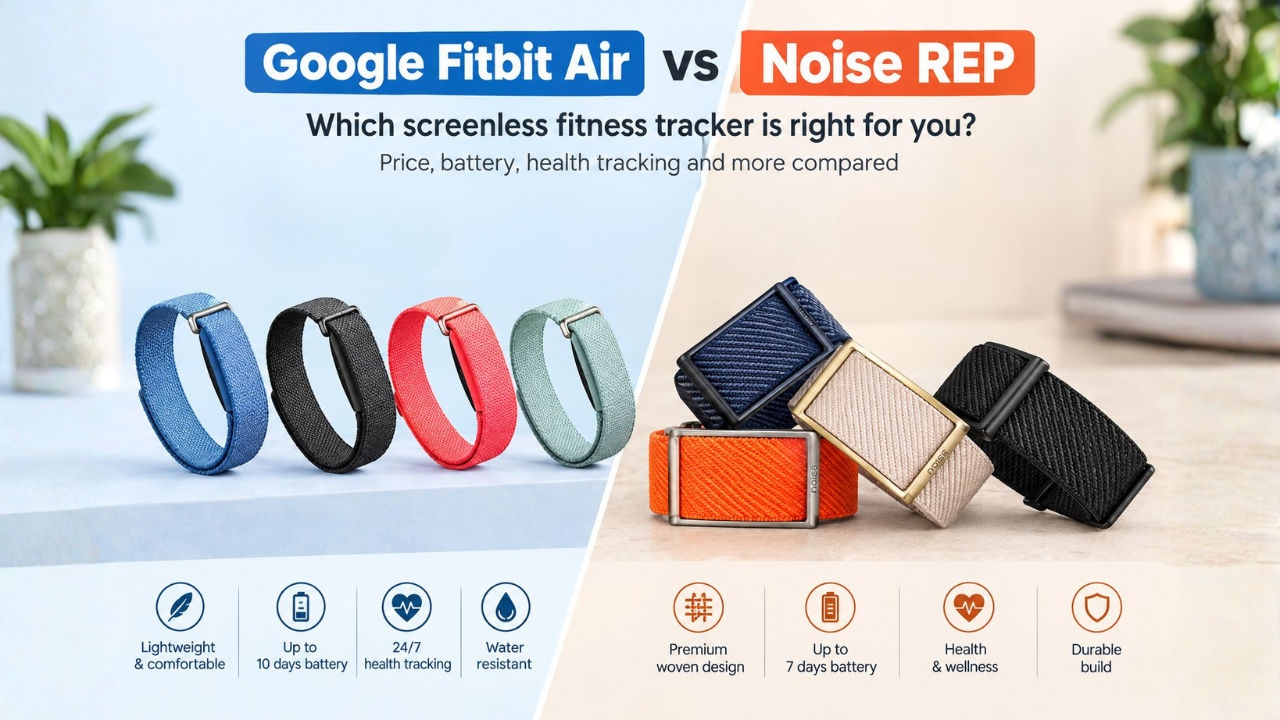

If you are into fitness you might already know that the screenless fitness trackers are taking the market by storm. Recently, Google also stepped in the segment with its Google Fitbit Air and joined some homegrown brands like Noise with almost similar features but different approaches. Both Google Fitbit Air and Noise REP focus on round-the-clock tracking, recovery insights and battery life while leaving the screen out entirely. But if you have a budget of around Rs 14,000, which one should you buy? Let’s try to find out based on the specs.
 Survey
Google Fitbit Air vs Noise REP: Price in India, design and battery
The Google Fitbit Air is priced at Rs 13,999, while the Noise REP costs Rs 9,999. Both trackers are screenless and rated for water resistance up to 50 metres or 5ATM.
The Fitbit Air tracker module weighs 12 grams and measures 8.3mm in thickness. Its removable pebble-shaped tracker can be moved between different bands, including a Performance Loop, silicone Active Band and Elevated Modern bracelet.
The Noise REP weighs 27 grams with its strap and has a 9.9mm profile. It uses a sandblasted stainless steel frame and comes with a premium nylon twill strap.
Battery life is another major difference. The Fitbit Air is rated to last up to seven days, while Noise claims up to 10 days for the REP. However, we will be testing both the devices in our Digit Test Labs and come out with the results.
Different approaches to health tracking
Fitbit Air takes a high-frequency approach to heart-rate monitoring, sampling heart rate every two to three seconds continuously, including during periods of rest. The idea is to create a more detailed picture of changes in metrics such as heart rate variability.
Noise REP takes a more conservative approach to sensor activity. During normal sedentary use, it checks heart rate roughly every 15 minutes, while workout detection increases the sampling frequency when the accelerometer identifies physical activity.
Noise also says its optical sensor system is tuned for Indian skin tones, with software adjustments designed to reduce potential measurement issues associated with different skin pigmentation.
Software and subscription differences
The Fitbit Air feeds data into Google’s Health app, where users can view metrics including sleep stages, blood oxygen levels, respiratory rate and resting heart rate. Basic trends are available without a subscription, while deeper AI-powered analysis through the Google Gemini Health Coach requires Google Health Premium, listed at Rs 499 per month or Rs 4,999 per year after a three-month trial.
Noise REP takes a different approach by making its health data available without a recurring subscription. The NoiseFit app centres its experience around three key scores: Sleep, Recovery and Effort.
Sleep tracking includes sleep-stage analysis and skin temperature variations, while the Recovery score combines metrics such as respiratory rate, resting vitals and HRV. The Effort score focuses on cardiovascular training load and overall activity.
Where the two trackers differ in everyday use
The differences between the Fitbit Air and Noise REP become clearer once you look beyond basic activity tracking. Fitbit focuses on continuous monitoring and automatic workout detection, while Noise puts more emphasis on dedicated sports profiles, longer battery life and targeted tracking.
The Fitbit Air records heart rate every 2–3 seconds, allowing it to follow changes in intensity and combine longer activities, including rest periods, into a single workout timeline. However, it lacks a dedicated badminton mode, so users have to manually categorise the activity as general cardio in the Google Health app. The Noise REP offers a dedicated badminton profile alongside more than 20 sports modes. It can automatically recognise activities such as walking, running and cycling, but normally samples heart rate every 15 minutes.
The charging experience is different too. Fitbit uses a magnetic Type-C charging setup, making it easier to use existing USB-C chargers, and a five-minute top-up can provide up to a day’s battery life. The Noise REP uses a proprietary magnetic charging dock, but its 10-day battery life means fewer charging sessions.
Fitbit also has 64MB of internal storage, allowing up to seven days of background biometric data and 24 hours of high-frequency workout data to be stored offline. Noise relies more heavily on periodic Bluetooth syncing, which can lead to gaps during prolonged phone disconnections.


