

India’s 6 GHz opening makes Wi-Fi 6E worthwhile, and Wi-Fi 7 less theoretical
 Follow Us
New spectrum policy might pave way for PS5 Pro India launch
Lower 6 GHz de-licensing could solve urban Wi-Fi congestion and latency
India opens 6 GHz band, boosting Wi-Fi 6E
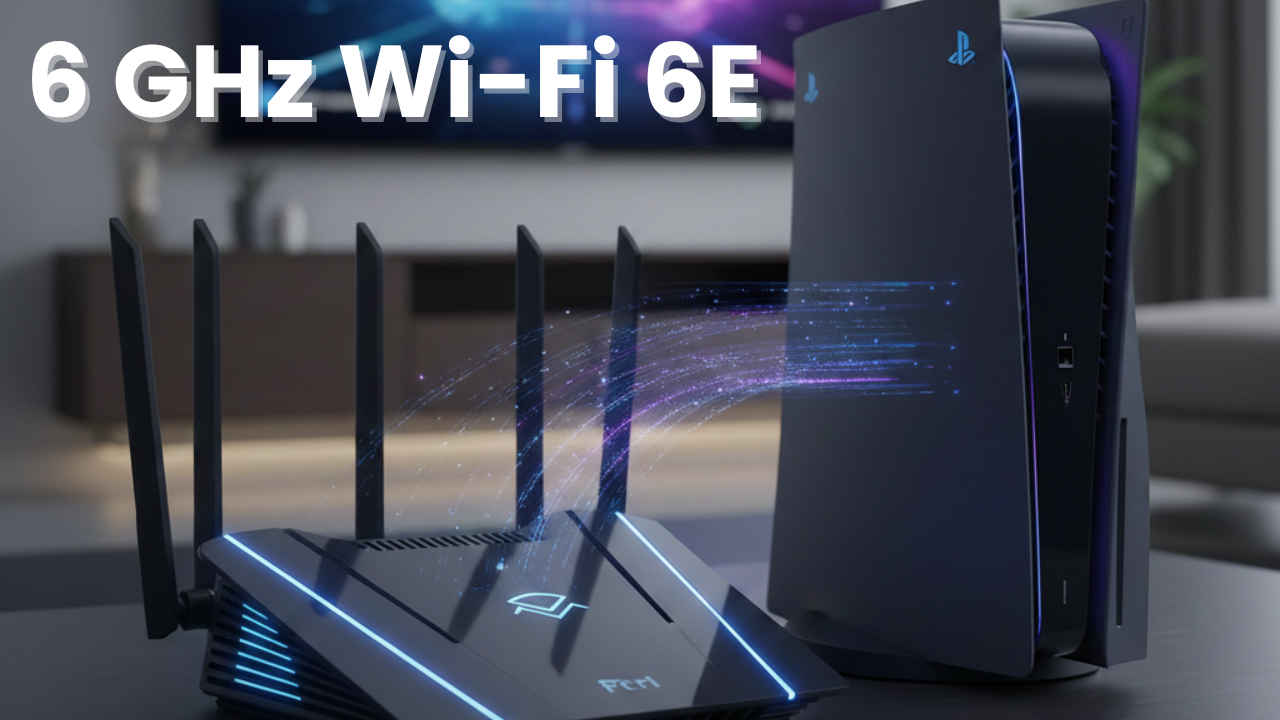

For a while now, India’s home broadband story has had an odd punchline. Fibre has got faster, 5G has become more normal, and yet a lot of people still end up blaming “the internet” for what is really a Wi-Fi problem. Congested air waves, too many devices, too many neighbouring routers, and not enough clean spectrum to go around. That’s why the government’s latest move on 6 GHz matters, it is one of those quietly important policy decisions that people only notice when their video call stops stuttering.
 Survey
Also read: Digit Research: One in two people ask AI chatbots, Google for health advice in India
First, a quick reality check on the numbers, because the public chatter has already muddied them. What has been opened for licence-free use is the lower 6 GHz range from 5.925 to 6.425 GHz, which is 500 MHz. That is not the full 6 GHz Wi-Fi range used in markets that allow 5.925 to 7.125 GHz (a total of 1200 MHz). In other words, India has taken a meaningful step, but it has not thrown open the entire band.
From the perspective of new Wi-Fi technologies, this is the moment Wi-Fi 6E stops being a polite promise and becomes a feature people can actually use. Wi-Fi 6E is essentially Wi-Fi 6 with access to the 6 GHz band, so if 6 GHz is unavailable, the “E” is mostly a badge. Wi-Fi 7 benefits too, not only because it can operate on 6 GHz, but because the whole point of 6 GHz is cleaner spectrum that supports high throughput with lower latency and fewer interruptions. Even if the average household is not thinking in terms of channel widths and modulation schemes, they are absolutely thinking in terms of whether the mesh backhaul stays stable, i.e. whether a video call breaks up, and whether cloud gaming feels responsive.
There is, however, a second reality check worth stating plainly: Wi-Fi 7’s long-term promise is easier to fulfil when you have more 6 GHz to work with. In places where the full 1200 MHz is available, there is simply more room for wider channels and more simultaneous networks before things start getting noisy again. India’s 500 MHz lower band aligns more closely with the “partial” approach seen elsewhere, and it will deliver real benefits, but it also means the ceiling arrives sooner as adoption scales. If Wi-Fi 7 becomes common in urban apartment blocks, and if mesh systems keep multiplying, the same old story can return, just on a newer band.
That is the core tension: policy is trying to unlock better consumer Wi-Fi without creating interference headaches for incumbents, and without handing telecom operators an easy argument to auction everything in sight. The documents around the process show that the focus has been on low-power use in the lower 6 GHz band, with DoT draft rules aimed at low power and very low power wireless access systems and RLAN operation in 5925 to 6425 MHz. Also, the rules are not “use it anywhere, however you like”, there are restrictions around usage contexts such as indoor operation in vehicles and certain other environments. That sort of guardrail is not accidental, it is how regulators try to avoid unintended interference while still giving consumers and businesses something useful.
Also read: Claude gets new superpowers: You can access multiple apps directly inside chatbot
So, does this unlock the “full potential” of Wi-Fi 6E and 7 in India? It unlocks a lot of it, especially for homes and offices where low-power indoor Wi-Fi is exactly the point. It should also make product roadmaps less awkward. The big question is whether this kind of regulatory opening forces custom hardware, or whether it is “just firmware”. In most cases, for any product that already contains a Wi-Fi 6E or Wi-Fi 7 radio, it is overwhelmingly a firmware and certification exercise rather than a hardware redesign. Modern Wi-Fi chipsets that support 6 GHz are typically built to cover the broader 6 GHz range at the silicon level, because chip vendors want one piece of silicon that can ship worldwide. What changes across countries is not the radio’s fundamental capability, it is the allowed channels, power limits, and operational constraints.
But if the question is whether India will eventually want more than 500 MHz, the answer is probably yes. Not because today’s households are desperate for the full 1200 MHz, many are still battling router placement and cheap ISP hardware, but because spectrum decisions are supposed to age well. A partial 6 GHz release solves the immediate “we are behind on next-gen Wi-Fi” problem, yet it does not guarantee that India avoids a future crunch as Wi-Fi 7 becomes mainstream and new categories pile in. The sensible outcome is a phased approach: start with lower 6 GHz under conservative power limits, watch how it behaves in the wild, then decide whether and how the remainder can be opened.

Now, the fun question: does this mean the PS5 Pro can finally launch in India? It removes the biggest public-facing blocker that Sony itself pointed to. In November 2024, multiple reports said Sony would not release the PS5 Pro in India due to regulatory hurdles around the 6 GHz spectrum that Wi-Fi 7 relies on. If 6 GHz is now permitted for licence-free Wi-Fi in the lower band, it becomes much easier for Sony to certify and sell a Wi-Fi 7 device without feeling like it is shipping a feature it cannot legally use.
Still, “easier” is not “guaranteed”. Console launches involve certification, inventory planning, and sometimes region-specific decisions that go beyond one spectrum announcement. Also, if Sony’s implementation expects access to the full 6 GHz range or has specific compliance assumptions, it may still need to validate behaviour under India’s rules and restrictions. The most honest take is that the policy shift makes a PS5 Pro launch in India far more plausible than it was last year, but the final call remains Sony’s.
Overall, India’s lower 6 GHz de-licensing is the kind of infrastructure decision that makes modern connectivity feel less fragile. It gives Wi-Fi 6E meaning, gives Wi-Fi 7 room to breathe, and nudges the market towards better routers and better client devices. But it is also a reminder that spectrum policy is rarely a one-and-done moment. 500 MHz is a strong start, yet if India wants Wi-Fi to keep pace with gigabit broadband, dense urban living, and whatever comes after Wi-Fi 7 hype cycles settle, it should treat this as step one, not mission accomplished.
Also read: Maia 200 explained: Microsoft’s custom chip for AI acceleration


