

Why Motorola created Signature as a new flagship series
 Follow Us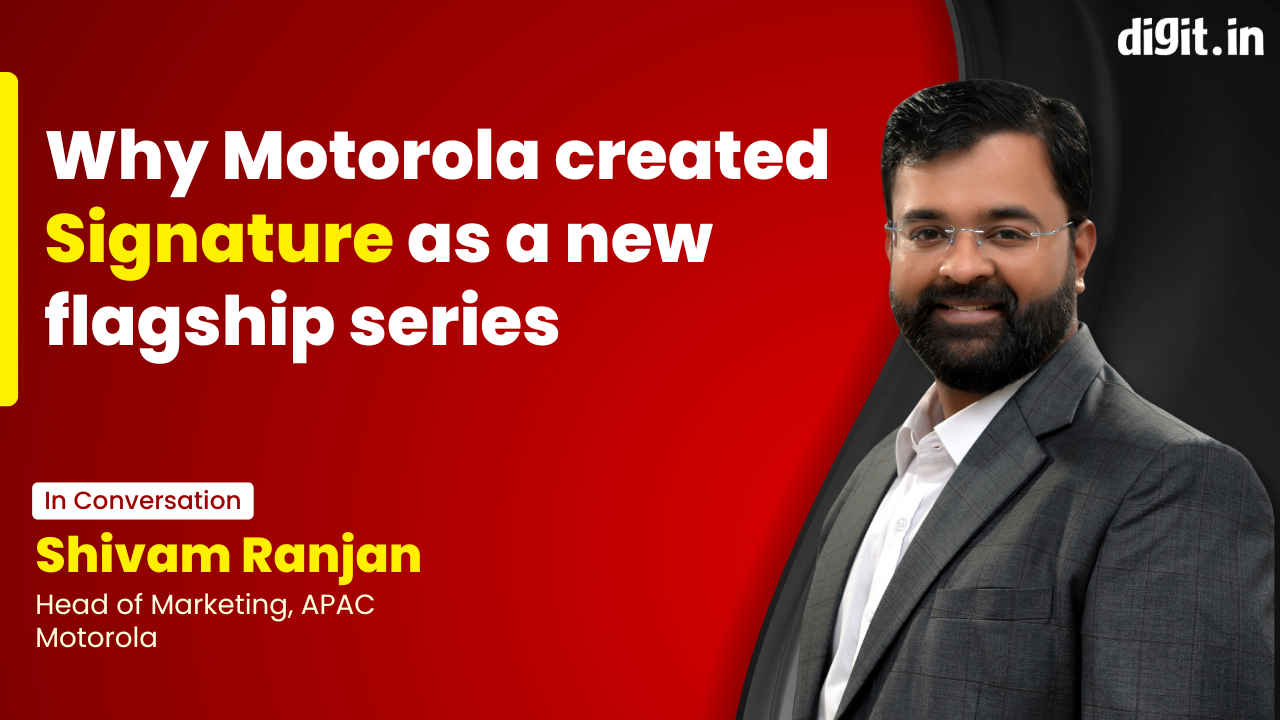

Motorola has launched its new smartphone lineup, called Signature, starting at Rs 59,999. The Motorola Signature is the brand’s entry into the mainstream flagship segment. It features a traditional candy-bar form factor that positions it alongside the existing Razr and Edge premium offerings.
 Survey
Speaking with Digit, Shivam Ranjan, Head of Marketing, APAC at Motorola, shared insights into why the company felt the need to create an entirely new flagship series and how Signature differs from everything else in Motorola’s current lineup. What was concluded from the discussion is a carefully thought-out strategy where each premium franchise serves a different purpose, with Signature filling a specific gap that neither the foldable Razr nor the value-focused Edge could address.
Filling a gap in the portfolio
When asked about the thinking behind creating a new Signature device, Ranjan explained that Motorola already had a strong presence in the premium segment, but there was a specific gap that needed to be addressed. Till now, the company had three main franchises: Moto G for the mass market, Moto Edge for the premium segment, and Razr for the foldable flagship space. However, something was missing.
‘What we felt was that there was a need for a mainstream flagship franchise, which we lacked,’ Ranjan said. ‘We did have Edge and Razr in the premium segments, but both of them stood for something else.’
Each of Motorola’s existing franchises has a clear identity and purpose. For instance, the Razr line is associated with foldable technology. ‘Razr stands for iconic or bespoke innovation when it comes to foldable technology. It takes design and form factors into consideration and brings those experiences to life,’ Ranjan explained, adding that many people still remember the V3 flip phone. Because the form factor is so important to what Razr represents, the company didn’t want to touch that identity by extending it to traditional candy-bar phones.
Meanwhile, the Edge series has its own distinct positioning. ‘When you look at Edge, the proposition is to bring premium experiences to consumers through cutting-edge technology at more accessible price points,’ Ranjan noted. Edge targets a younger group, particularly Gen Z consumers, offering flagship features at price points that don’t break the bank. It’s about delivering value and making premium technology accessible.
Motorola Signature: A different kind of flagship
So where does Signature fit in? According to Ranjan, this new franchise addresses a different set of consumer needs entirely. ‘With Signature, the idea was to give that flagship experience to consumers, but with a mix of design and innovation focused on lifestyle experiences,’ he said. ‘That’s the difference. Signature has a very different positioning compared to both the premium franchises we already have, whether it’s Edge or Razr.’
The Signature is also created to meet a specific customer need. There are consumers in the flagship space who aren’t necessarily looking for the most affordable option or the most experimental form factor, Ranjan explains. They want a traditional smartphone design but with true flagship capabilities and experiences.
‘There is a lot of demand in the flagship space from consumers who are not just looking for affordability. They are looking for a mainstream candy-bar form factor device,’ he said. “If you combine these two things, we need one candy-bar flagship phone in that segment. We believed that the positioning of Razr and Edge was not what we wanted for our candy-bar flagship, which is why you see Signature.’
A true signature experience
When asked to summarise in one line why users should be excited about the new series, Ranjan’s response revealed the thinking behind Signature: ‘Motorola Signature is a truly signature experience. It’s beyond premium. It focuses on creating the perfect fusion of design, innovative technology, and lifestyle experiences.’
What’s worth noting is how Motorola managed to pack all these premium features without compromising on form factor. ‘When you pack so much into a device, typically devices become bulkier, heavier, and bigger,’ Ranjan said. ‘But we’ve maintained that distinction and differentiation by delivering a super-premium, super-slim, super-sleek device with a luxurious finish, premium lifestyle access, and incredible camera experiences. It’s the perfect balance of power, experiences, and design.’
More Signature devices
While the first Motorola Signature device has just launched, this isn’t intended to be a one-off product. ‘Since this is a new franchise, Motorola Signature is the first device of the franchise. You will see more devices as part of this franchise.’
However, he stopped short of providing specific details about future models or variants. ‘We don’t commit to future details of our portfolio,’ he noted.
The flagship strategy
In terms of product cycles and release strategy, Signature will follow what Ranjan calls ‘a flagship strategy,’ which aligns more closely with the Razr approach than the Edge lineup. The Edge series has seen various release patterns, with some variants like the Ultra appearing in certain years but not others. For instance, while the Razr had an Ultra variant last year, the Edge did not. But that doesn’t mean these options won’t return in the future.
‘The variants we launch in any franchise depend on consumer demand, market scenarios, and perspectives. These things vary year over year,’ Ranjan explained.
Signature: A device made with care
What becomes clear from the conversation is that Signature takes a different approach to flagship smartphones. Rather than focusing purely on specifications and features, Motorola has tried to create a device that connects with users on an emotional level, according to Ranjan.
‘Signature is a device we’ve created with a lot of love, care, and affection. We’ve tried to do something truly differentiated because we believe that consumers looking for a flagship experience are not just looking for hardware specifications,’ he said. ‘Of course, we’ve packed in the best hardware, but our approach with Signature is driven by creating an emotional connection with consumers through lifestyle experiences.’
The 24/7 concierge service is one of the key parts of Signature’s lifestyle-focused approach ‘We’ve also focused on effortless convenience through 24/7 butler services, available 365 days a year, catering to customised needs at the tip of your fingertips,’ he said. ‘This makes consumers feel valued and privileged, and builds aspiration for the device.’
Of course, lifestyle features wouldn’t mean much without the performance to back them up. According to Ranjan, Signature doesn’t hold back on the technical specifications. ‘Performance and AI are top-notch as well, with the Qualcomm Gen 5 platform, on-device AI, best-in-class camera ISPs, and more,’ he said.
But even with all this power under the hood, what Ranjan believes will really set Signature apart is how it all comes together. ‘Beyond all that, Signature stands out on a table full of flagship devices because of how it’s designed, how it feels, and how it approaches the user experience,’ he said. ‘It’s a device that truly lives up to its name: a Signature that is very different from anything else in the flagship market.’
The bigger picture
The launch of Motorola Signature shows how Motorola views the flagship market and where it wants to position itself. By creating three different premium franchises, Motorola has given itself the flexibility to address different consumer needs without diluting any individual brand identity.
Razr is for those who want a foldable phone, Edge targets buyers looking for good features at reasonable prices, and Signature is aimed at people who want a flagship phone with lifestyle extras.
Motorola Signature shows a clear shift in how the company is thinking about flagship smartphones. Rather than competing only on specifications, the focus is on design, camera performance, and added services that aim to enhance the overall user experience. It is positioned as a mainstream flagship phone that sits separately from the Edge and Razr lines, without overlapping their identities.
How well this strategy works remains to be seen. For now, Signature adds a new dimension to Motorola’s flagship lineup and gives buyers another option in the high-end smartphone segment.
Also read: Best Motorola Phones


