
Exclusive: How Indkal is betting big on Wobble smartphones
 Follow Us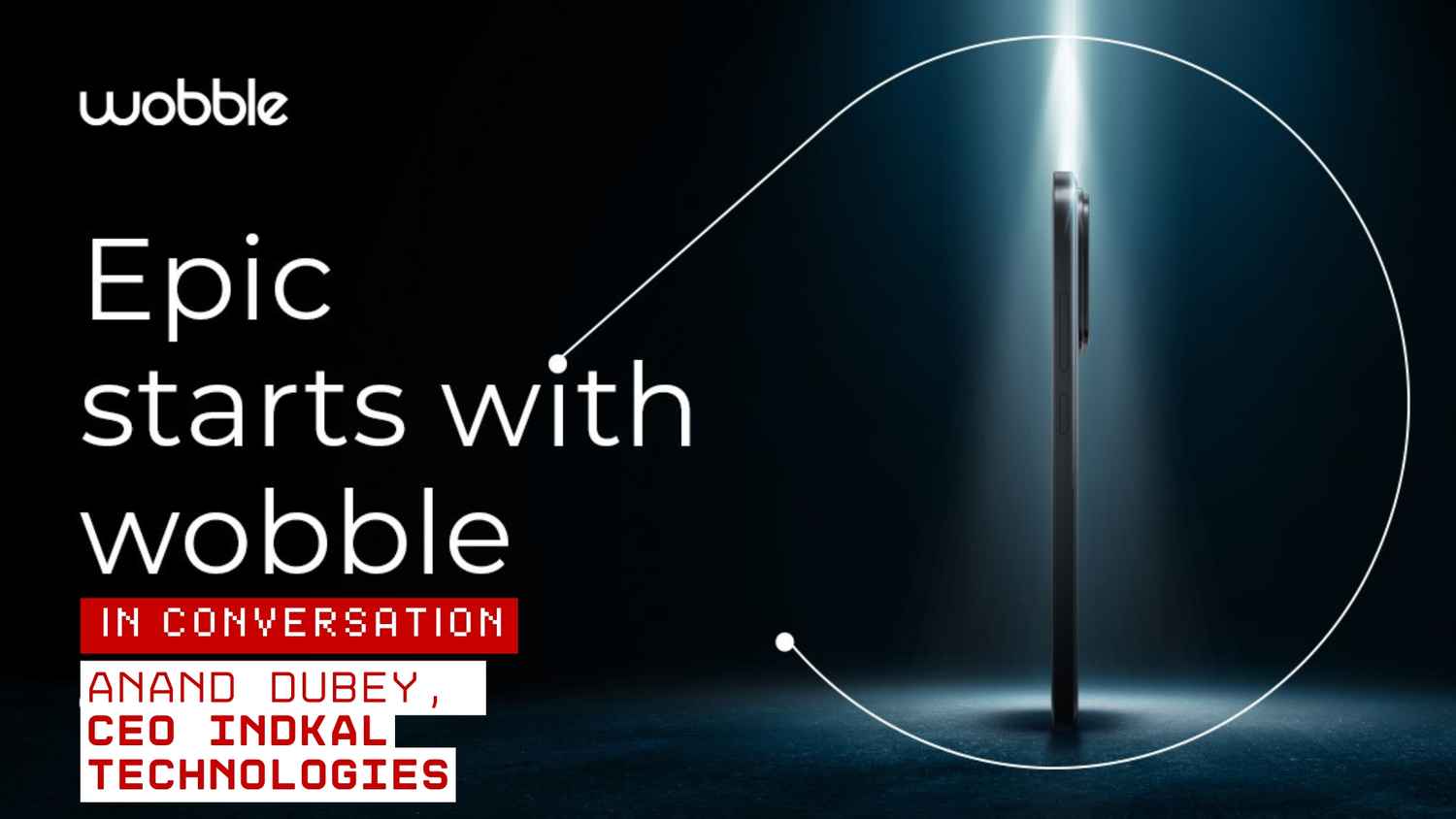

In a market where the smartphone race often feels like a treadmill of incremental upgrades and borrowed design philosophies, Indkal’s latest move is, by all definitions, audacious. The company, best known for manufacturing televisions and appliances under global brands like Acer, is now stepping into the most cut-throat product category on the planet with a brand of its own. It’s called Wobble, and its CEO, Anand Dubey, believes it represents something far deeper than a name or a logo.
 Survey
“We’ve been working towards this for nearly two years,” Dubey tells Digit in an exclusive chat, leaning into the idea as if he’s waited long enough to finally say it aloud. “Smartphones are the toughest consumer product category globally. To compete here, you need to build everything, from the value chain to consumer insight to technology, inside-out. That’s what we’ve done.”
For Indkal, Wobble isn’t a detour; it’s the next evolutionary step. The company continues to license and manufacture smartphones under the Acer brand, but Wobble is different. It’s designed, engineered, and conceptualised in India, for India, a phrase that often feels like lip service until you realise how rarely it’s actually true.
The Origin of a Name
In an industry obsessed with power words such as “Edge,” “Ultra,” “Pro,” and “Max”, Wobble sounds pretty unconventional. Dubey smiles when I ask about it. “All of our lives,” he begins, “are a sum of movements, small and large. Wobble is that smallest unit of movement, that nudge that takes you from thinking to doing.”
That definition feels oddly poetic for a phone brand, but also intentional. Wobble’s identity is built around motion, around people who are “active, dynamic, always moving.” It’s meant for India’s restless generation, the ones who move fast, chase ideas, multitask, and don’t necessarily want to worship at the altar of specs.
“Movement,” Dubey says, “isn’t just physical. It’s also emotional and intellectual. We wanted a brand that embodies that kind of kinetic energy.”
Over two years, Indkal conducted extensive focus groups to understand how Gen Z and young professionals interact with their phones. “We realised the conversation has shifted,” he says. “It’s no longer about megapixels or gigahertz. It’s about fluidity and how seamlessly a device fits into your rhythm.”
Design as Intent
When the first Wobble smartphone launches on 19 November, Dubey promises it will feel “young and aspirational” but also rooted in real function. Design, he insists, is not ornamentation, it’s intention.
“People will appreciate the design language,” he says, “but what they’ll remember is how responsive it feels.”
That responsiveness, he adds, has been a non-negotiable through development. “The experience has to be lag-free, consistent, and secure. We’ve gone with a near-stock Android setup, with absolutely no bloatware. We don’t believe in monetising user experience at the cost of performance.”
That decision places Wobble in rare company. While most mid-range phones ship with pre-loaded apps and monetised UI layers, Wobble is betting on minimalism. The company’s first device will ship with a close-to-stock Android experience, designed to stay lightweight and distraction-free.
“The less we interfere, the more control the user has,” he says. “And that’s where trust begins.”
Performance With Personality
Dubey doesn’t dwell on specs, at least, not yet. But he’s clear that performance won’t be an afterthought. “For every price segment we enter,” he says, “the core specs: camera, processor, overall performance, will sit at least a couple of notches above the competition.”
He hints that the first model’s camera system, powered by AI-driven computational enhancements, has been in development for over 15 months. “AI is an enabler,” he explains, “not a gimmick. What we’ve built will make the camera experience feel completely new.”
Indian consumers, particularly Gen Z, expect flagship-grade features at accessible prices. Wobble’s approach, then, is to compress that expectation gap, to make “premium” less about price and more about experience.
Building From the Inside Out
The Indian smartphone industry has long been dominated by outside-in design—devices conceived abroad, adapted slightly for Indian consumers, and then assembled locally. Dubey believes that model no longer works.
“Most of the technology we consume is designed elsewhere,” he says. “Even when products are made here, they’re developed from the outside in. With Wobble, we’re building from the inside out.”
He points out that the phone is completely designed and fine-tuned in India. The software, camera module, and much of the assembly happen domestically, though key components like chipsets are still imported. “Anything that can be sourced in India,” he says, “is sourced in India.”
“The level of localisation is very high,” he says. “We’re not trying to build a slogan. We’re trying to build capability.”
Trust Is the New Luxury
A new brand in a cynical market has to do more than launch; it has to convince. Dubey understands that better than most. To that end, Wobble enters the field with an advantage most startups can’t dream of: an existing national service network.
“Smartphones are not a product you can live without, even for a minute,” he says. “So service has to be immediate, local, and dependable.”
Indkal already operates across hundreds of retail and service touchpoints through its electronics portfolio, and that infrastructure now extends to phones. At launch, the company will have over 500 dedicated smartphone service centres across 200 cities, with the full list made public on launch day.
“It’s about creating trust even before the product reaches consumers,” Dubey says. “We want people to know where their nearest touchpoint is before they buy.”
Gen Z, Grounded Design
For Wobble, the target audience is unapologetically young. But Dubey’s interpretation of youth isn’t limited to age, it’s about the mindset.
“This generation doesn’t want generic products,” he says. “They want something designed for their lives, something that looks aspirational but also works flawlessly.”
That’s why Wobble’s design language and UX philosophy were guided by behaviour, not demographics. “We studied how people actually use phones,” he says. “What we found was that emotional utility, the feeling a product gives is as important as the technical utility.”
Its first phone, Dubey hints, won’t be the cheapest, nor the most expensive, but it aims to “feel flagship” in the areas that matter: design, camera, and day-to-day fluidity.
The Long Game
When I ask Dubey about first-year expectations: market share, revenue, growth, he pauses before answering. “Right now,” he says, “it’s about getting it right. Launch the product well, service our customers well, create awareness, build trust. Numbers will follow.”
Most new smartphone brands in India arrive with fireworks, celebrity endorsements, influencer blitzes, impossible claims. Dubey’s approach is deliberately quieter.
Indkal, he reminds me, is already a multi-brand company, and Wobble will sit alongside, not above, its existing portfolio. “Each brand represents a specific value proposition,” he explains. “Wobble is our expression of movement and youth. Acer continues to represent reliability and scale. Together, they form a portfolio that shares infrastructure and learnings.”
As manufacturing scales up, he adds, “we’ll be able to bring high quality at lower costs. That’s how we make products more accessible without diluting world-class standards.”
The Risk and the Reward
When I ask him about the biggest risk he’s taking, Dubey’s answer is quietly revealing. “I don’t see it as a risk,” he says. “We’re infatuated by the fact that we’re building something dynamic. We’re part of this young India that’s defying the old rules, where people don’t just consume global brands but create them.”
He credits India’s evolving infrastructure, both physical and policy, for enabling this kind of ambition. “What’s changed in the last few years,” he says, “is that it’s now possible to build a large-scale institution that competes globally. Wobble is a natural translation of that philosophy. If you’re stationary, you’re not progressing.”
“Wobble,” he says, “isn’t just a smartphone. It’s a reminder that movement, no matter how small, creates progress.”


