
Microwave capacity guide: What size do you need?
 Follow Us
Smaller 20-litre microwaves are great for singles and couples with limited counter space.
25-litre options are the sweet spot for most Indian households.
While 30-litre and above models fit baking needs and serve families of four or more.
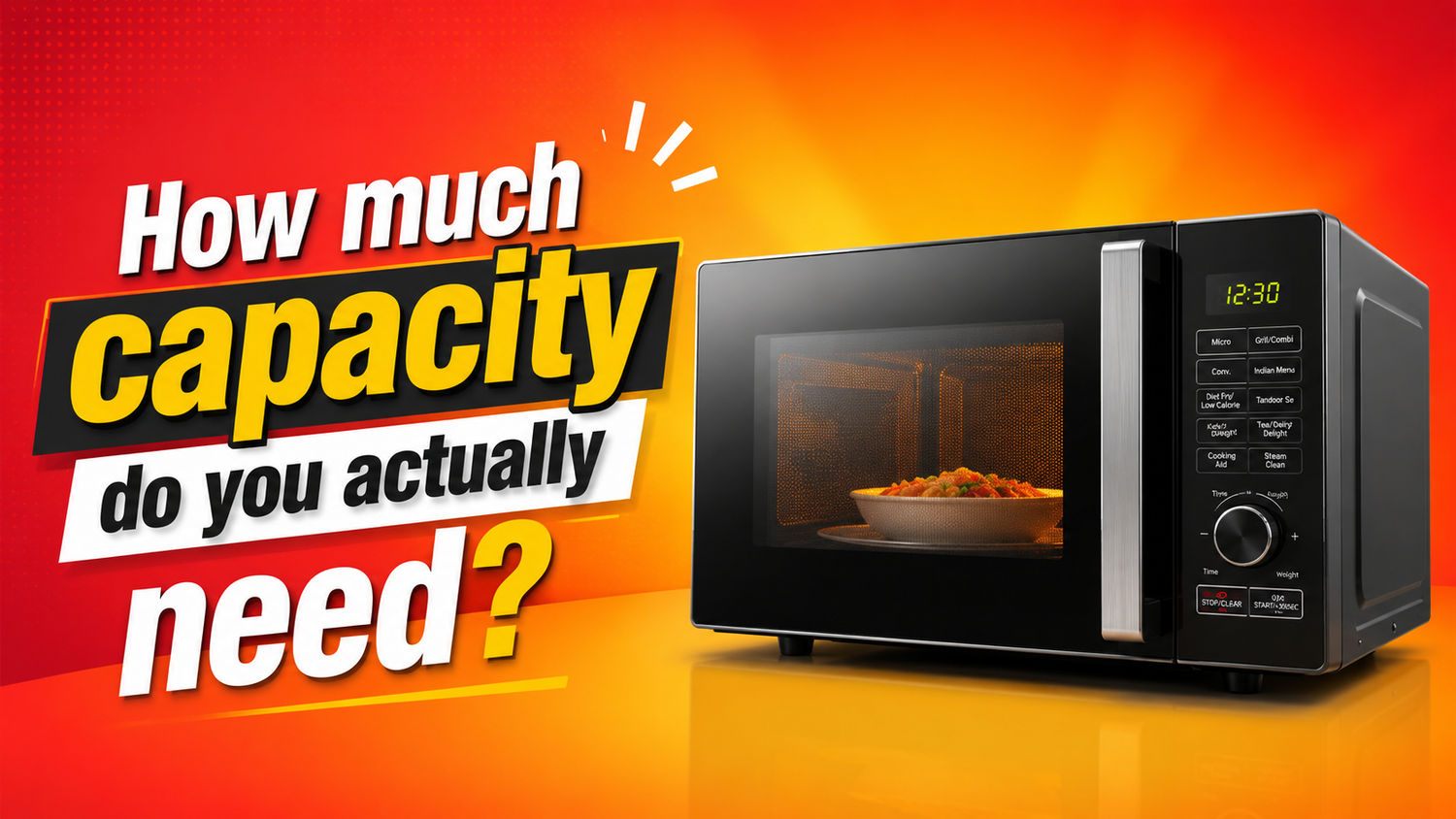

If you’re looking to buy a new microwave, I’m sure you would have thought that it should be pretty simple. I mean, aside from the basics, what other things are going to make a difference? Well, that’s where most people get it wrong, since capacity options are actually the ones that make the biggest difference.
 Survey
Microwaves are usually available in options that range from 20 litres to beyond 32 litres. The number on the box would tell you how much space is inside the product. But getting that one factor wrong would mean that you’re either getting something that does not fit your dishes or you’re unnecessarily paying for space that you’re never going to use.
But to avoid all that, here is a practical breakdown to help you pick the right size of microwave. Without wasting much time, let’s get right into it.
Why microwave capacity matters
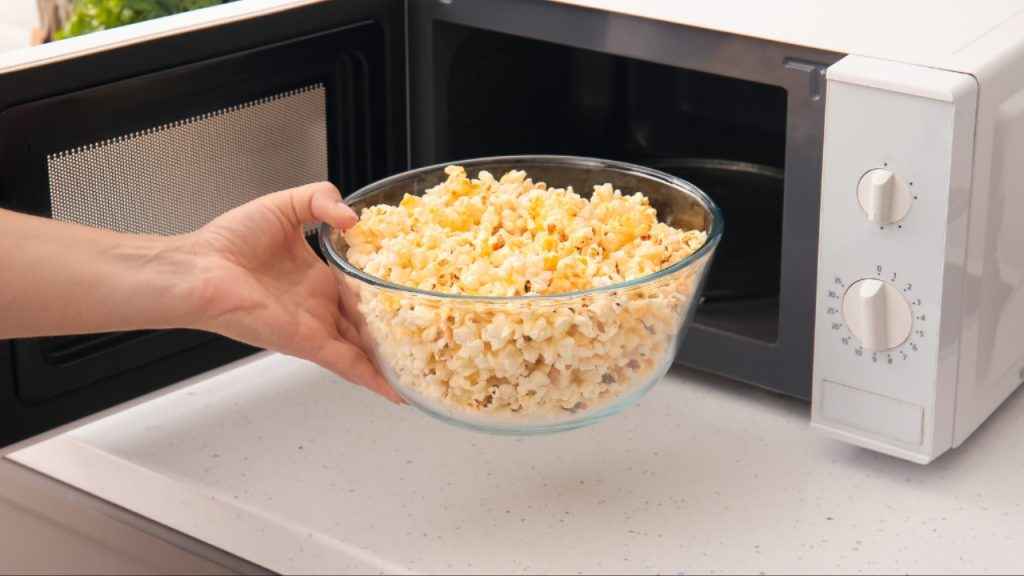
Before I get into how much microwave capacity you actually need, it’s important to understand why it matters. Well, microwave capacity is measured in litres, and it refers to the internal volume of the cooking chamber. A larger capacity would mean more room for bigger dishes and taller containers.
But because of the larger capacity, it would also mean a bigger physical footprint on your counter. Not only that, but higher power consumption and a higher price are also things to factor in. So the major goal here is to get something that matches your cooking behaviour and your household habits so that you don’t buy the wrong option. Let’s now get into the microwave capacities themselves and how big of a microwave you should get based on your needs.
Also Read: Dishwasher running costs explained: Water, electricity, detergent are big contributors
20-litre microwave
Starting with the smallest option, which is a 20-litre microwave. It is the entry point of the most options available in the market; for most households, it is enough. If you’re someone who lives alone or with a partner and primarily uses the microwave for reheating leftovers, defrosting, and heating beverages, a 20L model should be sufficient for most of your needs without taking much space on your counter.
On the inside, the turntable diameter in most 20-litre units would sit close to around 24 to 25 cm, which fits standard dinner plates and medium-sized bowls. If your cooking is primarily reheating and the occasional quick recipe, this is the most space-efficient and budget-friendly option.
Best for: 1-2 person households, hostel rooms and studio apartments.
25-litre microwave
Moving up the price ladder, you’re going to find microwaves in the 25-litre range. These are in the sweet spot for most Indian households. It bridges the gap between basic reheating and actual cooking without needing significant counter space.
The turntable size would typically measure somewhere around 28 to 30 cm, which is large enough for standard baking. If you have a microwave in the 25-litre range, you can bake smaller cakes and even grill chicken without any issue. It is a great option for families of three to four people, as it would handle everyday tasks like reheating multiple food portions, cooking rice, or the occasional baking sessions.
Best for: 3-4 person households, occasional bakers, and small kitchens.
30-litre and above
The 30-litre capacity segment is when you start thinking about microwave size for large family use in at least a 6-person household. If you bake regularly, a large model with 32 litres of capacity makes a lot of sense. Larger-capacity models also tend to come with higher wattage, which takes more electricity, but it speeds up cooking for large quantities of food.
The only real trade-off is the physical size itself, as at 30 litres and above, you will roughly need 50 to 55 cm of counter space. So before you purchase, ensure your counter space, as many buyers discover too late that their kitchen counter simply cannot house the microwave.
Best for: Large families of 4 or more people, and for those who frequently bake
Quick reference
If you’re still confused, check out this simple table. It covers all the major capacities that microwaves are available in, along with their ideal usage.
| Capacity | Ideal For |
| 20L | Singles and couples |
| 25L | Small families and casual bakers |
| 30L+ | Large families and regular baking |
It’s safe to say that a 25-litre microwave would cover a range of use cases without counter space being an issue. With that said, I hope this guide helped you figure out the microwaves you should get based on your household. For more such guides like these, keep on reading Digit.in
Also Read: What is a dishwasher? How it works and an installation guide for Indian homes
FAQs
What size microwave is best for a family of three or four?
A 25-litre microwave is the ideal sweet spot for a typical family of three to four people. It offers a larger turntable that easily accommodates standard baking dishes and multiple food portions, making it perfect for everyday cooking, reheating, and occasional baking without taking up too much counter space.
Can you bake cakes or grill in a 20-litre microwave?
A 20-litre microwave is primarily designed for basic tasks like reheating leftovers, defrosting food, and warming beverages, making it best for singles or couples. Because of its smaller internal volume and turntable size, it cannot comfortably fit standard baking dishes or handle heavy baking and grilling needs.
What should I check before buying a 30-litre or larger microwave?
Before buying a 30-litre or larger model, you must measure your available kitchen counter space. These large-capacity appliances have a significant physical footprint and generally require at least 50 to 55 cm of counter width.


