
Every product starts with a problem, not an idea: Dyson’s Nathan Lawson McLean
 Follow Us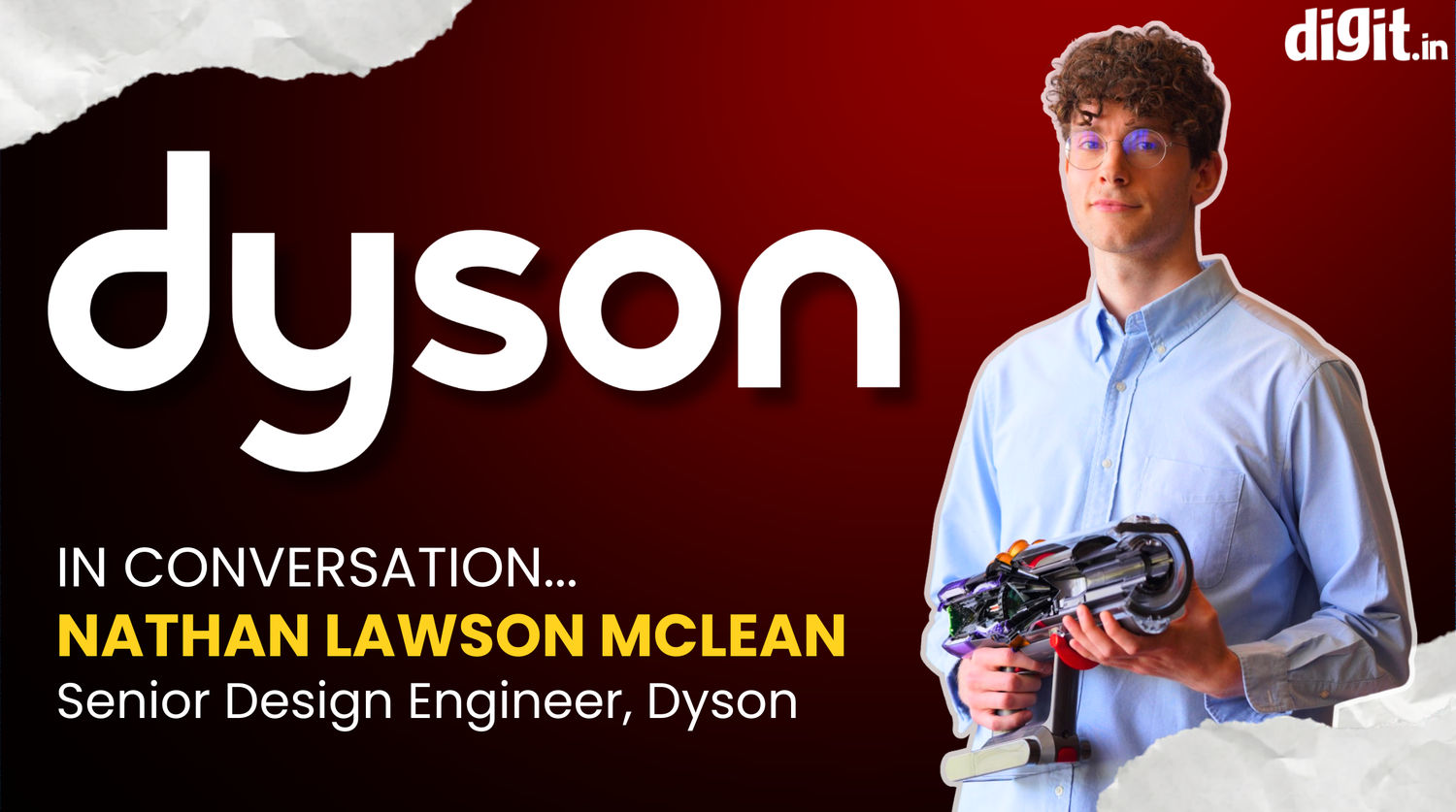

Few companies have managed to build a reputation quite like Dyson. The company started with the world-famous Dyson DC01 vacuum cleaner in 1993, but has since expanded its product line with a variety of air purifiers, hair care, and robotic cleaning systems. Of course, the brand is also quite synonymous with engineering-led innovation and thoughtful design. But what actually happens behind the scenes before a Dyson product reaches consumers? And where does the company see the future of home technology heading? To discuss these points in detail, I had a chance to sit down with Nathan Lawson McLean, Senior Design Engineer at Dyson, to understand how ideas evolve into products, the engineering challenges hidden inside seemingly simple machines, the growing role of AI and automation, and why Dyson believes there’s still plenty of room for innovation in home cleaning. Here’s our conversation.
 Survey
Also read: Best phones for playing BGMI in 2026: iQOO 15, OnePlus 15 and more
Q. Every Dyson product starts as an idea. Can you tell me how an idea is born at Dyson and what the journey looks like before it becomes a product people can buy?
Nathan Lawson McLean: Well, I’d say every product starts with a problem, not an idea first. We’re always looking to solve real-world problems. One example is our dust illumination technology that you now see across most of our cordless vacuum range. It’s all about revealing hidden dust around your home. That actually started inside our labs in the UK. Someone had brought in an enormous green laser after their child’s party and noticed that particles in the air and smoke became illuminated when the laser was shone around.
We thought, ‘What can we do with this?’ So we took a hot glue gun, attached the laser to an existing vacuum cleaner head, got down on the floor and started experimenting with different angles. When we found the right angle, it illuminated everything in front of it, including hidden dust. That was just the beginning.
From there, it goes through prototype after prototype before it even leaves the lab. We show it to our chief engineers and founders, James and Jake Dyson, and then it begins to gather momentum. We create more formal prototypes and take them through testing.
You’ve seen some of the amazing labs we have here in Singapore at St James Power Station, where we really put products through their paces using Dyson-specific test methods that mirror real-world conditions. From impacts to drops and everything in between, that’s where we refine products and prepare them for manufacturing.
The final result became the cleaner head you now see on the Dyson V16.
Q. A Dyson vacuum or purifier looks simple from the outside. I want to know, what’s one piece of engineering inside these products that most people never realise is incredibly complex?
Nathan Lawson McLean: There are many components inside a Dyson purifier. You’ve got the Air Multiplier technology, the impeller and the filter. The impeller is incredibly important because it’s attached to the motor and is responsible for drawing air in and pushing it through the filtration system and Air Multiplier.
Noise is becoming more important than ever in people’s homes, alongside filtration performance. It’s a balancing act. You want strong performance without drawing too much power or generating excessive noise.
The motors inside our fans, and particularly the impellers, are incredibly carefully engineered. We use computational fluid dynamics here in this building and across our global development centres to constantly refine them.
Today, artificial intelligence is helping us run thousands of simulations, allowing us to maximise performance, minimise acoustics and ensure products are suitable for home environments.
Q. Dyson does everything from research and testing to engineering and manufacturing. How do you make sure that all of this work translates into a product that performs reliably in someone’s home, whether they’re in Delhi, London or any place in the world?
Nathan Lawson McLean: It starts with an incredible team of designers, engineers and people across the entire operations and supply chain network. Once we have an idea and a working prototype, we put it through rigorous development and testing. That includes verification, validation and all the work we do in our labs.
But what’s equally important is getting products into real homes.
For example, our Spot and Scrub AI robotic vacuum went through thousands of hours of user trials globally, from the US to India and Singapore. It was even tested in James Dyson’s own home.
All of this helps ensure products are genuinely fit for real-world use.
Q. Sir James Dyson often talks about creating technology that lasts and leaves a lasting legacy. How does that philosophy influence the way Dyson teams think and work today?
Nathan Lawson McLean: I think when people talk about design and engineering, it’s ultimately about solving problems in ways that are usable and intuitive. It’s also about making sure the products we design genuinely last.
For instance, take the Dyson V16. We’ve minimised wall thicknesses down to around one millimetre while carefully selecting materials such as the polycarbonate used in the bin. That’s all done to ensure products pass our design and engineering tests and are built to last.
At the same time, we’re being incredibly efficient with material usage.
When I think about products leaving a legacy, I think about products that are useful, durable and capable of lasting for many years with proper maintenance.
Q. Dyson built its reputation on vacuum cleaners, but recently we’ve seen a bigger focus on wet-floor cleaning. What made Dyson feel there was still a problem worth solving in a category that’s actually been around for generations?
Nathan Lawson McLean: People are more aware of health and hygiene inside their homes than ever before. They’re no longer just vacuuming. They’re mopping as well, and often using multiple specialised tools to achieve the level of cleanliness they want.
When it comes to cleaning floors, there are stains and stubborn messes that require more than just dry pickup and agitation. You need wet cleaning systems too. That’s why we’ve started combining the dry-cleaning expertise we’ve developed over the past 30 years with the wet-cleaning knowledge we’ve built in-house over a long period of time.
You first saw that with the WashG1, and now across our cleaner-wash range and the PencilVac Wash.
People have different needs, and we’re trying to provide different solutions to help them achieve a deeper level of cleanliness in their homes.
I know wet cleaning is particularly popular in India. People often vacuum or sweep and then mop afterwards. In one of our global wet-cleaning studies, we found that people in India clean incredibly frequently, almost every two days, using both dry and wet cleaning methods.
Q. Most people believe that if they’ve vacuumed or mopped their floor, it’s clean. During your research, what surprised Dyson the most about the reality of how people clean their homes?
Nathan Lawson McLean: Through our global wet-cleaning study, one thing that surprised us in India was how many people don’t change their mop water between rooms. They use the same cloth and bucket throughout the home. What that often means is that while they may remove one stain effectively, they’re actually spreading dirty water around the house. It can even become a breeding ground for bacteria.
In some ways, they’re doing more harm than good.
That insight helped inform the continuous self-cleaning roller systems we now use across products such as Clean and Wash, Spot and Scrub AI and PencilVac Wash.
These systems continuously hydrate the roller, replenish clean water and scrape away dirty water. That means we’re not smearing dirt around and can remove stains much more effectively.
Q. AI, sensors and automation are becoming a bigger part of home technology. How do you see the home of the future evolving, and how do you make sure these technologies remain useful rather than complicated?
Nathan Lawson McLean: Exactly. It’s about solving real problems and being useful, not simply adding complexity. At Dyson, we’ve been developing perception systems for around 30 years, going back to our earliest robotic vacuum concepts.
I like the word ‘perception’ because it’s about understanding the home and understanding user intent. What does the user want to achieve? What’s the most intuitive way for them to interact with a product? How can products react and predict what users need?
You’ll continue to see more of that. Previously, we used sensors primarily on robots such as the Dyson 360 Eye. Then we introduced Time-of-Flight sensors on products like the Supersonic Nural to measure proximity and protect scalp health.
More recently, our latest purifiers include camera systems that can intelligently track users around the home.
We’re incredibly excited about what perception, automation and predictive analysis can do, both in existing categories and in entirely new categories yet to come.
Q. Looking ahead five or ten years, what excites you most about the future of floorcare and home technology, and what challenges do you still think need solving?
Nathan Lawson McLean: We can never comment on what we’re developing in the labs or discuss our future product roadmap.
What I can say is that people are always looking for a deeper level of cleanliness. More than ever, they’re aware of health and hygiene in their homes.
I’m particularly excited about products like the PencilVac Wash and the lightweight PencilVac format, which I personally worked on.
Also read: OnePlus Nord CE 6 vs Nord CE 5: What you are getting under Rs 35000 in 2026
Technology naturally moves towards becoming smaller, lighter and more powerful. Motors become more compact, batteries become denser, and users expect more capability from their devices. That’s why multifunction machines that can perform both wet and dry cleaning while remaining easy to use and maintain are so important.
Ease of maintenance is a critical part of the cleaning process itself.
Those are some of the challenges and opportunities we see on the horizon, and there’s still a long way to go.


