
Siri’s biggest reinvention yet? Why Apple is betting its AI future on a smarter assistant
 Follow Us
Siri can now understand on-screen content, remember conversational context, and execute multi-step actions across apps.
Apple is combining on-device AI, Private Cloud Compute, and external models to deliver advanced intelligence while emphasizing privacy.
The new Siri could drive future iPhone upgrades and become the foundation for Apple's broader smart home and AI hardware ambitions.
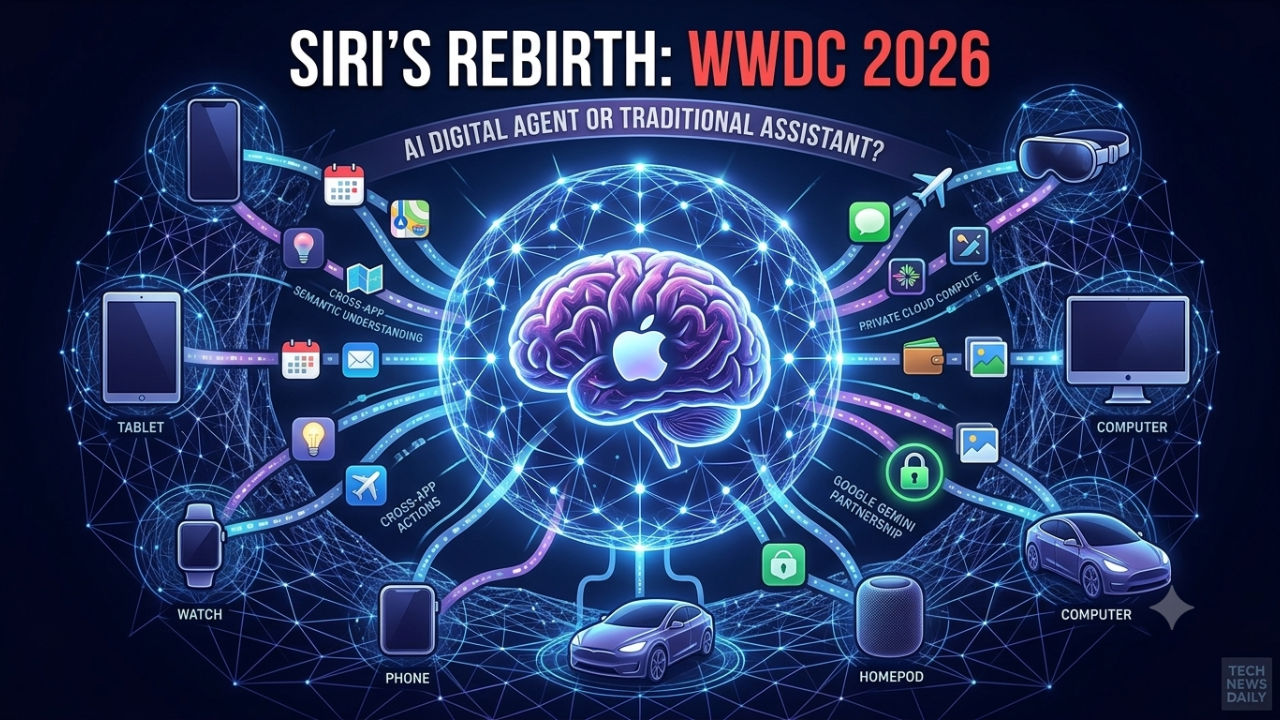

For over a decade, Siri has been one of the favorite voice assistants. Yet over time, it became increasingly overshadowed by newer AI systems capable of reasoning, generating content and understanding natural conversations. On the other hand, rivals like Google, OpenAI and Microsoft have been aggressive in this space.
 Survey
But WWDC 2026 finally changed this. Apple’s latest announcement is more than a software upgrade. The company is now attempting to reposition Siri as the central intelligence layer across its ecosystem, one that understands context, performs actions across apps and works more like a digital agent than a traditional voice assistant.
From voice assistant to digital operator
Historically, Siri has been largely reactive. The users issued commands, Siri responded and the interaction ended there. But, the new version is designed around continuity and context. Instead of treating every request as a fresh command, Siri will now maintain conversation awareness across multiple interactions. A follow-up question no longer requires repeating information that was already discussed moments earlier.
More importantly, Siri now has visibility into what is happening across the device. Apple says that the assistant can understand information that is currently on your screen, whether it is an address in a message, an event invitation, a receipt, or a photograph.
For example, a user receiving an event poster in Messages could ask Siri to extract the date and add it to a calendar. A receipt shared in a conversation could potentially be analysed and split between contacts without switching between multiple apps.
Advantage Apple believes only it can offer
Unlike most AI assistants, which primarily exist as standalone apps, Apple is now trying to integrate intelligence directly into the operating system itself. The company’s approach relies heavily on what it calls a semantic understanding of personal data stored across devices. Emails, messages, photos, calendars, reminders and app activity can be connected to create a better understanding of user context. Although even after Apple promised privacy, I believe that it is creepy if a machine knows all of your details.
But speaking of the good, let’s take an example. Suppose you are asking when a family member’s flight is arriving and what they asked you to bring. Instead of searching the web, Siri could theoretically pull information from airline notifications, text conversations and calendar entries to construct a useful answer.
This is possible largely because Apple operates the hardware, operating system and many of the services running on its devices itself. This makes it completely different from competitors and, honestly, not available anywhere else.
Privacy is promised, but how?
As I mentioned above, AI has created an uncomfortable trade-off for users. More capable systems typically require more data. And Apple’s response to it is Private Cloud Compute, which combines on-device processing with cloud-based AI resources when additional computing power is required.
The company says requests that leave the device are processed in a way that prevents data from being permanently stored. Apple has repeatedly positioned this architecture as a privacy-first alternative to cloud-heavy AI models that rely extensively on user data.
Whether consumers view privacy as a deciding factor remains to be seen. However, it is clear Apple intends to make it a central part of its AI narrative. At a time when concerns around data collection, surveillance and AI training practices continue to grow, privacy may prove to be one of Apple’s strongest competitive advantages (only if true).
Apple and Google are friends?
Yet another aspect that raised eyebrows was the partnership with Google. The company rebuilt Siri, which is backed by Gemini. But it was not like this earlier. Apple is now integrating external large language models for broader knowledge-based tasks while retaining control over user data, system integration and device-level intelligence.
Also Read: WWDC 2026 recap: iOS 27, macOS Golden Gate, Siri AI and everything Apple announced
This suggests that Apple is now thinking that winning the AI race may not require building the best model in every category. Instead, success may depend on owning the interface through which users access AI. In that scenario, Siri becomes less of a chatbot and more of a traffic controller.
This matters beyond iPhone
As shown at the WWDC 2026, this move has an impact well beyond iPhones. For years, Apple’s smart home ambitions have been constrained by the limitations of its assistant. HomePods, smart displays and connected home devices become more useful if the intelligence layer controlling them can understand context and execute complex actions.
A smarter Siri could therefore become the foundation for Apple’s next generation of connected hardware. The same logic applies across Macs, iPads, wearables and future devices that may rely heavily on conversational interfaces.
Still, there are challenges
It is true that Apple has already lagged behind the competitors and the fact that the Siri AI will be available in beta in the coming months still raises the same question: where is Apple in the race? Many headlines that say that features are rolling out ‘gradually’ will make you think that Apple is catching up, but the reality is- competitors already have mature AI products in consumers’ hands.
Hardware compatibility can be another problem. Advanced AI features will need powerful neural processing hardware, limiting support to newer Apple devices. Critics are likely to argue that AI is becoming another mechanism to accelerate hardware upgrades.
Lastly, Siri’s ability to perform actions across apps will also depend on developer adoption. Apple can obviously offer a framework, but third-party developers must build support for those capabilities. If it is slow, Siri’s most ambitious promises may take longer to become reality.


