
NASA Athena supercomputer explained: It’s much faster than your PC!
 Follow Us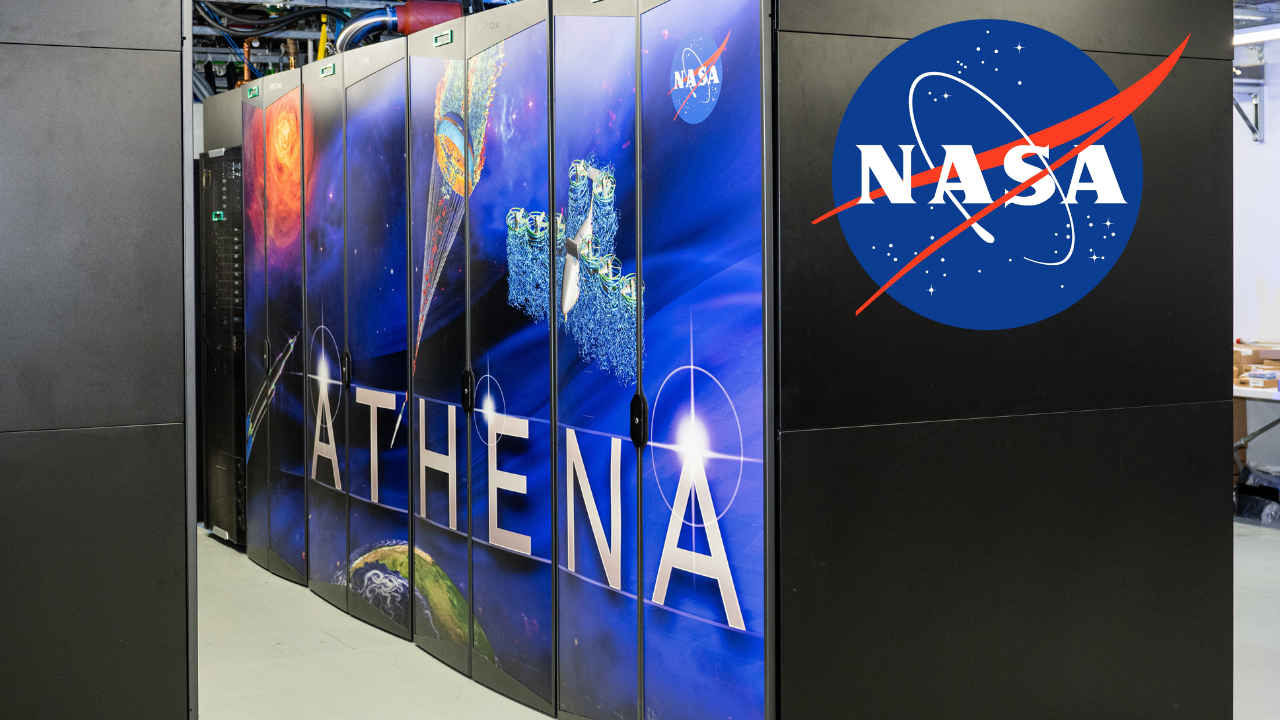

If you’ve ever felt the rush of adrenaline after hitting the power button on a freshly built DIY gaming rig, you know that personal satisfaction of seeing your components hum to life. You’ve got the latest silicon, RGB strips glowing like a neon city, and enough RAM to keep a hundred Chrome tabs open. But even the most beastly consumer PC is a mere candle flame compared to the roaring sun that is NASA’s Athena.
 Survey
Located at the Ames Research Center, Athena is NASA’s latest computational titan, designed to crunch the physics of the Artemis Moon missions and simulate the complex climate patterns of our home planet. While it looks like a series of monoliths in a sterile room, its DNA is surprisingly familiar to any PC enthusiast. To understand Athena, we have to look at it not as an alien machine, but as your desktop PC – evolved and multiplied by a factor of thousands.
Also read: CISA ChatGPT leak: Acting director Madhu Gottumukkala investigation explained
CPU: Hundreds of thousands of cores
In your home build, the CPU is the brain, likely a single chip with 8 or 16 cores. It’s plenty for gaming or editing 4K video. However, Athena doesn’t just use a “fast” chip; it uses an entire army of them. Athena is powered by AMD EPYC 9745 “Turin” processors.
While you might boast about a single CPU socket on your motherboard, each of Athena’s 1,024 compute nodes houses two of these 128-core behemoths. When you do the math, that’s hundreds of thousands of physical cores working in perfect parallel. Conceptually, they are doing exactly what your Ryzen or Core i9 does: executing instructions and feeding data into memory. But while your PC is a solo sprinter, Athena is a marathon start line with a quarter-million runners all moving in unison.
Also read: Meet Superagent: New AI agent analyst taking on Manus and Claude
RAM: Server-scale memory beyond gigabytes
Most enthusiasts today aim for 32GB of DDR5 RAM. It’s the “short-term memory” that keeps your open applications snappy. Athena treats memory with the same logic but on a scale that defies standard logic. Each individual compute node on Athena is packed with 768 GB of DDR5 memory.
If you multiply that across the entire machine, you get a total system RAM of 786 TB. This massive pool of memory acts just like your system RAM, it keeps simulation states and massive datasets ready for the processors so they never have to wait. It’s the same fast, temporary storage you use to play Cyberpunk 2077, just scaled up to hold the data for an entire planetary weather system.
Storage: Parallel filesystems vs. NVMe
When you want fast loading times, you grab an NVMe M.2 SSD. It’s fast, but it’s a single point of entry. If you tried to make thousands of CPUs talk to a single SSD, you’d hit a bottleneck instantly. Athena solves this by using parallel filesystems.
Think of it like a massive RAID array or a NAS cluster on steroids. Instead of one drive, the data is spread across thousands of storage devices working in concert. This allows the supercomputer to read and write huge datasets at speeds your desktop’s PCIe 5.0 drive couldn’t dream of, ensuring that the “Save” button for a galactic simulation doesn’t take a century to finish.
Networking: The fabric that binds a thousand nodes
Your PC likely connects to the world via a Gigabit or 10-Gigabit Ethernet port. It’s great for downloading games, but it’s too slow for Athena. Because Athena is composed of 1,024 separate nodes that must act as one single machine, the “networking” has to be instantaneous.
Athena uses the Cray Slingshot-11 interconnect. In PC terms, imagine a LAN switch where every single component can talk to another with incredibly low latency and bandwidth measured in hundreds of gigabits per second. It turns a room full of individual computers into a single, cohesive “computing fabric” where no node is left waiting for a message from its neighbor.
The GPU conundrum: A different kind of power
In a high-end DIY PC, the GPU is often the star of the show, handling the heavy lifting for graphics and AI. Interestingly, Athena’s current configuration doesn’t rely on dedicated NVIDIA or AMD graphics chips. Instead, it uses those hundreds of thousands of EPYC CPU cores to shoulder the entire workload.
It is essentially a “headless workstation” at a cosmic scale. While many modern supercomputers are adding AI accelerators, Athena’s baseline focuses on CPU scaling first, proving that sometimes, sheer multi-core muscle is the best way to simulate the turbulent vibrations of a rocket launch or the flow of air over a supersonic wing.
Also read: AlphaGenome explained: How Google DeepMind is using AI to rewrite genomics research


