
Meet Composer: Cursor’s 4x-faster model that writes, tests, and thinks code
 Follow Us
Cursor 2.0’s Composer redefines AI coding with 4x faster performance
Meet Composer, the agentic AI model that writes, tests, iterates
Cursor 2.0 integrates writing, testing, and debugging into one agentic loop

For years, the promise of AI-assisted coding has been tempered by a simple reality: the latency of the model-human interaction often slows down the overall development loop. A few seconds of waiting here, a few seconds there – it all adds up, breaking the flow state essential for deep work. That’s why the release of Cursor 2.0 and its cornerstone model, Composer, marks a significant inflection point, accelerating the agentic coding workflow to an unprecedented degree.
 Survey
Also read: GitHub Agent HQ explained: How it aims to create specialized AI agents for developers
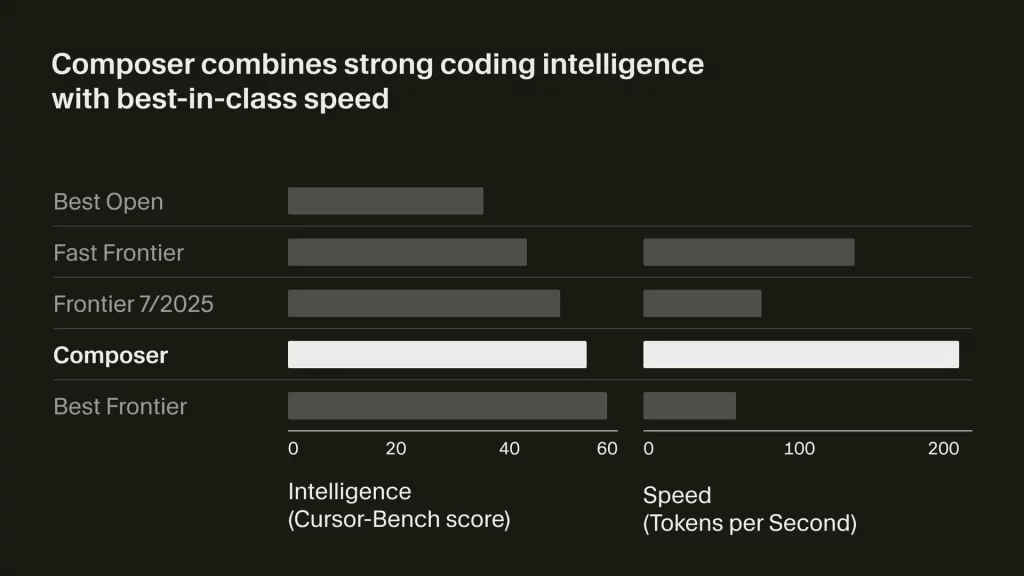
The headline feature of Composer is its staggering speed. This is a frontier coding model that is an average of 4x faster than other similarly intelligent models on the market. In a domain where waiting time dictates adoption, this is a revolutionary leap. Composer is engineered specifically for low-latency agentic coding in Cursor, designed to complete most turns and multi-step tasks in under 30 seconds. Early testers have reported that this rapid feedback loop feels “delightful,” restoring the sense of immediacy that developers demand. The model’s speed transforms what was once a disruptive pause into a collaborative conversation, allowing developers to iterate with the AI quickly and confidently.
Thinking and writing code
Composer doesn’t just write code; it “thinks” about the entire codebase, making it trustworthy for complex, multi-step tasks. Its intelligence is rooted in how it was trained, equipped with a suite of powerful developer tools, including codebase-wide semantic search. This capability allows the model to deeply understand and navigate large code repositories far more effectively than models limited to token windows alone.
When a developer asks Composer to implement a feature, refactor a module, or trace a bug, the model doesn’t just generate a naive suggestion. Instead, it leverages semantic search to locate relevant definitions, historical context, and analogous implementations across the entire project. This enables it to produce highly contextual, accurate, and idiomatic code suggestions that truly integrate with the existing architecture. For developers working on massive, entrenched projects, this ability to grasp the “big picture” of the code is perhaps more valuable than pure generation speed alone.
Writing, testing, and iterating
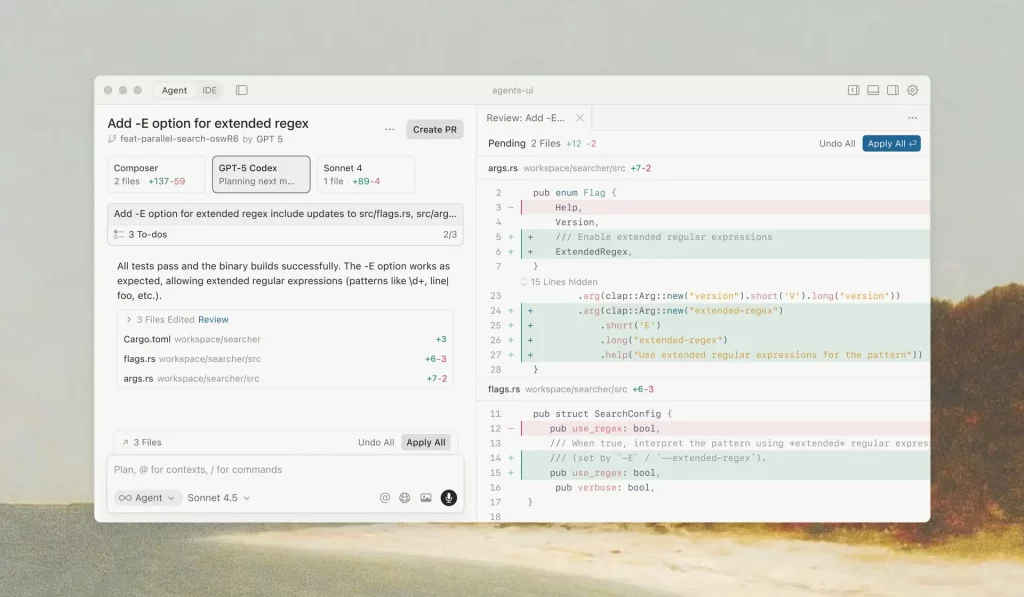
Composer’s capabilities are maximized by the new Cursor 2.0 interface, which fundamentally shifts the environment from a file-centric IDE to an agent-centric workspace. This design philosophy recognizes that the agent is not merely a suggestion engine but a full-fledged co-developer.
Also read: Can ChatGPT really care? OpenAI wants to make AI more emotionally aware, here’s how.
The most critical advancement in Cursor 2.0 is the direct integration of the “tests code” part of the development loop. As developers increase their reliance on agents, two bottlenecks emerge: reviewing the agent’s changes and verifying their functionality. Cursor 2.0 addresses the latter with a native browser tool. This means that after Composer writes a solution, the agent can immediately spin up the environment, run the code, simulate user interactions, and test its own work. If the tests fail or if the result is incorrect, the agent doesn’t stop, it receives the failure report and iterates on the code until the correct final result is produced.
Furthermore, the new interface is built to support running many agents in parallel, powered by tools like git worktrees. This allows developers to tackle complex problems by having multiple Composer models attempt the task simultaneously, providing a safety net and often improving the final output quality by combining or selecting the best result.
A new era of flow
Composer, paired with Cursor 2.0, represents a matured vision for agentic development. By providing a model that is 4x faster, capable of semantic reasoning, and integrated with native tools for self-correction and testing, Cursor has moved AI assistance past simple code completion and into a full-cycle development partnership. For the developer, this means less time waiting, less time reviewing, and more time focusing on the architectural challenges that truly matter. The new era of code flow has arrived.
Also read: Meet NEO: Humanoid robot designed as your home assistant for ₹18 lakh


