India’s May 7 nationwide civil-defence drill might be more than just a siren test – it could potentially be a full-scale rehearsal of a brand-new 5G Cell Broadcast warning alert system that the Ministry of Home Affairs (MHA), Department of Telecommunications (DoT) and the National Disaster Management Authority (NDMA) have been assembling since mid-2023.
 Survey
It’s not yet confirmed, but if your phone suddenly blares on May 7 as part of India’s civilian defence drill, it will most likely not be a text message squeezed through a congested SMS queue. It could be India’s first fully operational, 5G-era Cell Broadcast drill for a fast, multilingual, congestion-proof wireless alert system. Here’s what we know about it so far…


What is Cell Broadcast technology?
Cell Broadcast (CB) is a one-to-many channel of communication (riding on the radio layer) and can push a 360-byte message to every device camped on selected cells without knowing phone numbers. India’s implementation layers the open Common Alerting Protocol (CAP) on top and is orchestrated by C-DOT’s national Cell Broadcast Centre (CBC).
In terms of speed and efficiency, the 5G Cell Broadcast delivers a bilingual flash message to every compatible handset in the affected towers in less than 10 seconds flat, even when voice and data channels are jam-packed.
Why India’s choosing CB over SMS
For a simple reason, it’s about spectrum isolation – CB uses a dedicated signalling channel, while SMS shares control channels that saturate quickly in disasters. Secondly, it’s about speed, since a single CAP message registers on millions of phones in under 10 seconds, while mass SMS delivery can take several minutes in congested cells, according to GSMA.
The new CB tech allows precise geo-targeting of alerts, where operators broadcast only from cells inside a particular targeted area, avoiding “alert fatigue” outside the hazard zone. Lastly, since no phone numbers, subscriber data or SIM registration is needed, even visitors and roaming phones get the same protection through the CB alert system.
SMS struggles during crises like floods and earthquakes because its control channels are also used for call setup. When voice call volume surges, SMS speed plummets from thousands to just dozens of messages per second per switching center (MSC). In contrast, the GSMA emphasizes that Cell Broadcast (CB) remains operational even with network congestion, making it ideal for urgent public alerts.
How India’s alert system compares with Japan and US
Just like India, Japan’s system also uses CB but precedes the main text with a 90-byte “Primary Notification” to shave milliseconds in overall scale of message delivery, while the United States’ Wireless Emergency Alerts (EWA) adds rich templating (longer 360-char limit) for their alerts.
India’s CB-CAP alert system doesn’t allow opting out of any mock drills, while Japan and US’ systems allow opting out of drills. Where India’s wireless alert system supports English plus 10 local Indian languages, Japan and US’ alert systems only support two languages each.
According to India’s CB technology, messages can reach millions of handsets under 10 seconds flat, whereas for Japan that number’s anywhere between 4-20 seconds depending on the length of the message. For the US, this number is less than 12 seconds, according to reports.
5G, Android and iPhone behaviour in CB alert
Of course, 5G plays an important role in the CB alert system. You see, 5G-NR’s built-in CBCF directly multicasts alerts to phone towers (gNodeBs), cutting out old systems and speeding up delivery by seconds.
According to reports, Android 11+ and iOS 17+ will likely display a full-screen banner, override silent mode, and trigger the 8-second dual tone mandated by WEA/ETWS standards, ensuring users notice the alert even while streaming video or in Do Not Disturb mode.
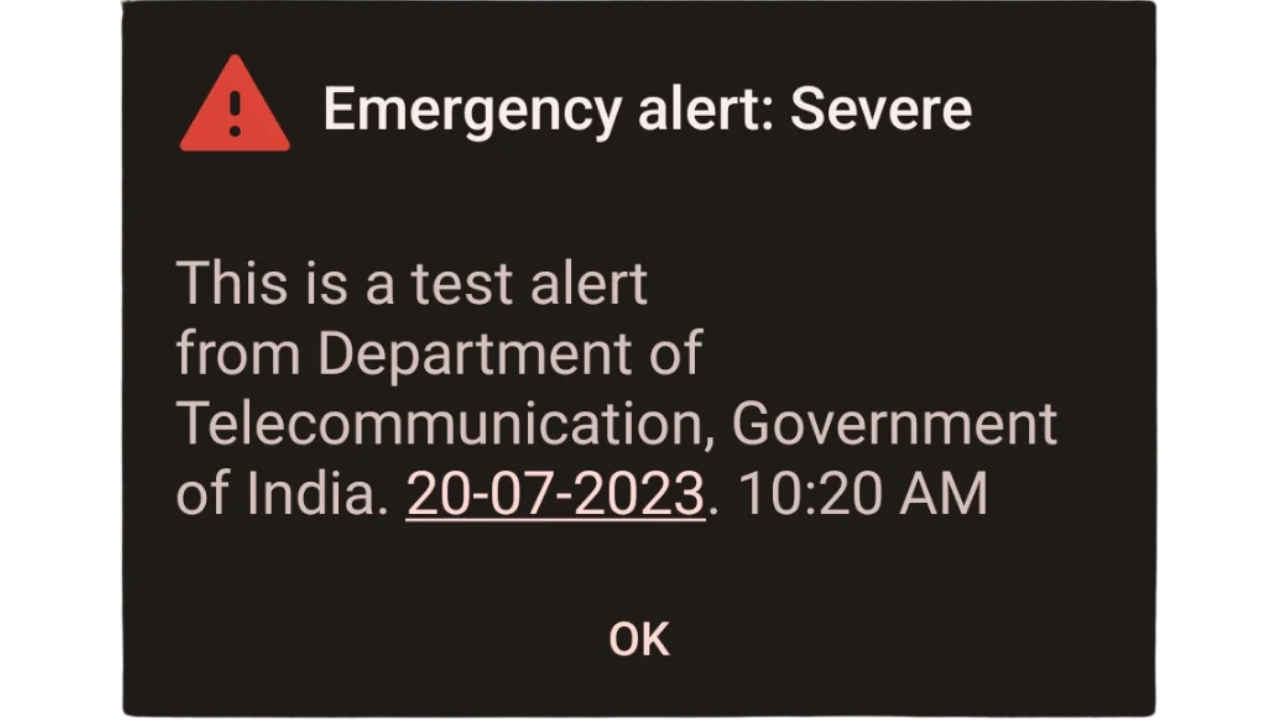
Results from past such tests in 2023 and 2024
Based on how Cell Broadcast works and previous tests, it seems unlikely that Airtel, BSNL, Jio or Vi will experience significant strain on their networks on May 7th civilian defence drill. CB sends a single message from each tower, regardless of how many people are connected, so it doesn’t create a “storm” of individual messages.
Past nationwide tests in 2023 and 2024, involving all major carriers including Jio and Airtel, showed no network congestion or increased load. Operators even kept their normal traffic data public during these drills, confirming that Cell Broadcast doesn’t significantly impact their network capacity. These tests indicate that the network performance indicators remained unchanged, and message delivery was quick. Based on this evidence suggests that India’s all four major telecom networks should handle the CB alert on May 7th without noticeable issues, if the government chooses to do so.
Also read: Govt issues high-risk warning for Google Chrome users in India: Is your device safe?
 Follow Us
Team Digit
Team Digit is made up of some of the most experienced and geekiest technology editors in India! View Full Profile


