
India AI Impact Summit 2026: Union Railway Minister Ashwini Vaishnaw on sovereign AI models
 Follow Us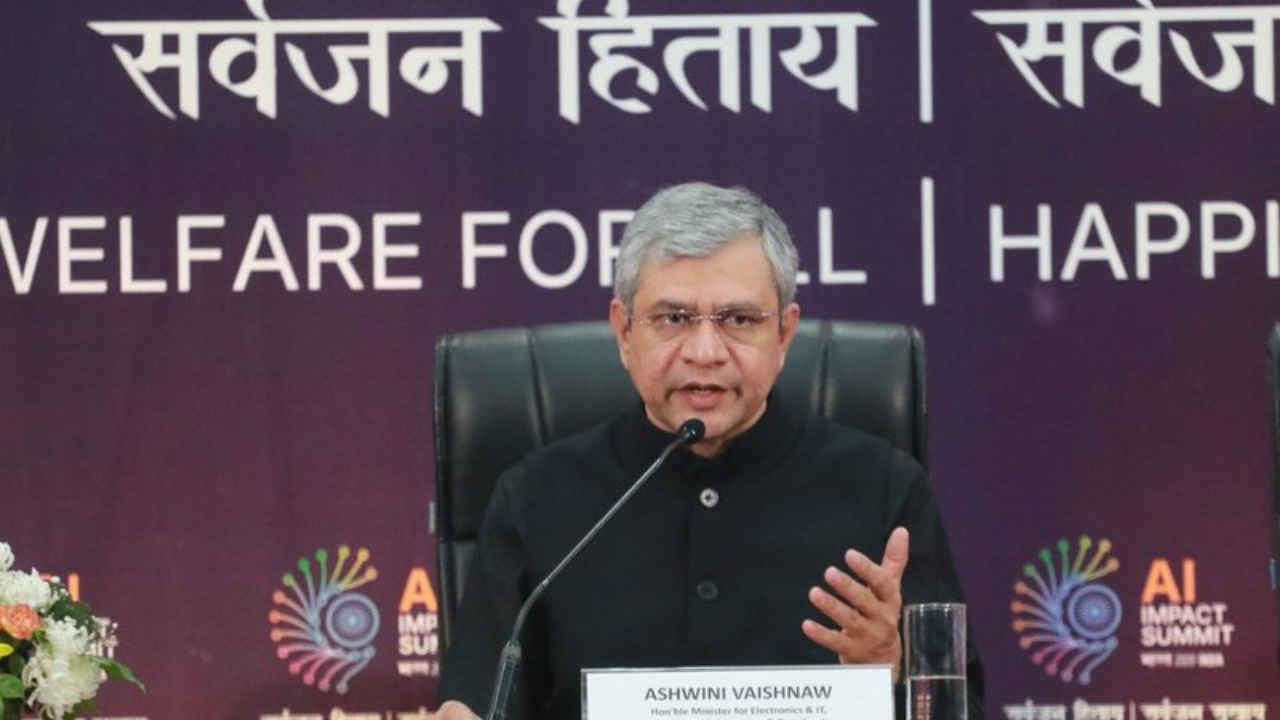

The India AI Impact Summit 2026 has marked a pivotal moment in the nation’s technological journey, with Union Minister Ashwini Vaishnaw delivering a powerful vision for Bharat’s role in the global artificial intelligence landscape. Speaking to a massive audience of young innovators and industry leaders, the Minister detailed how India is no longer just a consumer of technology but a primary architect of it. The summit highlighted a palpable shift toward strategic independence, underpinned by massive infrastructure investments and the exceptional performance of homegrown intelligence.
 Survey
Also read: DeepMind CEO Demis Hassabis on the “Golden Era” of scientific discovery by AI
Sovereign AI and global dominance
A central theme of the Minister’s address was the success of India’s sovereign AI models. These models, developed on frugal resources, have begun to consistently outperform established global benchmarks. Vaishnaw noted that several Indian models are now rating higher than some of the most prominent international counterparts on key technical parameters. This success has solidified India’s position as a top three AI nation globally, as recognized by Stanford’s latest rankings. By prioritizing “Sovereign AI,” the government is ensuring that the nation’s strategic requirements – ranging from data security to cultural context – remain under domestic control, reducing long-term dependency on foreign platforms.
Building a massive $200 billion AI stack
The scale of India’s ambition is supported by a staggering financial roadmap. The Minister revealed that the country is on track to see over $200 billion in investment across the five layers of the AI stack within the next two years. This capital is being directed toward deep-tech startups, cutting-edge mathematical innovation, and physical infrastructure. To fuel this growth, the government is aggressively expanding its compute capabilities. Building on the foundation of AI Mission 1.0, an additional 20,000 GPUs are being ordered to complement the existing 38,000-unit cluster, ensuring that researchers and startups have the high-performance resources necessary to compete at the highest levels.
Also read: Sarvam to Yotta: NVIDIA shows India AI ecosystem scale
Infrastructure democratization and clean energy
Unlike many nations where AI infrastructure is concentrated in the hands of a few tech giants, India is following a “Digital Public Infrastructure” model. Vaishnaw emphasized that the government’s goal is to democratize technology, making AI compute accessible to a vast section of the population. This infrastructure is also uniquely sustainable; more than 50% of India’s power generation capacity is now derived from clean sources. This green energy advantage is a critical differentiator for India, as it allows for the scaling of massive data centers and AI training facilities with a significantly lower carbon footprint than other global tech hubs.
Strengthening regulation and the deepfake challenge
While promoting rapid innovation, the Minister was equally vocal about the need for robust safety guardrails. He called for significantly stronger regulations to combat the growing threat of deepfakes, emphasizing the need to protect children and the broader society from digital harms. The government is currently in dialogue with industry stakeholders and Parliament to create a “techno-legal” framework that prevents the misuse of AI without stifling creativity. This balanced approach, modeled after the Digital Personal Data Protection Act, ensures that while innovation is encouraged, the “harmful impacts” are contained through technical solutions and clear legal boundaries.
Looking toward the future, the Minister highlighted the synergy between the AI and semiconductor missions. Under Semicon 2.0, India is shifting its focus toward chip design and the commercial production of memory chips, with a large-scale manufacturing facility set to begin operations shortly. This hardware foundation will be supported by a massive upskilling effort involving over 100 colleges and the AICTE. By integrating AI into the national curriculum and creating a steady pipeline of talent, Bharat is preparing its youth for what Vaishnaw described as the “Fifth Industrial Revolution,” ensuring that the country’s destiny remains firmly in its own hands.
Also read: India AI Impact Summit 2026: BharatGen Param 2, SarvamAI, and the rise of Indian LLM models so far


