
Google’s Universal Commerce Protocol explained: The new standard that lets AI shop for you
 Follow Us
Google’s Universal Commerce Protocol lets AI discover, negotiate, and buy products
How Google enables agentic AI shopping with the Universal Commerce Protocol
Google UCP brings chat-to-checkout AI commerce to Search and Gemini

We have spent the last decade getting comfortable with asking AI to find things for us. “Hey Google, what’s the best running shoe?” or “Find me a cheap flight to Tokyo.” But the next decade won’t be about finding, it will be about doing.
 Survey
Google has now officially ushered in the era of “Agentic Commerce” – a shift where AI agents don’t just recommend products, but actively negotiate, select, and purchase them on your behalf. At the heart of this shift is a new technical backbone called the Universal Commerce Protocol (UCP).
But what exactly is UCP, and how does it change the way we shop online? Here is everything you need to know about the new standard powering the future of retail.
Also read: After OpenAI, Microsoft adds Copilot Checkout to turn Copilot into an AI shopping assistant

What is the Universal Commerce Protocol (UCP)?
Think of the Universal Commerce Protocol (UCP) as a “common language” for AI agents.
Until now, e-commerce has been fragmented. Amazon has its own system, Shopify stores have another, and payment gateways like Stripe or Visa operate on their own rails. An AI agent trying to navigate this mess would hit a wall every time it tried to move from a search query to a checkout page.
UCP solves this by establishing a standardized set of rules that allow different AI systems to talk to each other across the entire shopping journey, from product discovery and cart management to payment and post-purchase support.
Because it is an open standard, it isn’t locked to Google. It is designed to work across different verticals and is compatible with existing industry protocols like Agent2Agent (A2A) and Model Context Protocol (MCP).
How It Works: From Chat to Checkout
The most immediate application of UCP is the elimination of the “click-through” friction.
Traditionally, if you search for a product, you click a link, land on a retailer’s site, add to cart, and enter your details. With UCP, Google is introducing a checkout feature directly within AI Mode in Search and the Gemini app.
Also read: Perplexity launches its own AI shopping experience, but with a catch
- Discovery: You ask Gemini for a recommendation (e.g., “I need a durable hiking backpack under $100”).
- Decision: The AI presents options. Thanks to new UCP data attributes, it knows not just the price, but answers to specific questions like “Is it waterproof?” or “Does it have a laptop sleeve?”
- Purchase: Instead of leaving the app, UCP allows the transaction to happen right there. You confirm the purchase using credentials stored in Google Wallet (and soon PayPal).
Crucially, the retailer remains the “seller of record.” Google isn’t becoming the store; it is simply providing the universal language that lets the store’s system talk directly to your AI agent.
The “Business Agent”: Your Virtual Sales Associate
UCP also powers a new consumer-facing tool called Business Agent.
Imagine walking into a store and asking a sales clerk, “Does this coffee maker work with reusable pods?” Online, finding that answer usually involves digging through FAQ pages or Reddit threads.
With Business Agent, shoppers on Google Search can chat directly with a brand’s specific AI. This agent speaks in the brand’s voice, knows the inventory intimately, and can answer nuanced product questions instantly. It is live now with major retailers like Lowe’s, Michael’s, and Reebok.
Who is backing this?
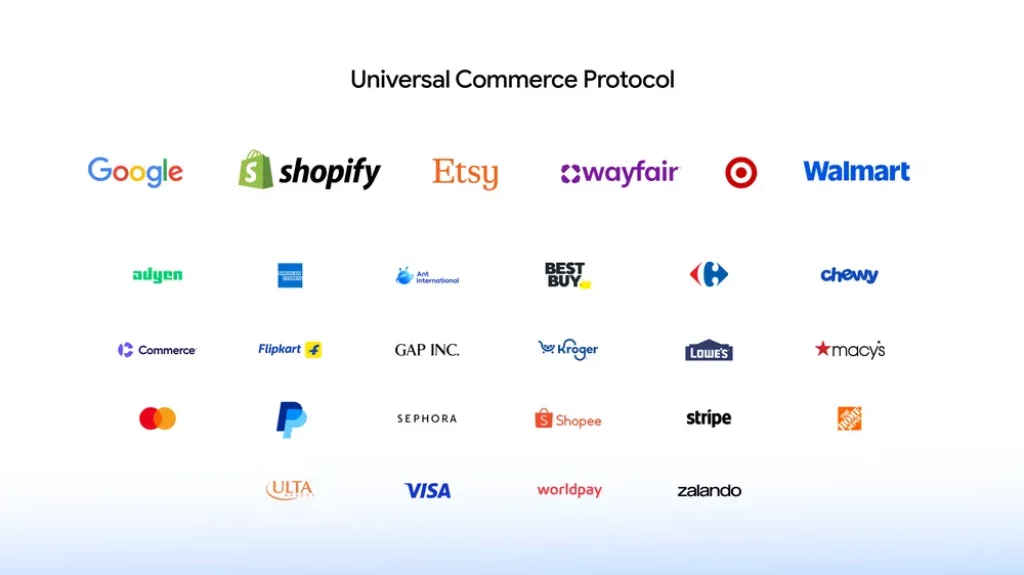
A standard is only “universal” if people actually use it. Google has lined up a massive coalition of heavy hitters to ensure UCP adoption. It was co-developed with:
- Retail Platforms: Shopify, Etsy, Wayfair
- Big Box Retailers: Walmart, Target, Best Buy, The Home Depot
- Payments & Fintech: Stripe, Visa, Mastercard, American Express, Adyen
This broad support suggests that UCP has a very real chance of becoming the default infrastructure for AI commerce, rather than just another proprietary Google project.
Why this matters for the future of Tech
This is the bridge between “generative AI” (which creates text/images) and “agentic AI” (which takes action). For users, it promises to end the fatigue of opening twenty tabs to compare products. For the industry, it represents a move away from keyword-based SEO toward “Conversational Optimization.” Retailers will no longer just compete on keywords; they will compete on how well their AI agents can communicate value to your AI agent.
As UCP rolls out globally in the coming months, the question won’t be “What did you buy?” – it will be “What did your AI buy for you?”
Also read: Agentic commerce explained: How ChatGPT Is testing AI’s role in shopping


