The Snapdragon X family splits into Elite (12-core, up to 4.3 GHz boost), Plus (8–10 cores, up to 4.0 GHz) and entry (8 cores, 2.98 GHz) tiers to match performance with price.
Built on Qualcomm’s custom Oryon microarchitecture, these chips prioritise sustained high clocks, efficient power management and low memory latency.
Every model includes a Hexagon NPU (30–45 TOPS) for AI tasks, flagship silicon can juggle multiple concurrent workloads without slowing down the CPU.

When Qualcomm launched its Snapdragon X series processors, it didn’t just release a single chip but gave us an entire range of ARM-based CPUs designed to challenge the traditional x86 dominance in laptops. But here’s what many don’t realise: the differences between these variants go far deeper than simple clock speeds and core counts. Each Snapdragon X processor represents a carefully engineered balance of performance, power efficiency, and cost considerations that could change how we approach laptop computing. So let’s explore the technical details that separate each Snapdragon X variant and what they mean for real-world performance.
 Survey
But before we get into details, here is a brief overview of all the Qualcomm Snapdragon X chips that are available at the time of writing:


| Chip Model | Cores | Base Frequency | Boost Frequency | GPU Performance | |
| X Elite | X1E-00-1DE | 12 | 3.8 GHz | 4.3 GHz | 4.6 TFLOPs |
| X1E-84-100 | 12 | 3.8 GHz | 4.2 GHz | 4.6 TFLOPs | |
| X1E-80-100 | 12 | 3.4 GHz | 4.0 GHz | 3.8 TFLOPs | |
| X1E-78-100 | 12 | 3.4 GHz | None | 3.8 TFLOPs | |
| X Plus | X1P-66-100 | 10 | 3.4 GHz | 4.0 GHz | 3.8 TFLOPs |
| X1P-64-100 | 10 | 3.4 GHz | None | 3.8 TFLOPs | |
| X1P-46-100 | 8 | 3.4 GHz | 4.0 GHz | 2.1 TFLOPs | |
| X1P-42-100 | 8 | 3.2 GHz | 3.4 GHz | 2.3 TFLOPs | |
| X | X1-26-100 | 8 | 2.98 GHz | None | 2.3 TFLOPs |
The Oryon architecture foundation
At the heart of every Snapdragon X processor lies Qualcomm’s custom Oryon CPU architecture, a complete design that represents years of development following the company’s acquisition of Nuvia. Unlike previous Qualcomm mobile processors that relied heavily on ARM’s reference designs, Oryon delivers a custom microarchitecture optimised for laptop workloads.
The Oryon cores feature an advanced out-of-order execution engine with improved branch prediction and instruction scheduling capabilities. Each core includes dedicated L1 instruction and data caches, with the instruction cache optimised for the mixed workloads typical of productivity applications. The L2 cache implementation varies across variants, but all feature high-bandwidth interconnects designed to minimise memory latency bottlenecks.
Also read: Should you buy an AI laptop in 2025?
What sets Oryon apart from both ARM reference designs and competing x86 architectures is its focus on sustained performance rather than just peak burst capabilities. The microarchitecture includes advanced power management features that allow cores to maintain higher frequencies for longer periods whilst staying within thermal envelopes typical of ultrabook designs.
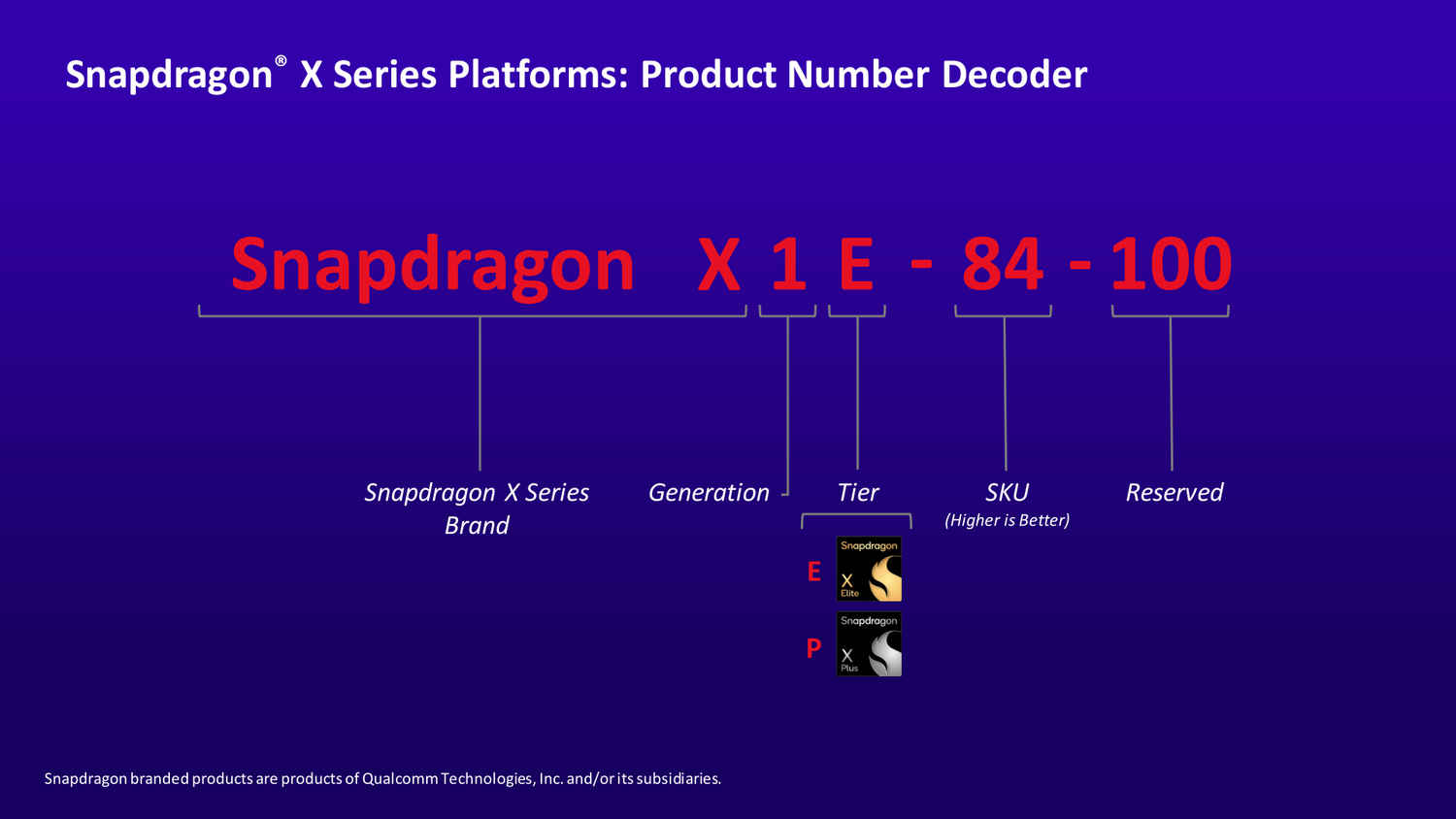
Before we jump into the different variants, it is important to understand what each letter and alphabet means in the processor name, or else it would be nothing more than a jargon for you.
Snapdragon X Elite series
The Elite series represents Qualcomm’s flagship offerings, designed to compete directly with high-end Intel Core Ultra and AMD Ryzen processors. All Elite variants feature 12 Oryon CPU cores built on a 4nm process, delivering substantial performance whilst maintaining excellent power efficiency.
X1E-00-1DE (Developer edition): Not available in the consumer-grade machines
The X1E-00-1DE stands as Qualcomm’s most powerful processor, featuring 12 Oryon cores that can reach up to 4.3 GHz in boost mode. This flagship chip delivers 4.6 TFLOPs of graphics performance through its Adreno X1-85 integrated GPU, making it suitable for content creation and light gaming. The processor includes 42 MB of total cache and supports LPDDR5x-8448 memory with an impressive 135 GB/s bandwidth. But sadly, it is not available in the consumer-grade machines, and we are yet to witness any machine powered by this CPU, not only in India but worldwide.
Also read: Best Qualcomm Snapdragon laptops under 1 lakh
X1E-84-100: The X1E-84-100 closely matches the flagship model with its 3.8 GHz base frequency and 4.2 GHz boost capability. It maintains the same 4.6 TFLOPs graphics performance and shares identical memory specifications with the top-tier model. The primary difference lies in the slightly lower maximum boost frequency, which translates to marginal performance differences in real-world usage.
X1E-80-100: Moving down the Elite lineup, the X1E-80-100 operates at a 3.4 GHz base frequency with boost capabilities up to 4.0 GHz. The graphics performance drops to 3.8 TFLOPs, though this still provides capable integrated graphics performance for most users. This processor strikes a balance between performance and power consumption.
X1E-78-100: The X1E-78-100 serves as the entry point into the Elite series, maintaining 12 cores at 3.4 GHz but removing boost capabilities entirely. Graphics performance matches the X1E-80-100 at 3.8 TFLOPs, representing the most affordable Elite option whilst still providing 12-core performance..
The Snapdragon X Plus series
The Plus series targets mainstream users who want excellent performance without the premium pricing of Elite models. These processors feature either 10 or 8 Oryon cores, providing different performance tiers within the mainstream segment.
X1P-66-100:The X1P-66-100 is the top of the Plus lineup with 10 cores running at 3.4 GHz base frequency and single-core boost up to 4.0 GHz. Graphics performance reaches 3.8 TFLOPs, matching the mid-tier Elite models. This processor delivers roughly 85% of Elite performance at a more accessible price point. The 10-core configuration handles multitasking admirably, whilst the boost capability ensures responsive performance for single-threaded applications.
X1P-64-100: The X1P-64-100 maintains the same 10-core, 3.4 GHz configuration as its Plus sibling but removes boost functionality. Graphics performance remains at 3.8 TFLOPs with identical power specifications. This creates a more predictable performance profile at an even more attractive price point.
X1P-46-100: The X1P-46-100 marks a shift in the Plus lineup with its 8-core configuration running at 3.4 GHz base frequency and boost capability up to 4.0 GHz. This processor features the Adreno X1-45 GPU delivering 2.1 TFLOPs of graphics performance. This variant is built on the smaller Purwa die, making it more cost-effective to manufacture. The 8-core design with boost capability provides excellent single-threaded performance whilst maintaining respectable multi-core capabilities. The processor includes 6 MB of L3 cache and supports at least 8 PCIe 4.0 lanes plus 4 PCIe 3.0 lanes for device connectivity.
X1P-42-100: The X1P-42-100 features 8 Oryon cores with a 3.2 GHz base frequency and boost capability up to 3.4 GHz. The integrated Adreno X1-45 GPU delivers 2.3 TFLOPs of graphics performance. This processor represents the entry point into the Plus series whilst maintaining boost functionality for improved responsiveness.
Entry-level Snapdragon X
X1-26-100: The X1-26-100 serves as the entry point for the entire Snapdragon X lineup, featuring 8 Oryon cores running at 2.98 GHz base frequency with no boost capability. The Adreno X1-45 integrated GPU provides 2.3 TFLOPs of graphics performance, matching the X1P-42-100. Despite being the most affordable option, this processor includes 6 MB of L3 cache and maintains full support for LPDDR5x-8448 memory with 135 GB/s bandwidth. The lower base frequency and lack of boost capability make this processor ideal for budget laptops where consistent, efficient performance matters more than peak processing power.
Neural Processing Unit (NPU) architecture
Every Snapdragon X variant includes Qualcomm’s Hexagon NPU, but the implementation differs significantly between tiers. The premium variants feature a 45 TOPS (Tera Operations Per Second) NPU capable of handling complex AI workloads, whilst the budget-oriented variants include a reduced 30 TOPS implementation.
The NPU architecture features dedicated tensor acceleration units optimised for the mathematical operations common in machine learning workloads. These units can handle multiple precision formats, from INT4 for inference tasks to FP16 for more complex computations. The NPU operates independently of the main CPU cores, allowing AI workloads to run continuously without impacting system responsiveness.
The significance of NPU performance extends beyond simple benchmark numbers. The 45 TOPS variants can handle multiple concurrent AI tasks, such as real-time video processing, background noise cancellation, and productivity features like intelligent document summarisation. The 30 TOPS variants, whilst capable, may need to prioritise certain AI tasks over others during peak usage periods.
Choosing the right Snapdragon X variant
The choice between variants depends primarily on your performance requirements and budget constraints. Elite series processors suit users who need maximum performance for content creation, development work, or demanding multitasking. The flagship X1E-84-100 provides the absolute best performance available in the Snapdragon X family.
Also read: Snapdragon X Plus vs X Elite AI laptop chip: 3 key differences
The X1E-80-100 and X1E-78-100 offer compelling alternatives for users who want 12-core performance but don’t require the absolute peak frequencies of flagship models. These variants often provide the best value within the Elite tier.
Plus series processors excel for mainstream users who prioritise battery life and general performance over peak computational power. The 10-core X1P-66-100 and X1P-64-100 handle modern computing tasks effectively while maintaining excellent efficiency characteristics.
The 8-core Plus variants (X1P-46-100 and X1P-42-100) target users who want solid performance at more affordable price points. These processors handle productivity tasks, light content creation, and casual gaming whilst delivering exceptional battery life.
The entry-level X1-26-100 serves budget-conscious users who still want the benefits of ARM architecture, including excellent battery life and instant-wake capabilities. Despite its lower performance, it remains capable of everyday computing tasks.
The Snapdragon X series represents a genuine alternative to traditional x86 processors, offering unique advantages in battery life, thermal management, and AI capabilities. Each variant serves specific market segments effectively, providing options for virtually every laptop user’s needs and budget requirements.
 Follow Us
Sagar Sharma
A software engineer who happens to love testing computers and sometimes they crash. While reviving his crashed system, you can find him reading literature, manga, or watering plants. View Full Profile


