
Asus Pad T3201 review: The tablet that broke the OLED price barrier
 Follow Us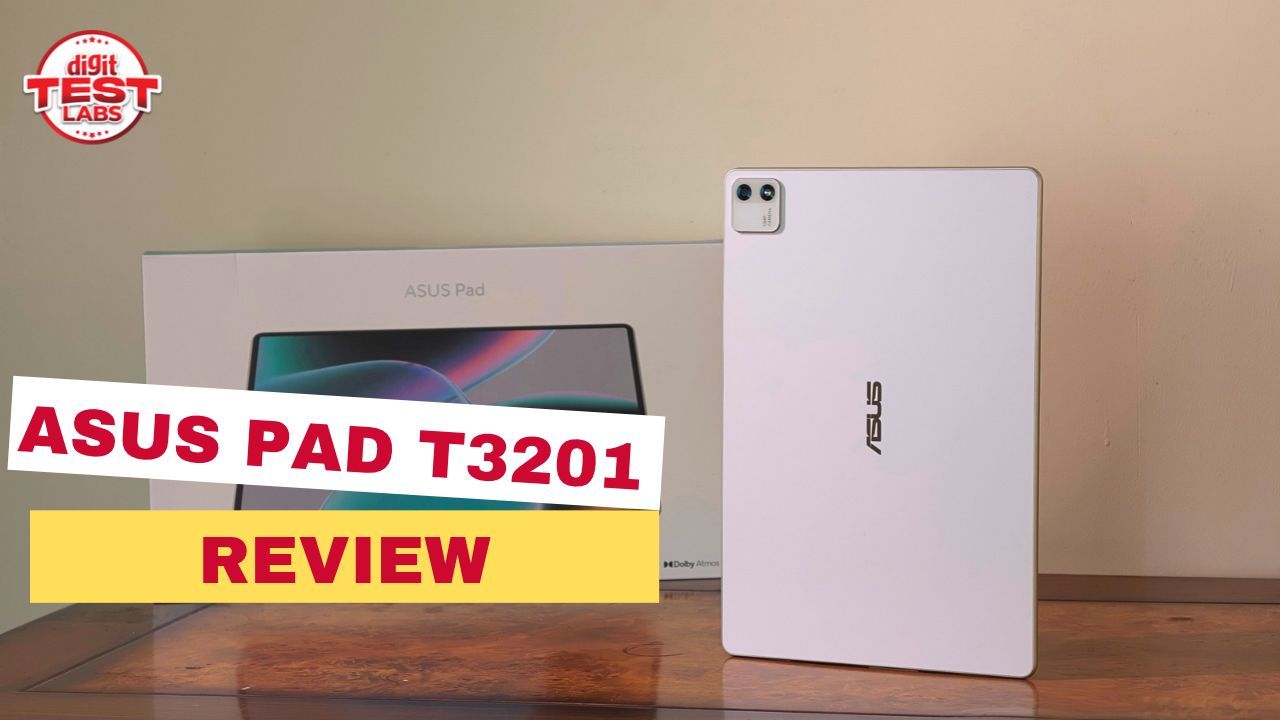

The Android tablet market in India has, for a long time, treated OLED displays as a flagship-tier feature. If you wanted a large-format OLED tablet, you were looking at an iPad Pro at Rs 1,00,000 and above, or a Samsung Galaxy Tab S9 at similar or higher prices. The Asus Pad T3201 changes that because at Rs 43,990 for the 128 GB variant, it brings a 12.2-inch dual-layer OLED display to a segment that has otherwise been dominated by LCD panels. The dual-layer design, which stacks two OLED light-emitting layers to achieve higher brightness, better efficiency and a longer panel lifespan than conventional single-layer panels, is a premium technology. Finding it in a tablet at this price is a meaningful development for the segment.
The pitch is straightforward that this is a content consumption device. A large, bright, high-refresh-rate OLED screen, quad speakers with Dolby Atmos, a 9000 mAh battery, a protective case included in the box and storage expandable to 1 TB via microSD. The MediaTek Dimensity 8300 chip handles the performance side while Android 16 runs the software. And then there is the catch: despite being Widevine L1 certified, the Asus Pad has not received DRM certification from Netflix, Prime Video or JioHotstar at launch. For a tablet being positioned as a streaming and entertainment device, this is a significant gap and it is the tension at the centre of every other good thing this tablet does.
- 12.2-inch dual-layer OLED at Rs 43,990: the best display available in this segment at this price
- Calman-verified 99.99% DCI-P3 coverage; DeltaE 2000 average of 2.71 confirms colour accuracy
- Strong outdoor performance
- 144 Hz display is smooth and responsive
- Quad speakers with Dolby Atmos are a standout for a mid-range tablet
- Protective case included in the box
- 9000 mAh battery gets well over eight hours in real-world use
- microSD expansion up to 1 TB
- GlideX cross-device software is useful for multi-device workflows
- Widevine L1 certified but HD streaming unavailable on major OTT platforms at launch
- Stock Android 16 does not take full advantage of the 12.2-inch panel
- No 3.5mm headphone jack
Asus Pad T3201M5A key specifications
| Specifications and Features | Asus Pad T3201M5A |
| Display | 12.2-inch dual-layer OLED, 2800 x 1840 px, 3:2 ratio, 144 Hz, 2000 nits peak |
| Chipset | MediaTek Dimensity 8300 (4 nm), octa-core, up to 3.35 GHz |
| GPU | Mali G615-MC6 |
| RAM / Storage | 8 GB LPDDR5X / 128 GB or 256 GB UFS 3.1 |
| Expandable storage | microSDXC up to 1 TB |
| Battery | 9000 mAh, 45 W wired |
| Speakers | Quad speakers with Dolby Atmos 360°, 8Ω/1.0 W x4 |
| Cameras | 13 MP rear (AF), 5 MP front |
| Connectivity | Wi-Fi 6E, Bluetooth 5.3, USB-C 3.0 (DisplayPort 1.4, OTG) |
| OS | Android 16 |
| Dimensions | 271.1 x 182.4 x 6.5 mm, 523 g |
| Colours | Pure White |
| In the box | Tablet, 45 W adapter, USB-C cable, protective case, eject pin |
Design and build: Slim, light, functional
At 6.5 mm thick and 523 g, the Asus Pad is one of the lighter 12.2-inch tablets available. It slides into a bag without demanding attention and holds comfortably in one hand for extended reading or browsing sessions. The fibreglass back is smooth, with a matte finish that resists fingerprints reasonably well.
The front is dominated by the display, which takes up 92% of the face and the bezels are slim and uniform. The USB-C port (USB 3.0 with DisplayPort 1.4 support) is the only physical port: there is no 3.5mm headphone socket, which means you need to get a pair of Bluetooth headphones or a USB-C adapter for wired audio. The protective case in the box supports four stand modes covering viewing, typing and propped-up orientations, which makes the package feel more complete at this price. The Asus Pen 2.0 stylus is supported but sold separately. The tablet is available only in Pure White colour at launch.
Display: The main ingredient
The 12.2-inch dual-layer OLED panel is the most compelling reason to consider the Asus Pad and our Calman display measurements largely bear out what Asus claims.
The display covers 99.99% of DCI-P3 in both CIE 1931 xy and CIE 1976 uv colour spaces, confirming the 100% DCI-P3 claim. The sRGB gamut coverage measures 153.27%, which means the panel’s native colour volume extends well beyond the sRGB standard. In practice, this produces vivid, punchy colours for consumer content; in precise terms, sRGB content will appear more saturated than intended unless the device’s colour management mode compensates.
In the D65 P3 profile, the Calman ColourChecker test returned an average DeltaE 2000 of 2.71 against a maximum of 4.81. An average under three is the generally accepted threshold for a well-calibrated consumer display, and the Asus Pad sits within that range. The DeltaE ITP average of 11.69 (maximum 35.18) reflects some colour drift in the most saturated regions of the gamut, which is typical of wide-gamut displays tuned for visual vibrancy rather than clinical accuracy. For content consumption, this is not a problem, but worth knowing for colour-critical creative work.
Our peak brightness test measured 2,710 nits in HDR mode and 805 nits in SDR, both exceeding Asus’s stated 2,000 nit peak and 600 nit typical figures respectively. Outdoor visibility under direct sunlight is handled comfortably at these levels. The dual-layer panel’s efficiency advantage over conventional OLED also means the display sustains brightness without the aggressive dimming that some single-layer OLED panels apply.
The 144 Hz display is very smooth in use; scrolling through long pages and switching between apps feels more fluid than the 90 Hz or 60 Hz LCD alternatives in this segment.
Now the caveat is that the Asus Pad is Widevine L1 certified, which means the hardware is capable of streaming HD and Full HD content from major OTT platforms. The problem is that Netflix, Prime Video and JioHotstar require individual DRM certification beyond Widevine L1 and the Asus Pad has not received those certifications at launch. The result is that streaming on these platforms is limited to standard definition, which is a significant limitation for a 2.8K OLED display. This can be addressed via an OTA software update, so it is not a permanent hardware limitation, but buyers should verify the certification status before purchasing if streaming quality is the primary motivation.
Performance and software
The MediaTek Dimensity 8300 (4 nm) is a solid mid-range chip that punches above its category in tablet use. Our AnTuTu score came in at 1,585,057, which is competitive for the price. Geekbench returned 1,186 in single-core and 4,077 in multi-core. PCMark Work scored 14,156, and the 3DMark Wildlife Extreme score of 3,034 suggests the Mali G615-MC6 GPU is capable of handling casual and mid-intensity gaming without trouble. CPU throttling held at 88% of peak performance during sustained loads, which means the chip maintains most of its output under pressure rather than dropping significantly.
Day-to-day use is smooth with app launches, multitasking between a browser, streaming app and note-taking app simultaneously, and 144 Hz scrolling all feel responsive. The 8 GB of LPDDR5X RAM keeps things moving without hesitation and Wi-Fi 6E handles fast network connections when on a compatible router.
The software is Android 16, running close to stock. This is functional and clean, but it misses an opportunity. A 12.2-inch display with a 3:2 aspect ratio, well-suited to split-screen multitasking and productivity workflows, would benefit from a tablet-optimised UI layer. Asus’s own ZenUI, which ships on its smartphones, offers multitasking conveniences and a more considered panel management system. The stock Android experience works but does not take full advantage of the screen real estate.
What the software does well is Android 16’s split-screen multitasking, Google Circle to Search, and ASUS GlideX for cross-device connectivity. GlideX allows the Asus Pad to act as a secondary display for a Windows or macOS laptop, mirror a phone screen, transfer files wirelessly and share a single keyboard and mouse across devices. It works across Asus and non-Asus devices and is available as a free download. For students and multi-device users, it is a welcome addition.
Audio: Loud and spacious
The quad-speaker system with Dolby Atmos 360° is one of the Asus Pad’s stronger supporting acts. The four speakers (8Ω/1.0 W each) produce a noticeably wide soundstage for a tablet, with reasonable bass presence and clear dialogue. Positioned in landscape mode for video content, the stereo separation between the left and right pairs is effective. At higher volumes, the sound stays clean without obvious harshness or distortion. For a device in this price range, the audio punches well above expectations and paired with the OLED display it creates a solid environment for films and shows once the OTT certification issue is resolved.
Battery
The 9000 mAh battery is well-sized for a 12.2-inch tablet. Our PCMark battery life test ran from 100% to 20% in 7 hours and 2 minutes at 50% screen brightness, which translates to well over eight hours of real-world screen-on time under mixed usage conditions. Lighter tasks such as reading, casual browsing and music streaming will extend this comfortably.
The included 45 W adapter charges the battery to 50% in 30 minutes and 100% in 60 minutes, which is a useful speed for a tablet of this capacity. The charger is in the box, which at any price is worth noting.
Verdict
The Asus Pad T3201 does something that no other Android tablet at Rs 43,990 currently does. It puts a large, bright, dual-layer OLED display in a category where LCD has been the default. The display measurements are strong, the peak brightness is impressive, the colour coverage is exactly what Asus claims and the 144 Hz panel makes the experience feel premium in daily use. The audio system is above average for the segment, the battery is well-sized, and the hardware performance is capable for the price.
The software could be more tablet-centric, the cameras are basic (acceptable for a tablet, not a selling point), and the stock Android experience leaves some of the screen real estate underused. These are manageable limitations.
The one that is not manageable until resolved is the Widevine certification gap. A tablet being sold primarily on its content consumption credentials, with a 2.8K OLED display and Dolby Atmos speakers, that cannot stream in HD on Netflix, Prime Video or JioHotstar is a practical problem for the majority of buyers this device is targeting. An OTA fix is possible, and if that certification arrives quickly, the Asus Pad becomes a straightforward recommendation at this price. Until it does, check the current certification status before purchasing.
For buyers who stream primarily through YouTube or locally stored content, the limitation is irrelevant and the Asus Pad is the best display you can get at this price in the Android tablet space. For everyone else, wait for the update.


