

Can AI make a web browser from scratch? This experiment says maybe
 Follow Us
Cursor CEO Michael Truell says an AI system using GPT-5.2 produced a working web browser with over 3 million lines of code in just one week.
The browser includes a custom Rust-based rendering engine, handling complex tasks like HTML and CSS parsing, layout, painting, and even a JavaScript VM.
It’s far behind Chromium or WebKit, but shows how fast AI can generate large codebases raising questions about quality and maintenance.
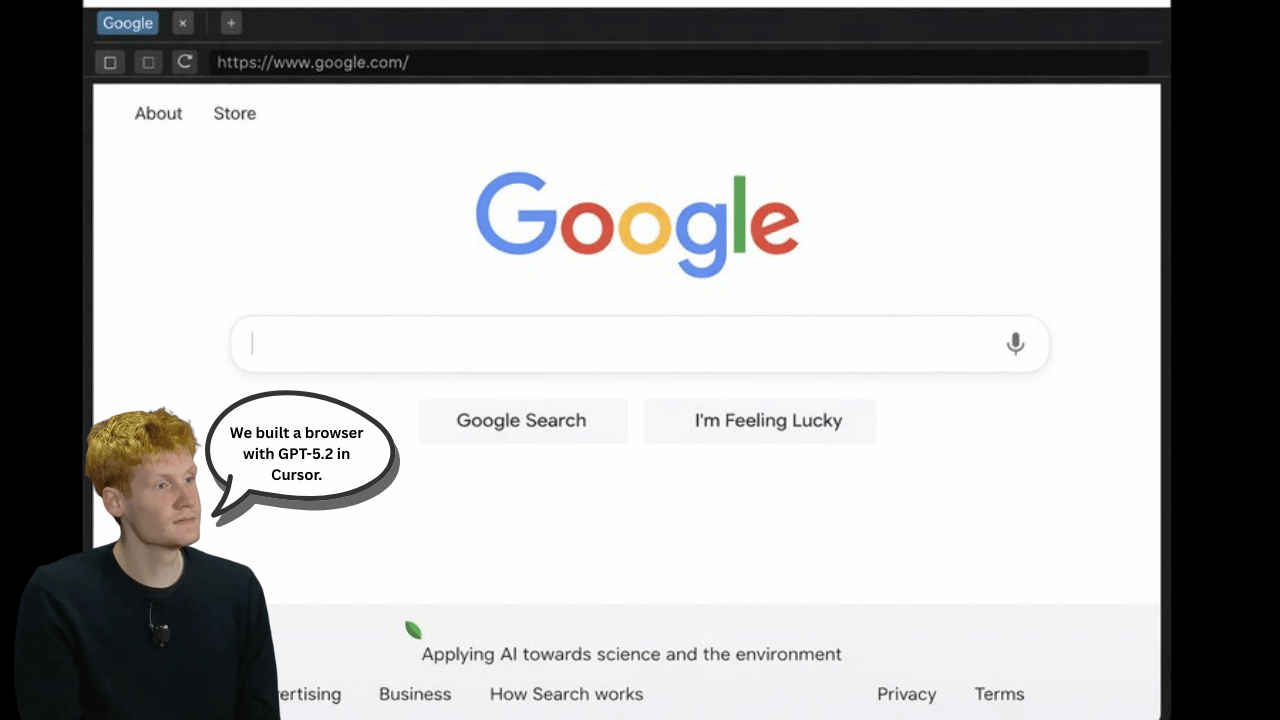

Cursor’s CEO Michael Truell recently revealed that his team built a working web browser almost entirely with the help of GPT-5.2. He shared the update on the social media platform X, calling the result surprising even for his own team. According to Truell, the system was allowed to run on its own for a full week without interruption. What came out of that experiment was not a small demo or test tool, but a large and complex software project. While the browser is far from perfect, the experiment raises fresh questions about how far AI coding tools have already come and what they might be able to do next.
 Survey
In his post, Truell said the browser contains more than three million lines of code spread across thousands of files. The most striking part is that the core rendering engine was built from scratch using the Rust programming language. This engine handles many of the hardest parts of a modern browser, including HTML parsing, CSS rules, page layout, text shaping, painting, and even a custom JavaScript virtual machine.
We built a browser with GPT-5.2 in Cursor. It ran uninterrupted for one week.
— Michael Truell (@mntruell) January 14, 2026
It's 3M+ lines of code across thousands of files. The rendering engine is from-scratch in Rust with HTML parsing, CSS cascade, layout, text shaping, paint, and a custom JS VM.
It *kind of* works! It… https://t.co/pHL5CgZCfK pic.twitter.com/jA6wDdwRif
The CEO was careful to set expectations as he said, ‘The browser only kind of works and still has many issues. It is also very far from matching the performance, features, and reliability of established browser engines like WebKit or Chromium’. Truell further said that the team was astonished by how well it performed in basic tasks. Simple websites were able to load quickly and display in a mostly correct way.
Also read: Will AI take over jobs? Goldman Sachs predicts automation of 25 pct of work hours
What makes this experiment notable is not that it replaces existing browsers. Instead, it shows how much raw output modern AI models can generate when given time and space to work. Writing millions of lines of structured code is something that normally takes large teams of engineers years to complete. In this case, the AI system did it in about a week, even if the result still needs heavy human review and fixing.
Also read: Microsoft scrambles to fix Windows 11 after security update causes unexpected failures
Online reactions were mixed. Some developers liked the experiment and saw it as a promising look at the future of software development. Others were doubtful, saying that writing a lot of code does not mean it is good code and that maintaining software over time is more important than creating it quickly.


