

Google wants to make smart glasses more useful with XREAL Aura and Android XR
 Follow Us
XREAL Aura features a sunglasses-style design weighing under 95 grams, with transparent lenses and a separate computing unit.
The XR glasses support Android XR apps, Gemini AI, up to five virtual windows and Micro-OLED displays with a 120Hz refresh rate.
XREAL Aura starts at $1,279 in the US, with a higher-end 16GB RAM and 512GB storage model priced at $1,499.
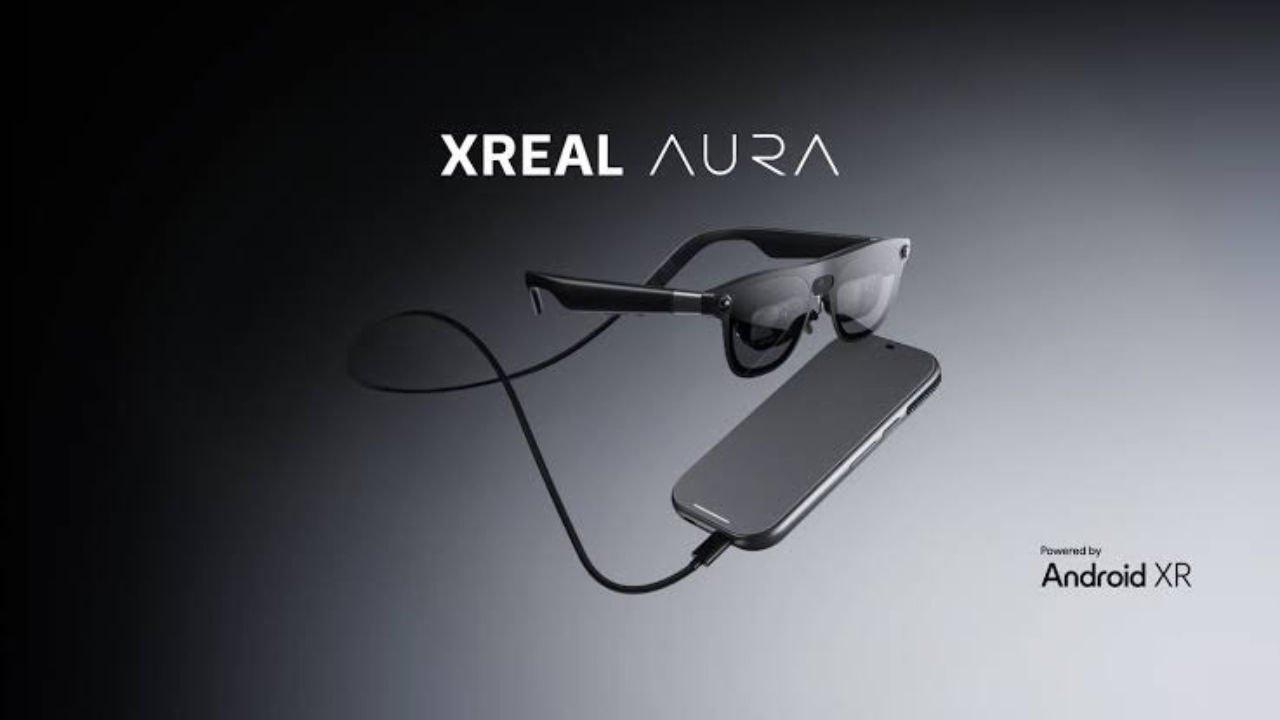

At the Google Android Dev Summit 2026, the company has introduced XREAL Aura, a pair of wired XR glasses running its Android XR operating system. The device points to a different approach to spatial computing, one that relies on third-party hardware makers rather than requiring Google to build an entire headset ecosystem on its own.
 Survey
If you don’t like bulky mixed reality headsets that cover a large portion of the user’s face, the XREAL Aura may appeal to you with its sunglasses-style design and clear lenses. It let users see physical surroundings while interacting with digital windows, apps and other virtual content. The idea is to bring a large virtual workspace into the real world without completely shutting users off from it.
A lightweight design with a separate computing unit
The Aura glasses weigh less than 95 grams, while a separate, compact computing unit handles much of the processing and power requirements. The two connect through a USB-C cable.
The external unit, described as a compute puck has the battery and Qualcomm’s Snapdragon Reality Elite platform. It also includes a trackpad and fingerprint reader with physical controls alongside the glasses’ other input options.
The glasses themselves have a dedicated XREAL X1S spatial coprocessor that handles tasks including sensor processing, spatial tracking and display management. And splitting these responsibilities between two chips allows the system to keep the glasses lightweight while doing all the XR duties.
XREAL AURA is officially here. 🕶️ Meet lightweight wired spatial computing glasses powered by Android XR, giving you a portable spatial canvas to work, watch, play, and explore. Expand your laptop into a multi-monitor workspace. Transform any room into a personal theater. Enjoy immersive 3D gaming experiences, access to millions of mobile and tablet apps from Google Play and over 150 experiences designed specifically for XR, and get contextual help from Gemini based on what you see. With an expansive 70° field of view, transparent lenses, and a dedicated pocket-sized Compute Puck, AURA brings spatial computing into a lightweight, portable design. For a limited time, enjoy special launch pricing on both standalone configurations: 1️⃣ 12GB RAM + 256GB storage: $1,099 2️⃣ 16GB RAM + 512GB storage: $1,299 Already ordered? Customers who paid the original price before October 28 will also receive the launch pricing, with the applicable price difference refunded. Or choose the setup that fits your needs with our bundles: ⌨️ Productivity Bundle: AURA + keyboard 🎮 Gaming Bundle: AURA + controller 🚀 All-in-One Bundle: AURA + keyboard + controller Available at https://t.co/DOYECoDy0C and Best Buy online. Shipping begins mid-November. #XREAL #AURA #AndroidXR Google, Android XR, Gemini and Google Play are trademarks of Google LLC.
— XREAL 👓 (@XREAL_Global) October 28, 2026
The transparent lenses are another important part of the design. Instead of relying entirely on cameras to show users a video feed of their surroundings, the glasses allow them to view the real world directly through the lenses, with digital content layered over it.
They also feature electronic dimming, allowing users to adjust lens transparency. This is useful when switching between a setting where visibility of the surroundings matters and one where a darker view makes virtual content easier to see.
READ: Google Fitbit Air gets blood pressure and insulin resistance tracking, but there’s a catch
Android XR brings apps and multiple virtual screens
The Aura’s biggest advantage may be its software. Running Android XR gives the glasses access to Google’s growing spatial computing ecosystem, with support for apps and experiences designed for the platform.
Users can arrange as many as five virtual windows around their physical environment. These can include a browser, messaging tools, video playback or music controls. Windows can be positioned and resized to create a workspace that extends beyond the limits of a conventional laptop display.
Google and XREAL have also talked about over 150 XR experiences that are built for or optimised for the platform. The selection includes entertainment, games and other interactive applications.
A new chapter in spatial computing, built together. XREAL and Google are bringing their shared vision to life with XREAL AURA, the first wired XR glasses powered by Android XR. Combining XREAL’s expertise in lightweight XR hardware and optics with the Android XR platform, AURA brings immersive spatial experiences into a portable form factor designed for everyday life. Hear from Chi Xu, Co-founder and CEO of XREAL, and Shahram Izadi, Vice President and General Manager of Android XR at Google, as they share the vision behind this collaboration and what it means for the future of spatial computing. A look back at a milestone for XREAL, Google, and the next generation of XR. #XREAL #AURA #AndroidXR Google and Android XR are trademarks of Google LLC.
— XREAL 👓 (@XREAL_Global) October 29, 2026
The Aura also supports wired display input. Users can connect compatible laptops and handheld gaming devices through USB-C to create a large virtual screen or a spatial desktop. This can make the glasses useful for work and gaming.
Gemini AI is built into the experience
Just like every Google device, the Aura also integrates Gemini into the operating system, allowing users to interact with the assistant while using apps and viewing their surroundings. The system is made to interpret visual context and help users with tasks based on what they are looking at with the compatible sensors and cameras. This can include asking questions about visible information, summarising text or getting assistance while working with digital content.
However, the usefulness of these features will depend on how well Gemini understands the context, how quickly it responds and how consistently it works across different applications. Camera-enabled AI features also make privacy controls and clear indicators of when sensors are active important considerations.
Micro-OLED displays and a wide field of view
Even with its sunglasses-like appearance, the Aura is made to display detailed digital content. It uses Sony Micro-OLED displays with a resolution of 1200p per eye and a refresh rate of up to 120Hz. XREAL claims a 70-degree field of view, which is intended to make virtual windows feel larger and more immersive than they would on a conventional pair of display glasses. A wider field of view can help with virtual desktops and entertainment, although it does not mean that the glasses provide the same visual coverage as a fully enclosed headset.
Users can interact with content through hand gestures, voice commands or the compute puck’s trackpad. The glasses also feature audio technology tuned by Bose, providing another way to consume media without relying on external headphones.
What about games and entertainment?
The Aura’s announced experiences include Asteroid which is an an immersive film directed by Doug Liman, which incorporates conversational AI powered by Gemini, and Galapagos, a nature documentary series narrated by Margot Robbie.
Gaming is another part of the platform, with titles and experiences including Cubism, Fallout: Factions, an NBA app for Android XR and a multiplayer Holochess game from Resolution Games.
XREAL AURA is officially here. 🕶️ Meet lightweight wired spatial computing glasses powered by Android XR, giving you a portable spatial canvas to work, watch, play, and explore. Expand your laptop into a multi-monitor workspace. Transform any room into a personal theater. Enjoy immersive 3D gaming experiences, access to millions of mobile and tablet apps from Google Play and over 150 experiences designed specifically for XR, and get contextual help from Gemini based on what you see. With an expansive 70° field of view, transparent lenses, and a dedicated pocket-sized Compute Puck, AURA brings spatial computing into a lightweight, portable design. For a limited time, enjoy special launch pricing on both standalone configurations: 1️⃣ 12GB RAM + 256GB storage: $1,099 2️⃣ 16GB RAM + 512GB storage: $1,299 Already ordered? Customers who paid the original price before October 28 will also receive the launch pricing, with the applicable price difference refunded. Or choose the setup that fits your needs with our bundles: ⌨️ Productivity Bundle: AURA + keyboard 🎮 Gaming Bundle: AURA + controller 🚀 All-in-One Bundle: AURA + keyboard + controller Available at https://t.co/DOYECoDy0C and Best Buy online. Shipping begins mid-November. #XREAL #AURA #AndroidXR Google, Android XR, Gemini and Google Play are trademarks of Google LLC.
— XREAL 👓 (@XREAL_Global) October 28, 2026
XREAL has also partnered with GameSir on a dedicated controller for Android XR, featuring a physical button for accessing Gemini. The accessory could make it easier to use AI assistance while gaming without having to pause and navigate through menus.
XREAL Aura price and availability
The XREAL Aura is listed for buyers in the US, Canada, Japan and South Korea. According to the announced pricing, the 12GB RAM and 256GB storage model costs $1,279. A higher-end version with 16GB RAM and 512GB storage is priced at $1,499.
Both configurations are offered in standard and large frame sizes and include a carrying case for the glasses, compute puck and replaceable USB-C cable. Initial shipments are expected to begin in November 2026, while Google plans to expand availability through physical Google Store locations in the US and Japan in 2027.


