

Deepinder Goyal’s Temple is up for pre-order at Rs 85,000, but what are you actually buying?
 Follow Us
Temple uses its proprietary BrainFlow technology to track signals associated with cerebral blood flow and an Entropy score to estimate physiological strain.
Despite claims of advanced health monitoring and heart rate accuracy, much of the supporting research is company-led and still needs independent validation.
Buyers are being asked to pay Rs 85,000, with deliveries taking around three months, while key details about the hardware and lifetime subscription remain unclear.
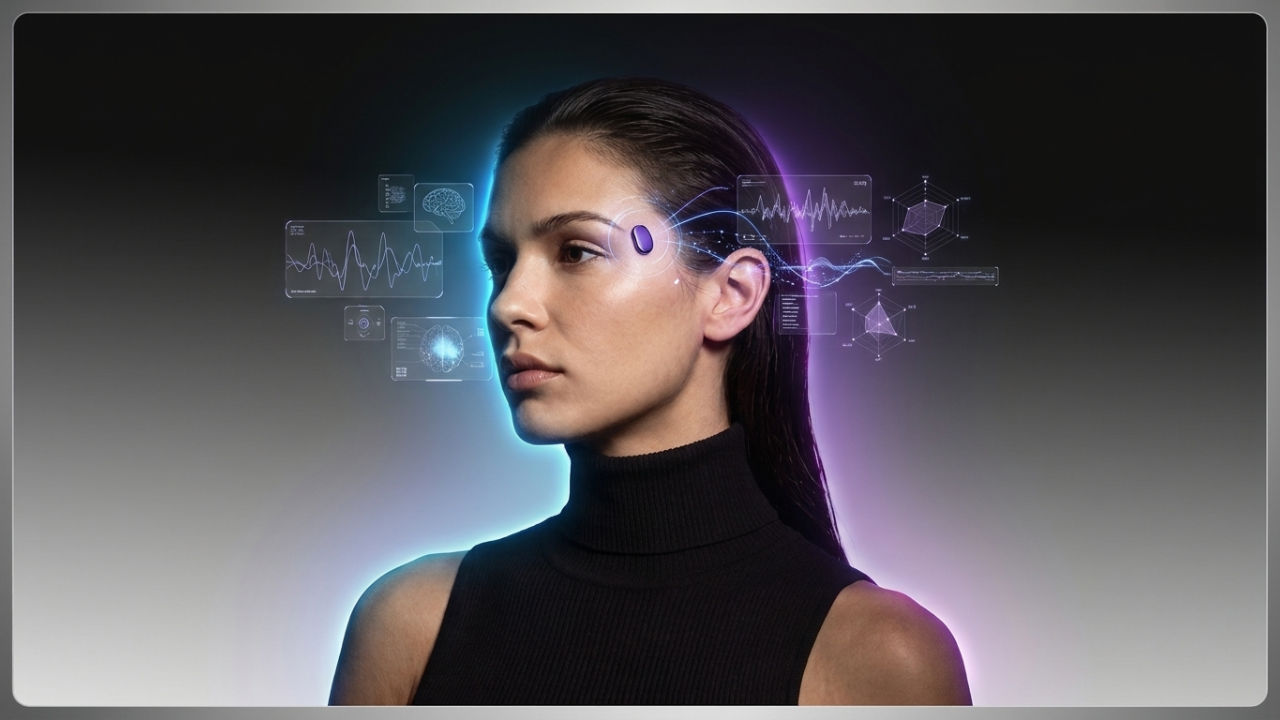

Until now, most consumer wearables have followed a similar formula. Smartwatches track heart rate, heart rate variability (HRV), steps, calories, workouts, sleep while handling notifications, calls and other smartphone features. The fitness bands offer a simple version of the same experience and the smart rings have made health tracking even more personalised. The hardware looks different, but the basic idea remains unchanged: collect information about your body and present it through an app.
 Survey
That approach, as I have said before, will be changed in the coming years. The wearable makers are now looking beyond fitness tracking and exploring more specialised ways to monitor the human body. Zomato and Eternal founder Deepinder Goyal’s Temple is one such example.
After months of attention on social media and podcasts, Temple has finally opened pre-orders in India. The first batch is priced at Rs 85,000, with deliveries expected approximately three months after an order is placed. That means buyers ordering now can be waiting until early 2027 to get their hands on it. The price is certainly premium. But the bigger question is what exactly buyers are getting for that money.
Temple has been discussed extensively by Goyal, who has appeared wearing the device and regularly shared details about its technology on social media. A few public figures like Shubhman Gill and PV Sindhu have also been spotted using it. Yet, for a product that is now accepting orders from consumers, there is still a surprising amount of information missing. We know what Temple ‘claims’ to do, but there is limited clarity on its specifications, the complete set of metrics it tracks, how those readings are presented to users and, most importantly, how reliably it works.
Temple pre-orders are open, but deliveries are months away
Temple is following a made-to-order manufacturing model, meaning the company will begin producing a device after a customer places an order. The stated delivery timeline is around three months from the date of purchase. Customers can reportedly request a refund until their device is shipped.
The first batch is priced at Rs 85,000, based on the early-access and ordering information shared by the company. The package is said to include lifetime access to Temple’s software platform, along with the adhesive Grips used to attach the device to the skin. However, the exact scope of this lifetime subscription, including the features and services it covers, is not clearly explained.
Temple pre-orders open now. Order at https://t.co/hi9q1VXygW, or from the app at https://t.co/GlZlv9KAH9
— Deepinder Goyal (@deepigoyal) November 1, 2026
And this is an important detail because the software is arguably one of the most important parts of such devices. Temple is not selling a conventional fitness tracker that displays familiar numbers such as steps and distance. Its proposition depends on how it processes physiological signals and turns them into information that users can understand and act upon. Without a clear explanation of what the app offers, it is difficult to judge the value of a lifetime subscription.
And if the device is priced at Rs 85,000, it is reasonable to expect more than a price tag, a few product images and broad descriptions of what a device might eventually achieve.
What does Temple actually do?
The most obvious difference between Temple and conventional wearables is where it sits. Instead of being worn around the wrist or finger, this small device attaches to the side of the forehead, between the forehead and the ear. It uses adhesive patches called Grips to remain in place.
The idea is to monitor physiological signals from the temple region, particularly changes associated with cerebral blood flow. Goyal has explained that Temple uses optical sensing technology, with its proprietary system called BrainFlow designed to interpret these signals. The company believes that monitoring this area could provide information that conventional wrist-based wearables may struggle to capture.
Temple also talks about a proprietary metric called Entropy, which is intended to represent the body’s physiological strain. The score reportedly ranges from 1 to 250 and can respond to factors such as exercise, stress, sleep, digestion and caffeine consumption. The company has also used terms such as Baseline, Threshold and Momentum to describe different aspects of its performance-tracking system.
It sounds ambitious, and there is a reasonable argument for exploring measurements along with the usual heart rate. But explaining the concept is not the same as explaining what a consumer will actually experience.
For example, how frequently does Temple record and update these measurements? What other health parameters will it track alongside BrainFlow and Entropy? How much of this information will be available in the app, and will users get detailed graphs, daily reports, or actionable recommendations? Can it distinguish between physical exertion and mental stress, or does it simply register changes in physiological activity that could have several explanations?
These are not minor questions. They determine whether Temple is a useful health wearable or simply another device that gives users a new number to obsess over.
The science is interesting, but the evidence needs scrutiny
To be fair, Temple is not making its claims without any research behind them. Goyal has discussed studies comparing BrainFlow readings with established measurement techniques, including transcranial Doppler ultrasound and near-infrared spectroscopy. One study involving 23 healthy adults reportedly found that Temple’s readings followed changes observed through transcranial Doppler measurements during exercise and changes in posture.
The company has also shared research involving other physiological tests and reported encouraging correlations. More recently, Goyal claimed that Temple recorded heart rate more accurately than several leading wearables, including the Apple Watch, during an internal comparison. The test reportedly included Garmin, Fitbit, Whoop and Oura devices, with a Polar H10 chest strap used as the reference.
Temple is the most accurate HR tracker compared to all flagship wearables, even in Zone 4 & 5. Detailed study here: https://t.co/lFuUX1cT0d https://t.co/d4EDUoPaHe
— Deepinder Goyal (@deepigoyal) November 1, 2026
These claims are interesting, particularly because accurate heart rate tracking during high-intensity exercise remains a challenge for wrist-based optical sensors. Goyal has argued that Temple’s adhesive design and its position over a major artery give it an advantage.
However, there is an important difference between a company’s own test results and independent validation. Temple’s reported findings should not be treated as established proof of accuracy across different users and everyday conditions. Goyal has said that independent researchers are conducting further studies and has invited others to replicate the results.
Until those findings are available and examined independently, consumers have little reason to take the company’s strongest performance claims at face value. A correlation with a reference measurement also does not automatically establish that a device can accurately assess cognitive performance, diagnose a health issue, or tell someone how well their brain is functioning.
And what is even more confusing- Temple itself is positioned as a general wellness product and not a medical device. That difference actually matters, specifically when the language around the brain monitoring can make the product sound considerably more medically capable than it may be.
Rs 85,000 for a wearable with unanswered questions?
The price is where the lack of clarity becomes harder to overlook. Temple costs considerably more than mainstream smartwatches and smart rings. And buyers are not paying for a screen, a conventional fitness-tracking experience, or a familiar ecosystem of apps. They are being asked to invest in a specialised sensing system and the promise of insights that other wearables may not provide.
That can be a good proposition for athletes, researchers, or people who are already interested in physiological monitoring. But the company needs to explain exactly what the product offers before expecting ordinary consumers to make that investment.
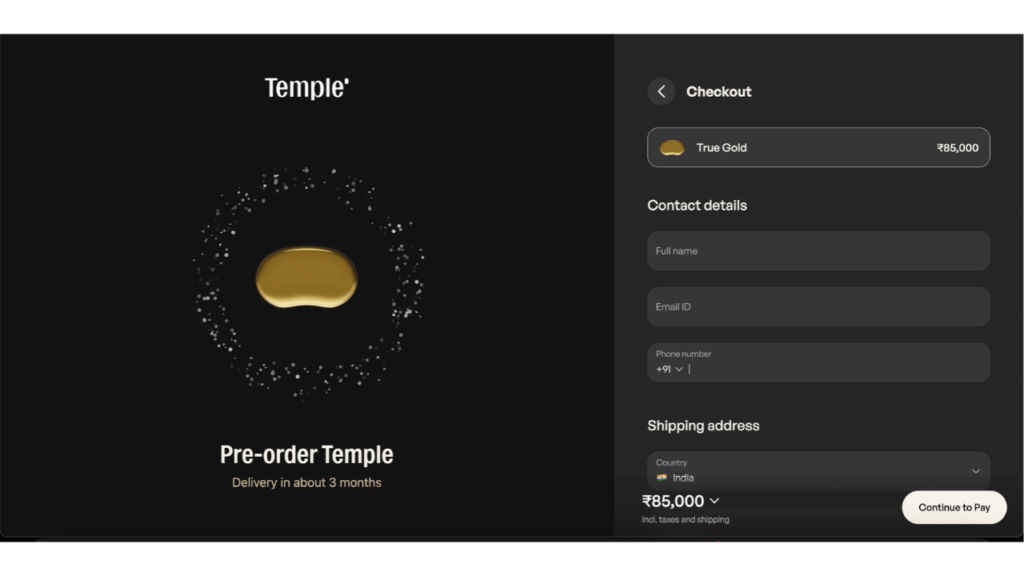
There are basic specifications that prospective buyers would usually look for before ordering a wearable. These include the sensor configuration, supported tracking parameters, battery capacity, charging time, connectivity, compatibility requirements and the level of detail available through the companion app. Goyal has discussed some aspects of its design and battery performance, which is around 5 to 7 days, but a complete, easily accessible specification sheet would make it much easier to evaluate the product.
The software also needs a closer look. What does the lifetime ‘free’ subscription actually unlock? Will users receive ongoing analysis, coaching and software updates? Are all features included in the upfront price, or could certain services be introduced separately later? The promise of lifetime access sounds attractive, but without a clear breakdown of what it covers, it is difficult to assign much value to it.
The device is available in six finishes: True Gold, Rose Gold, Black Mirror, Real Jade, Deep Blue and Purple Funk. Goyal has also discussed its adhesive Grips and a design intended to be worn alongside glasses. These are useful details, but colour options and the way a wearable attaches to the skin are hardly the biggest considerations when the product’s central selling point is its ability to track complex physiological signals.
Should you pre-order it?
Personally, the device feels fresh and exciting. So far, the wearables have spent years measuring familiar indicators of activity and recovery. And exploring the signals associated with cerebral blood flow can open up new possibilities. It is also good to see an Indian company attempt something different in a market dominated by global brands. I also think that Temple does not have to be dismissed simply because it is experimental. New categories often begin with products that raise more questions than they answer.
But that does not mean consumers should be expected to buy into the experiment without enough information. The company has spent considerable time building anticipation around Temple, with Goyal’s public appearances and social media posts doing much of the explaining. Now that the pre-orders are open, the product needs to stand on its own, with transparent specifications, a detailed explanation of its software and research that can withstand independent scrutiny.
So far, the price is clear. The complete value proposition is not. We know the broad idea behind BrainFlow and Entropy, but not enough about how the finished product will translate those measurements into useful everyday insights. And while the reported research is a promising starting point, it is not a substitute for independent validation.
A device that claims to offer a new window into the body’s physiology should be willing to show consumers exactly what that window reveals. At Rs 85,000, asking buyers to take that much on faith is a rather expensive proposition.


