
Einstein Rings and the cosmic lens: How NGC 6505 is reshaping our understanding of gravity
 Follow Us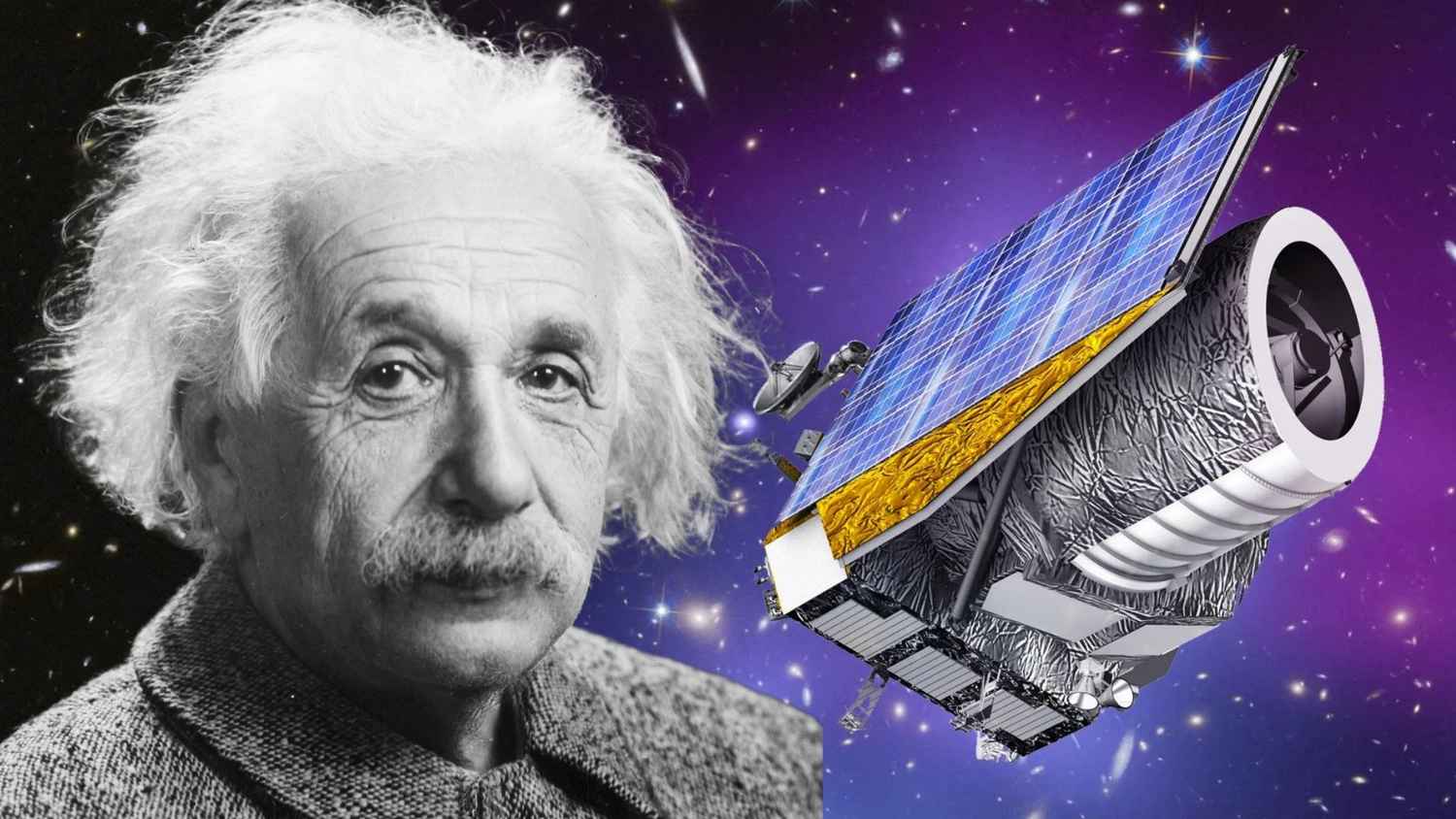

The universe has a habit of surprising us, revealing its deepest secrets in the most unexpected ways. One such revelation arrived in the form of an astonishing discovery around the elliptical galaxy NGC 6505 – a complete Einstein ring, captured by the keen eyes of the Euclid space telescope. This is no ordinary find. It is a cosmic phenomenon that elegantly showcases the warping of space-time, a consequence of gravity predicted over a century ago by Albert Einstein. Yet, beyond its scientific allure, this discovery holds implications that stretch far beyond the domain of astrophysics. It forces us to reconsider our understanding of dark matter, the fabric of the universe, and even the potential for intergalactic observations that could redefine modern cosmology.
 Survey
What exactly is an Einstein Ring?
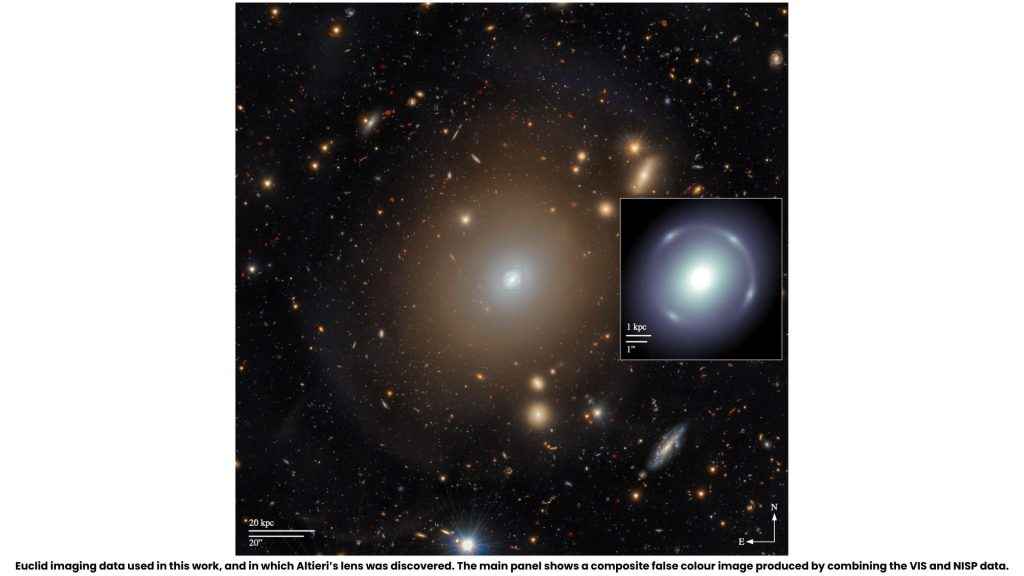
To appreciate the magnitude of this discovery, one must first understand what an Einstein ring is. In the grand cosmic theatre, light from a distant galaxy does not always travel in a straight line. When a massive foreground galaxy, like NGC 6505, sits directly between us and a more distant source, its gravity acts as a lens, bending the light around it. If the alignment is precise, the light forms a near-perfect circle around the intervening galaxy, creating what astronomers call an Einstein ring.
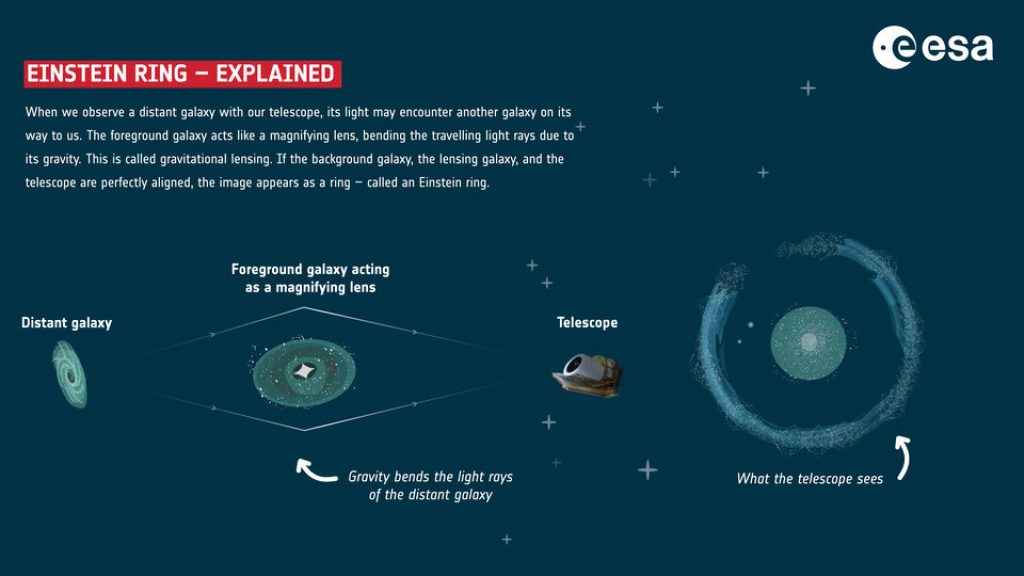
These rings are more than just celestial eye candy. They serve as powerful tools for measuring the mass distribution of galaxies, allowing astronomers to peer into regions otherwise obscured by luminous matter. More crucially, they offer rare glimpses into the enigmatic realm of dark matter, the unseen substance that makes up approximately 85% of the universe’s mass.
A discovery decades in the making
The presence of a strong gravitational lens around NGC 6505 was, until now, completely unknown. This elliptical galaxy has been observed in various wavelengths for decades – in X-rays, radio, and optical imaging – but its role as a cosmic lens remained undetected. It was only when Euclid turned its gaze toward this part of the sky that the complete Einstein ring became evident, marking the first discovery of its kind in an NGC object.
The data collected from Euclid’s Visible Camera (VIS) and Near-Infrared Spectrometer and Photometer (NISP) provided unparalleled clarity, enabling researchers to measure the source galaxy’s redshift at z = 0.406 and confirm the lensing effect. The Keck Cosmic Web Imager further bolstered the findings, revealing the remarkable precision with which this natural gravitational lens bends light across billions of years.
Dark matter and the missing mass problem
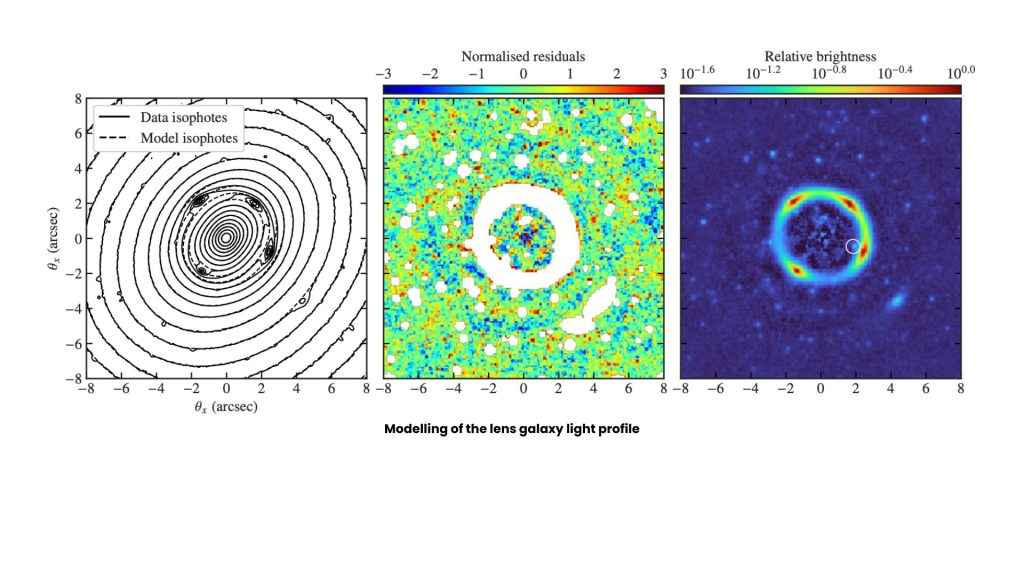
One of the most profound implications of this discovery lies in the study of dark matter. The mass inferred from the visible portion of NGC 6505 does not fully account for the degree of light bending observed in the Einstein ring. This discrepancy points to the presence of unseen mass, which astrophysicists attribute to dark matter.
By analyzing the velocity dispersion of the lensing galaxy, researchers estimate that dark matter constitutes about 11% of the mass within the Einstein radius of NGC 6505. This fraction, while smaller than expected in some models, provides a key data point in the ongoing effort to map dark matter distributions within elliptical galaxies. The discovery also raises questions about the nature of stellar populations in these galaxies, as the findings suggest a stellar initial mass function (IMF) that is heavier than previously thought, further complicating the dark matter puzzle.
Einstein rings as cosmic telescopes
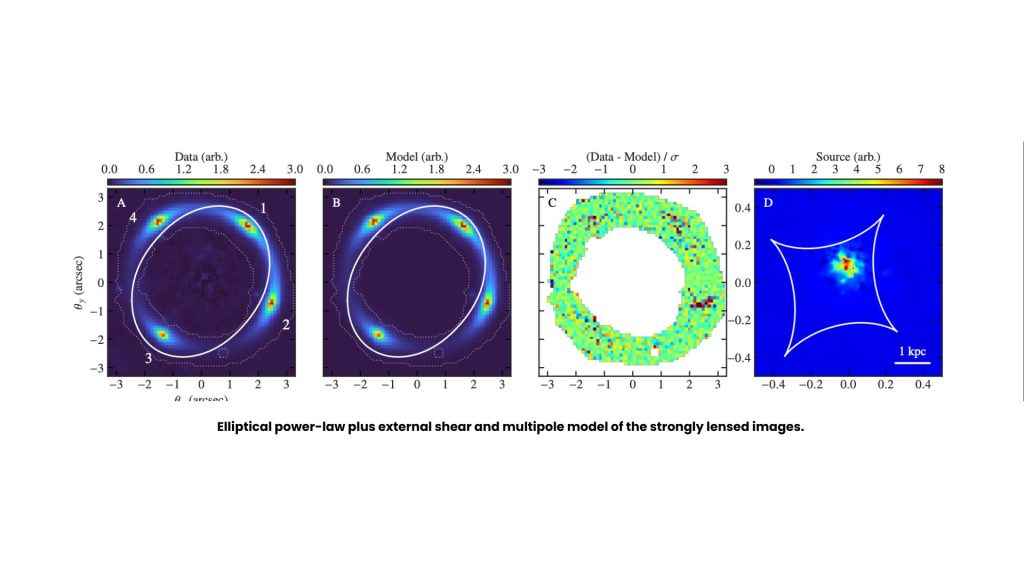
Einstein rings do not merely help us understand gravity and dark matter; they also act as magnifying glasses, allowing us to study distant galaxies with unprecedented resolution. The lensing effect of NGC 6505 amplifies the background source, enabling researchers to probe details that would otherwise be impossible to resolve with current telescope technology.
This technique, often referred to as gravitational lensing magnification, has been used in the past to examine early galaxies, supernovae, and even exoplanet atmospheres. With more discoveries like the one around NGC 6505, astronomers can expand their toolkit for observing the cosmos, unlocking details about the universe’s infancy and the processes that shaped the galaxies we see today.
Implications for cosmology and future discoveries
Beyond its immediate scientific impact, the discovery of a complete Einstein ring in NGC 6505 hints at what is yet to come. The Euclid mission is expected to uncover thousands of such lenses, each providing a unique window into the fabric of the universe. By mapping these lenses, scientists can refine their understanding of fundamental cosmological parameters, such as the expansion rate of the universe and the nature of dark energy.
Moreover, this discovery underscores the importance of continued investment in space-based telescopes and large-scale sky surveys. As detection methods improve, astronomers anticipate that gravitational lensing will play a crucial role in answering some of the biggest questions in physics: What is the true nature of dark matter? How did galaxies evolve over cosmic time? Could lensing effects even reveal signatures of new physics beyond the standard model?
Bridging science with everyday life
While the study of Einstein rings may seem confined to the halls of academia, its broader implications extend into the realm of everyday technology. The very same principles that govern gravitational lensing are applied in medical imaging, optical lens design, and even telecommunications. Understanding how light bends under extreme gravitational conditions improves the design of high-resolution imaging systems, from telescopes to MRI scanners.
Moreover, the computational models used to analyze these cosmic distortions have applications in artificial intelligence, machine learning, and big data analytics. By refining our ability to extract patterns from complex datasets, gravitational lensing research inadvertently contributes to fields as diverse as finance, climate science, and urban planning.
As Euclid and future telescopes continue their skyward gaze, we can only imagine what other cosmic spectacles await. Perhaps another Einstein ring, an even more distant lensing galaxy, or something so unexpected that it reshapes our understanding of reality itself. For now, NGC 6505 stands as a beacon in the dark, illuminating a path toward deeper cosmic insight, one bent ray of light at a time.


