
Motorola is going all out with the Signature 27, and Qualcomm’s new Snapdragon chip is at the heart of it
 Follow Us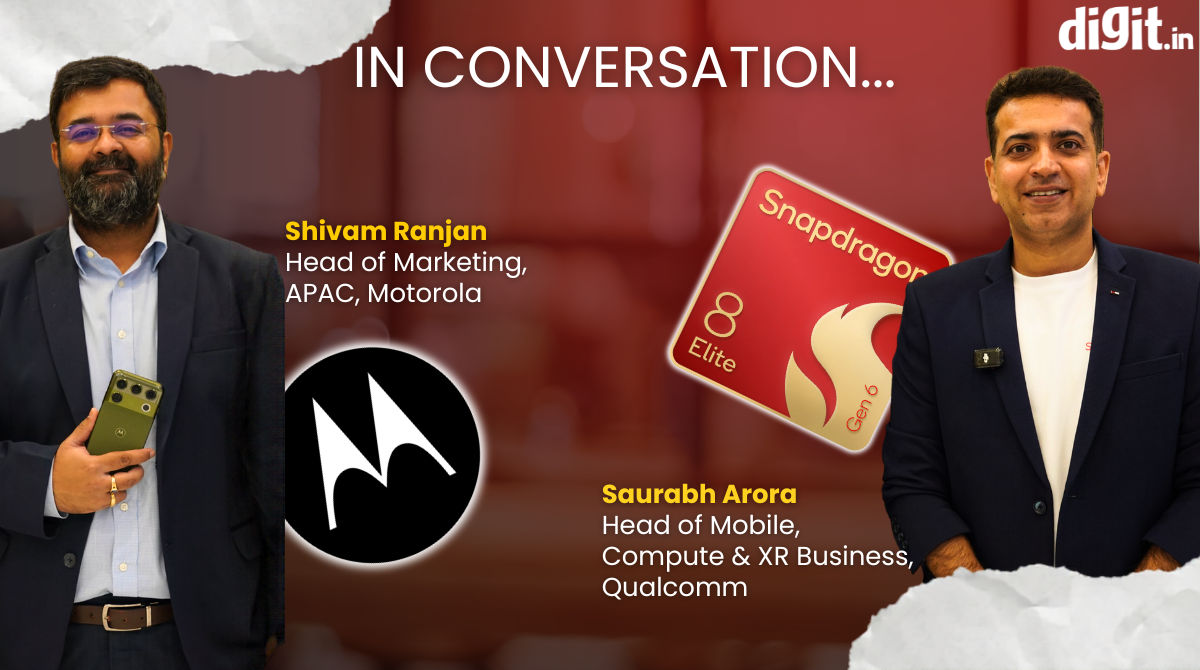

Motorola is all set to take its biggest leap in the premium smartphone segment with the Signature 27, and Qualcomm’s latest flagship Snapdragon processor is at the centre of that effort. At IMC 2026, I spoke with Saurabh Arora, Head of Mobile, Compute and XR Business at Qualcomm, and Shivam Ranjan, Head of Marketing, APAC at Motorola, about what the two companies are working on. The conversation offered a detailed insight into the Snapdragon 8 Elite Extreme Gen 6 chipset and the Motorola Signature 27, covering performance, on-device AI, camera improvements, cooling, and design. We also discussed how the companies are working together and what Motorola hopes to achieve with its Signature family in the premium smartphone market. Here are the key excerpts from the conversation.
 Survey
Also read: Motorola Signature review: A flagship that focuses on what matters
Q1. The Motorola Signature 27 is powered by Qualcomm’s latest flagship Snapdragon 8 Elite Extreme Gen 6 processor. What are the biggest improvements users can expect in everyday use compared to the previous generation?
Saurabh Arora: The Snapdragon 8 Elite Extreme Gen 6 brings together all the new features, innovations, and technologies we have developed and packed into the chipset. We haven’t limited ourselves to just one part of the chipset. We have introduced innovations and improvements across the CPU, GPU, NPU, and ISP, along with the image processing capabilities needed to support new-age agentic AI use cases. For the first time, this is the world’s fastest mobile CPU, with a breakthrough CPU speed of 5GHz.
Q2. There are several flagship smartphones available today. What makes the Motorola Signature 27 different, and what would you say is its biggest strength?
Shivam Ranjan: Motorola is one of the first OEMs to launch a device powered by the Snapdragon 8 Elite Extreme Gen 6 chip. The phone will be available soon globally and in India, with the launch taking place in the coming weeks.
The Signature 27 is the best smartphone we have ever made. That is a big statement for a company like Motorola, because we invented the mobile phone in 1973. More than 50 years ago, the world’s first mobile phone was created by Motorola.
We were also pioneers in innovation during the first journey to the Moon. The words ‘one small step for a man, one giant leap for mankind’ were transmitted using Motorola technology in 1969. Today, we are saying that the Signature 27 represents a leap of a similar scale in terms of technology.
There isn’t just one thing I can point to, but the heart of the phone is definitely the Snapdragon 8 Elite Extreme Gen 6. It powers several experiences on the device. As Saurabh mentioned, it is not just about performance or gaming. It is also about connectivity and camera experiences, supported by the ISP.
We bring all of this together with a beautiful design that feels differentiated, premium, and personal. We also want to enable agentic AI experiences that are changing the way people interact with their smartphones.
The Signature franchise stands for the best of everything. We entered this flagship space after a while, with last year’s model being our first step. This year, we have gone all out to give consumers the best of everything. More details will follow when we officially launch the device in India, but the biggest highlight for me today is the Snapdragon chipset at the heart of the phone.
Q3. AI is becoming a bigger part of smartphones, but many users may not know what it actually does for them. What are some useful things this new Snapdragon processor can do directly on the phone?
Saurabh Arora: Everybody is trying to figure out what AI can do, but things will change from the perspective of agentic AI use cases.
Earlier, you would look for answers, ask questions, and receive a response. Going forward, with the ultra-low-power island sensing hub we have in this chip, the phone can become contextually aware of where you are, what you are thinking about, your relationships, and what you might want to do next.
For example, if we are sitting together at dinner and have finished eating, the phone could prompt me to get my car if I am driving, or book a taxi if I need one. Similarly, if I receive an email, the phone could check my calendar and availability and ask whether I am free to do something with a friend. It could then carry out these tasks on my behalf without requiring me to ask it to do so every time.
That is the kind of proactive assistance agentic AI will bring.
Q4. Camera quality is one of the biggest reasons people spend more on a flagship phone. What improvements have you made to the Signature 27’s cameras, especially when it comes to taking photos and recording videos in everyday situations?
Shivam Ranjan: Imaging is one of the most important factors when it comes to buying a smartphone. With the Signature franchise, we redefined the camera experience when we launched the first Signature last year. It was rated among the best camera phones in the world, and that device was also powered by a Qualcomm chipset, the previous-generation Snapdragon 8 Gen 5.
With the Signature 27, we believe we are redefining that experience again. We have gone all out with the camera system. The phone comes with an impressive camera setup, including a 50-megapixel Sony LYT-910 sensor and a 200-megapixel periscope camera. The combination of this hardware with the Snapdragon chipset, its enhanced ISP, and the NPU allows us to do more with image processing. The phone can start sensing, monitoring, and observing a scene before you even take a shot, and then begin optimising the image.
Video is another area we have focused on. The device features an AI Video Enhancement Engine, which is automatically activated when someone records a video. It uses the Snapdragon chipset’s ISP and NPU to understand the scene and optimise the video in real time, helping deliver the best possible output. You don’t need to be a professional to get good results.
The device also offers optical image stabilisation with a range of 3.5 degrees. Combined with Qualcomm’s advanced electronic image stabilisation, this helps deliver smooth, stable videos.
These are some of the improvements we can talk about today. There is much more to discuss when it comes to the camera, and we will share more as we move forward.
Q5. Performance is one thing, but keeping a phone fast during long gaming sessions or while recording videos is another. How does Qualcomm help phone makers keep performance consistent without the phone getting too hot?
Saurabh Arora: We work very closely with our partners, including Motorola. We collaborate on optimisation across both hardware and software.
Although we have introduced improvements across the platform, the CPU is one of the major highlights, with its breakthrough frequency of 5GHz. We have also made enhancements to the GPU, which offers 44 per cent better performance, and to the NPU, which delivers 35 per cent better performance for AI use cases.
On the AI front, the chipset can run models with 30 billion parameters, including mixture-of-experts models. Larger language models can be tuned to handle a particular category of tasks, but this chipset can also support mixture-of-experts models and on-device agents.
The NPU also has 50 per cent more shared memory. All these improvements, combined with our collaboration with smartphone makers and optimisation across hardware and software, help deliver a premium experience.
I also forgot to mention the improvements we have made on the camera side. We touched upon this earlier, but for the first time, this chipset will support 8K video recording at 60 frames per second, along with 4K at 240fps. It is not just about frame rates. We have made other improvements as well. You can use APV, or Advanced Professional Video, and the chipset supports hardware decoding and power management for these capabilities.
These features will be particularly useful for creators.
Q6. Motorola is known for its clean software and distinctive designs. With the Signature 27, how have you brought together the design, software, and hardware to make the phone easier and better to use every day?
Shivam Ranjan: That is a great question, and it ties in very well with Motorola’s core philosophy. We are a brand that believes in lifestyle technology. We believe every device and every piece of technology should put people first and enable everyday experiences, making them easier and better for consumers. That cannot be achieved through hardware alone, or just software or AI. It requires a combination of everything.
With the Signature 27, we have tried to bring together the best of hardware and software, in line with that philosophy. We have talked about the seven years of OS upgrades and security updates, as well as our collaboration with Google Gemini to bring consumers the best agentic AI solutions.
The best chipset is at the heart of the device, enabling advanced performance, AI-powered camera experiences and agentic AI capabilities.
We have combined all of this with a beautiful aluminium silhouette, curved edges and a camera housing made with a ceramic and brushed aluminium finish. The back also features fabric-inspired designs, bringing the elegance and sophistication we believe a flagship should offer.
For us, a flagship should not just be a brick of power. It should be something elegant, premium and distinctive. That is what we believe the Signature delivers, and I am happy to repeat that this is the best phone we have created so far.
Q7. Qualcomm works with several smartphone brands. How does your team work with Motorola to make sure the processor and the phone work well together, rather than simply putting a powerful chip inside the device?
Saurabh Arora: We work very closely with the Motorola team, not just in India but globally. We collaborate and co-optimise every element of the hardware and software to deliver the best experience people can expect from a smartphone. We have collaborated deeply across all these areas and worked together to achieve that.
Shivam Ranjan: A chip with this level of power also deserves the right environment in which to operate, including an appropriate cooling solution, so that the phone does not get too warm.
We have worked closely together on this. The Signature 27 features our Arctic Mesh cooling system, which combines diamond-infused gel, liquid metal, a copper mesh and a 3D vapour chamber. This brings together some of the best cooling technologies available in a smartphone.
It is a very slim device, and I won’t reveal the exact numbers today, but you can see how slim this flagship is while still packing in so much power.
The idea is to bring together the chipset and the features around it to ensure optimal performance. Our collaboration also extends to the camera. Qualcomm’s imaging team works very closely with us, and we optimise each application to make the most of the ISP and NPU.
I am confident about the video capabilities, including 8K recording at 60fps. But it is not just about resolution. The quality of the output, electronic image stabilisation, ISP features, and the tuning we have done together all matter. That is what the combination of Motorola and Qualcomm is designed to deliver.
Q8. Finally, looking at the Signature family as a whole, what does Motorola want to achieve in the premium smartphone market, and what can customers expect from the brand in the coming years?
Shivam Ranjan: As I mentioned, Motorola has been growing very rapidly, both globally and in India. According to IDC figures for the first quarter, we were among the top five smartphone brands in India.
Our market share grew from around 4.6 per cent in 2024 to 8.9 per cent in the first quarter, according to IDC. That represents substantial year-on-year growth.
Also read: Motorola Razr Fold review: The most sensible book-style foldable yet?
Our objective is to become one of the top three smartphone brands globally and in India over the next three years. India is such a large market that our growth here will be important to achieving that global ambition. The two go hand in hand.
When it comes to the premium and flagship segments, our focus is on giving consumers more options. Our premium revenue contribution has also increased, from less than 25 per cent a few years ago to more than 50 per cent now. This includes our Edge, Signature and Razr devices.
The Signature franchise was created to address a gap in our portfolio. Last year, we had the Edge franchise in the premium segment, which catered to a more accessible flagship audience, while our Razr foldables occupied the core flagship space.
However, we felt there was a sizeable audience looking for a traditional flagship smartphone that could deliver on its promise of better experiences and capabilities. We believed Signature could address that need.
Signature has a differentiated position. It offers the raw power, benefits and capabilities of a true flagship, but combines them with a distinctive design, premium access and experiences, including the Signature Privilege programme.
It is about giving consumers a differentiated experience and allowing them to stand out when they choose a flagship smartphone. We believe the Signature franchise will continue to grow, and with the Signature 27, we expect that growth to accelerate, particularly as India’s premium smartphone segment continues to evolve.
We firmly believe that the Signature 27 will establish its place not just in India, but globally as well.


