
iPhone 17 Pro Max vs Galaxy S25 Ultra battery drain test: Which flagship lasts longer?
 Follow Us

When you think of smartphones that dominate the premium space, Apple’s iPhone Pro Max and Samsung’s Galaxy Ultra usually come to mind. In 2025, the iPhone 17 Pro Max and the Galaxy S25 Ultra are two of the most sought-after flagships, and both command a premium price for good reason. They promise the best displays, the most powerful processors, and cameras capable of rivalling professional gear. But a question that many buyers still ask is simple: which one actually lasts longer on a single charge? Battery life can make or break the experience, and for that reason, we ran a controlled 6-hour battery drain test to see how Apple’s latest and greatest stacks up against the king of Android.
 Survey
Test conditions
To keep things fair, both devices were connected to the same Wi-Fi network. Adaptive brightness was switched off, and brightness levels were calibrated to 500 nits with the help of a lux meter, given that this was an indoor setting. Volume output was set to 50% on both, and naturally, each device was charged to 100% before the test began.
Also read: iPhone 17 Pro Max review: Brilliance at a price
Prices in India
iPhone 17 Pro Max: Rs 1,49,900 (256 GB), Rs 1,69,900 (512 GB), Rs 1,89,900 (1 TB), Rs 2,29,900 (2 TB)
Samsung Galaxy S25 Ultra: Rs 1,23,499 (256 GB), Rs 1,35,499 (512 GB), Rs 1,59,499 (1 TB)
Key specifications
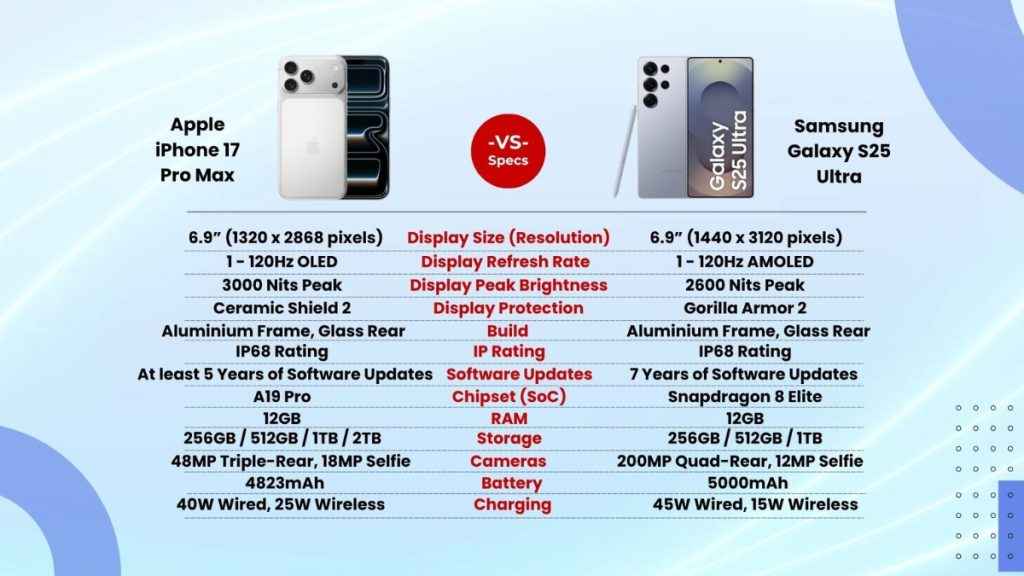
The iPhone 17 Pro Max comes with a 6.9-inch OLED display with a peak brightness of 3,000 nits, Apple’s A19 Pro chip, 12GB RAM, up to 2 TB storage, a 48MP triple rear camera system and an 18MP selfie camera. Its 4,823mAh battery supports 40W wired and 25W wireless charging.
The Galaxy S25 Ultra also features a 6.9-inch panel, though Samsung uses AMOLED technology with a rated peak brightness of 2,600 nits. Inside, it is powered by the Snapdragon 8 Elite chip with 12GB RAM and up to 1 TB storage. At the back, there’s a 200MP quad-camera system and a 12MP selfie camera. Its battery is larger at 5,000mAh, with support for 45W wired and 15W wireless charging.
2 hours of YouTube playback
The first test involved streaming HDR video on YouTube at 1080p/60fps. Both displays looked exceptional. The iPhone 17 Pro Max leaned towards a more natural colour profile, while Samsung continued its tradition of offering punchier, more vibrant visuals. In terms of peak brightness, Apple advertises 3,000 nits against Samsung’s 2,600 nits, but in real-world HDR playback, both comfortably touched 1,500 to 2,000 nits. Both also feature an anti-reflective coating, though Samsung’s implementation reduced reflections slightly better. Essentially, it comes down to preference: if you like a true-to-life look, the iPhone appeals more, while if you want bold colours that pop, the Galaxy has the edge.
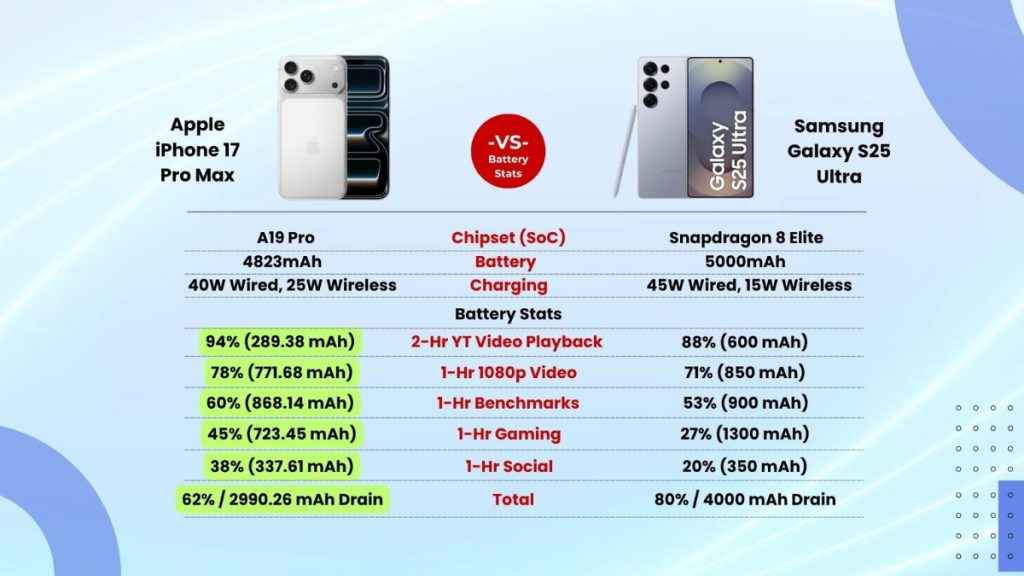
After two hours of continuous playback, the iPhone still had 94% left in the tank, while the Galaxy had dropped to 88%.
1 hour of 4K video recording
The second round was more demanding: one hour of 4K video recording split between the rear and front cameras. The iPhone’s 48MP triple setup, with its new 4x telephoto, captured sharp, consistent results, while the Galaxy’s 200MP quad-camera system produced vibrant shots with better HDR management. The iPhone’s 18MP front camera, however, held its ground against Samsung’s 12MP selfie shooter, delivering more natural tones, especially in backlit scenarios.
Thermals were also interesting here. Neither device overheated, but the iPhone ran cooler at about 34°C, compared to the Galaxy’s 36°C. This showed Apple’s cooling system managing longer sessions more comfortably.
At the three-hour mark, the iPhone 17 Pro Max was ahead again, with 78% left versus the Galaxy S25 Ultra’s 71%.
1 hour of benchmarks
Next, we pushed both phones with synthetic benchmarks. Geekbench results showed Apple’s A19 Pro chip was significantly faster in single-core tests, though the Galaxy’s Snapdragon 8 Elite closed the gap in multi-core scores. In Antutu, Samsung actually pulled ahead, scoring about 9% higher overall, thanks to its strong GPU performance. The 3D Mark stress test saw both phones perform well initially, but Apple’s chip maintained better stability over time, showing less throttling.
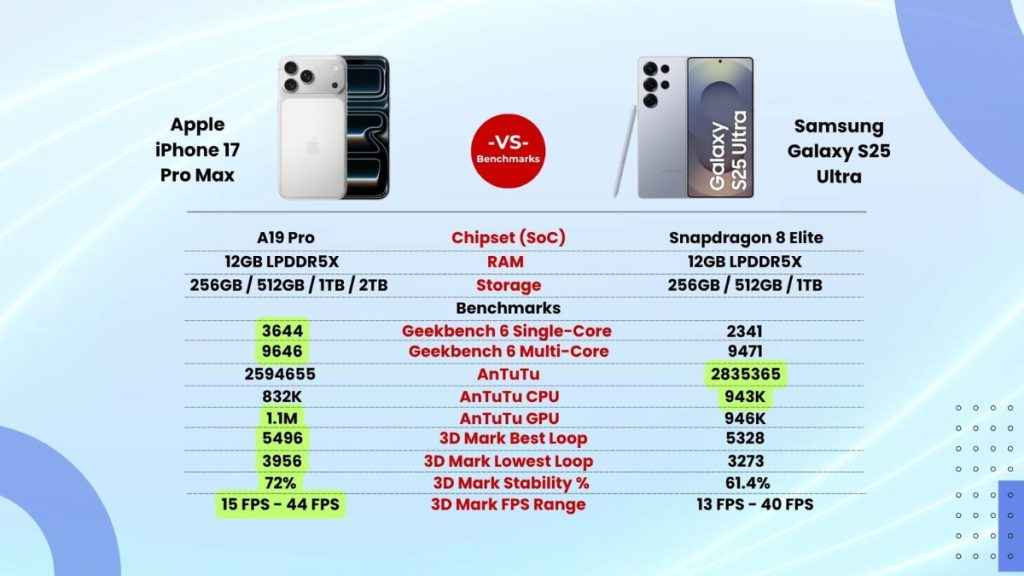
The heavy load did take its toll on the batteries, though. The iPhone 17 Pro Max dropped to 60%, while the Galaxy S25 Ultra slipped further to 53%.
1 hour of gaming
From benchmarks, we moved to real-world gaming. Both phones are able to run titles like BGMI, COD: Mobile and Genshin Impact at high frame rates (60-120fps), with the Galaxy allowing Asphalt 9: Legends to hit 120fps while the iPhone was capped at 60fps. Despite that, the iPhone felt smoother overall in sustained performance, thanks to more consistent frame pacing and lower surface temperatures, which stayed between 32-36°C compared to the Galaxy’s 34-38°C.
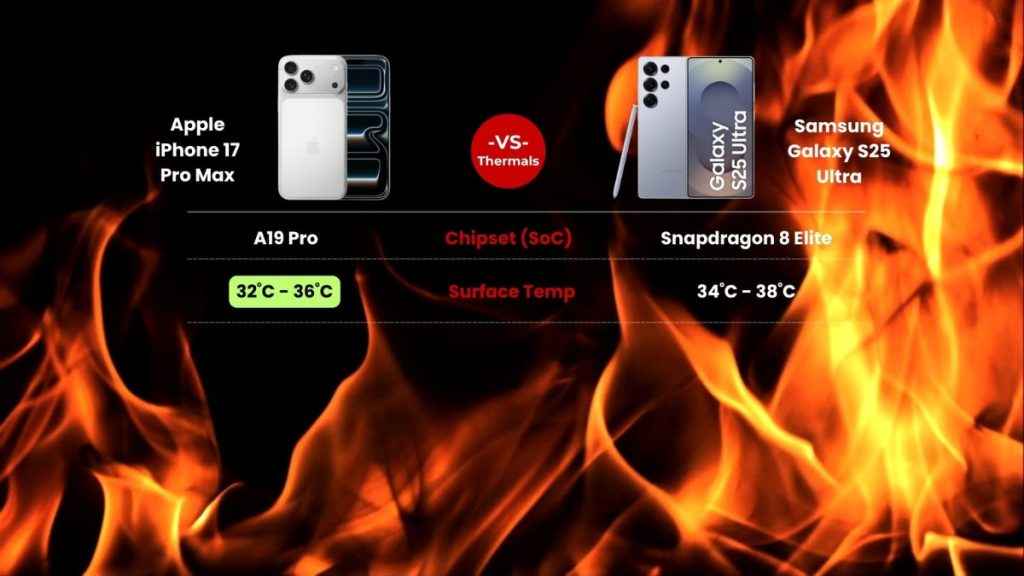
This is also where the gap widened considerably in endurance. By the end of the fourth hour, the iPhone 17 Pro Max still had 45% battery left, while the Galaxy S25 Ultra dropped to 27%.
1 hour of social media
For the final test, we opened Instagram and ran it continuously for an hour. By this stage, both devices had already endured gaming, video playback and benchmarks, but the iPhone still had more energy to spare.
At the end of the sixth hour, the iPhone 17 Pro Max had 38% battery remaining, while the Galaxy S25 Ultra was left with just 20%.
Total drain after 6 hours
iPhone 17 Pro Max: 62% (approx. 2,990mAh)
Samsung Galaxy S25 Ultra: 80% (approx. 4,000mAh)
Conclusion
Despite having a smaller battery, the iPhone 17 Pro Max proved to be more power-efficient. It consistently outlasted the Galaxy S25 Ultra across nearly every test, particularly in gaming and video playback, where it drained less while also running cooler. Samsung’s Galaxy S25 Ultra, with its larger 5,000mAh battery, still offered strong performance and endurance, but it burned through its capacity faster under load.
Ultimately, both devices deliver all-day battery life, but the difference lies in efficiency versus raw size. The iPhone 17 Pro Max edges ahead in power management, while the Galaxy S25 Ultra gives you a larger cell that can be stretched further with tweaks to performance settings.
Also read: Samsung Galaxy S25 Ultra first impressions: A bold design shift


