
NVIDIA RTX Spark brings CUDA, Blackwell and local AI agents to thin Windows laptops
 Follow Us
NVIDIA RTX Spark combines a Blackwell GPU, Grace CPU and up to 128GB unified memory.
NVIDIA and Microsoft are building a Windows platform for secure local AI agents.
Adobe, ASUS, Dell, HP, Lenovo, Microsoft Surface and MSI are among the early partners.
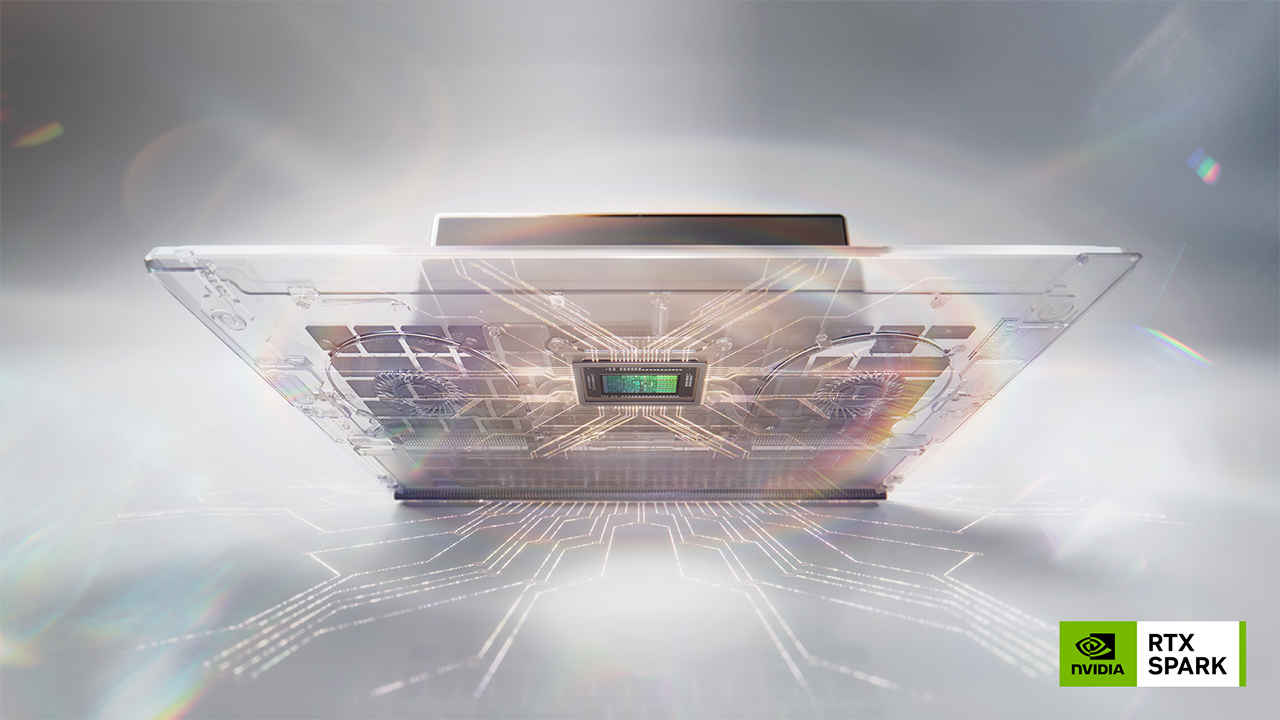

For the last two years, the phrase “AI PC” has mostly meant one thing: a laptop with an NPU (Neural Processing Unit) capable of running some on-device AI tasks. Microsoft’s CoPilot program has been quite successful at flooding the market with a bevy of AI-capable machines but it was always the CPU package doing most of the heavy lifting. NVIDIA, whose AI stack currently has the largest market share had to jump into the fray. And NVIDIA’s new RTX Spark is an attempt to do just that. Unveiled at NVIDIA GTC Taipei, NVIDIA RTX Spark is being positioned as a new class of Windows PC chip built not merely for AI features, but for personal AI agents that can work locally, reason across apps, generate content, assist developers and still run games with the RTX stack.
 Survey
The company’s framing is deliberately dramatic. NVIDIA says RTX Spark is designed for a world where the PC moves “from tool to teammate”. Jensen Huang, founder and CEO of NVIDIA, put it even more directly, “The PC is being reinvented. For forty years, you launched apps. Click. Type. With RTX Spark and Microsoft Windows, you ask — and the PC does the work. RTX Spark brings everything NVIDIA has built — CUDA, RTX, our AI platform — into a single superchip. Local agents. Frontier models. Creative workflows. RTX games. All on a laptop. This is the new PC. The personal AI computer.”
The underlying product is a 1-petaflop AI superchip for thin Windows laptops and compact desktops, combining a Blackwell RTX GPU, a 20-core Grace CPU, NVLink chip-to-chip connectivity, up to 128 GB of unified memory and the full NVIDIA software stack. The bigger question is whether this can do for AI PCs what discrete GeForce GPUs did for gaming laptops, i.e. create a performance category that users can understand, and software developers can reliably target.
A different kind of AI PC
Most current AI PCs are built around a CPU, integrated graphics, and an NPU that handles low-power AI workloads. RTX Spark takes a different route. NVIDIA is putting its GPU-first AI stack at the centre of the machine and using unified memory to make much larger local workloads possible.
According to NVIDIA, RTX Spark features a Blackwell RTX GPU with 6,144 CUDA cores and fifth-generation Tensor Cores with FP4 precision. That GPU is connected through NVIDIA NVLink-C2C to a 20-core Grace CPU. MediaTek collaborated with NVIDIA on the custom CPU design, contributing to the Arm-based SoC’s power efficiency, performance and connectivity. The chip is built to bring NVIDIA technologies such as CUDA, RTX, TensorRT, OptiX, DLSS, Reflex and G-SYNC into slim Windows laptops and small desktop PCs.
The memory configuration is one of the most important parts of the story. RTX Spark supports up to 128 GB of unified memory, giving the GPU access to a much larger memory pool than typical laptop discrete GPUs. NVIDIA says this will allow users to run 120-billion-parameter large language models locally with up to 1 million tokens of context, render 90GB 3D scenes, edit 12K 4:2:2 video and generate 4K AI videos.
NVIDIA said RTX Spark’s top configuration uses 300 GB/s memory bandwidth and a 600 GB/s NVLink chip-to-chip interface. The company also said RTX Spark’s graphics performance sits in the same broad class as an RTX 5070 laptop GPU, though this comparison will vary depending on workload because the architecture is different from a conventional x86 CPU plus discrete GPU design.
The efficiency pitch is just as important as the peak-performance pitch. NVIDIA says RTX Spark laptops will be as slim as 14 mm and as light as three pounds, while still offering all-day battery life. In response to journalist questions, NVIDIA said light workloads can run at low single-digit wattages, while top laptop configurations can scale up to around 80 W under heavy workloads. It also said gaming battery life will vary heavily by frame-rate caps, settings, battery size and workload, and acknowledged that pulling maximum performance from any laptop battery can still drain it quickly.
Local agents are the real platform play
The most interesting part of RTX Spark is not that it is another high-performance chip. It is that NVIDIA is using it to push a new model of personal computing built around local agents.
NVIDIA argued that AI agents have reached an inflection point, helped by the growth of open-source agent projects such as OpenClaw and Hermes Agent. The company’s claim is that local models are now capable enough to power agents that can understand intent, use tools, work across applications and act proactively.
NVIDIA frames the challenge more practically by stating that a broad adoption of agents has been limited by the difficulty of running them securely and privately on users’ primary PCs. To address this, NVIDIA and Microsoft are collaborating on a Windows platform for on-device agents, built around new Windows security primitives and NVIDIA OpenShell.
These Windows primitives are meant to provide identity, containment, policy and end-to-end security for agents. NVIDIA OpenShell adds another layer of user-defined policy, letting users decide what agents can and cannot do, which files and resources they can access, which queries must remain local, and when a cloud model can be used. NVIDIA says OpenShell can also disguise personal information in queries sent to cloud models.
This matters because the agents NVIDIA is describing are not limited to a chat window. They may control apps, search local files, code plug-ins, generate images and videos, operate across workflows, and potentially use the screen, mouse and keyboard much like a user. The security and containment layer is therefore central to whether users and enterprises will trust these systems.
Satya Nadella, chairman and CEO of Microsoft said, “Our goal is to deliver unmetered intelligence to every home and every desk with Windows. RTX Spark marks a real breakthrough towards that vision.”
NVIDIA also said Windows agent experiences powered by RTX Spark will eventually be accessible from the Windows taskbar interface. That suggests Microsoft and NVIDIA are thinking beyond third-party apps and towards agents that feel more native to Windows itself.
What agents could actually do on a Spark laptop
For creators, the company described an agent that can help an artist build complex generative AI workflows from a sketch, a mood board and natural-language instructions. Instead of forcing the user to master node-based AI tools, the agent could assemble the workflow, generate the image, produce additional camera angles and then call ComfyUI APIs to animate the output. The user could remain inside familiar tools such as Photoshop while the agent handles the more mechanical parts of the process.
When it comes to developers, NVIDIA described agents that can monitor GitHub repositories and websites, identify open issues, propose fixes, test them using computer-use skills and prepare changes for approval. The company repeatedly stressed that the developer remains in command, but the agent can work through repetitive investigation and QA tasks, including overnight.
And for gamers and streamers, the examples were simpler but more immediately understandable. A local agent could optimise monitor settings for esports, adjust game settings, configure peripherals, or manage a streaming setup by muting the microphone, switching an OBS scene and turning off lights when the streamer steps away. These are not grand, science-fiction tasks. They are the kind of small cross-app actions that are often tedious precisely because they involve several tools and settings panels.
NVIDIA is also working on performance improvements for agent workloads. The company said it has collaborated with llama.cpp on multi-token prediction, a technique where a smaller draft model proposes multiple future tokens and a larger model verifies them in a single pass. NVIDIA claims this can deliver 2x performance in dense models and 1.6x performance in mixture-of-experts models while maintaining accuracy. The company has also worked with H Company to optimise the Holo computer-use model, claiming a 2x speed-up on NVIDIA GPUs and a 35 percent reduction in memory consumption.
Georgi Gerganov, founder of llama.cpp said, “RTX Spark laptops change the game by multiplying the amount of context processing and putting it directly into a beautiful, portable chassis. Highly optimized models running locally through llama.cpp with RTX Spark’s AI performance will unleash the next wave of personal, private agents.”
Adobe is reworking Premiere and Photoshop for Spark
NVIDIA is not relying only on hypothetical agent workflows. The company is also pointing to major software vendors as proof that RTX Spark has a real application ecosystem behind it. The biggest creative announcement is Adobe. NVIDIA says Adobe is rearchitecting Premiere and Photoshop for RTX Spark to deliver up to 2x faster AI, editing, colouring and effects across creative workflows. Premiere will get a new video pipeline designed to use RTX Spark’s unified memory, Blackwell GPU and TensorRT software for real-time editing, colour correction, GPU-accelerated AI and more efficient rendering of complex timelines.
Photoshop is also getting a next-generation engine optimised for GPU-accelerated compositing, live filters, HDR and natural brushing. NVIDIA says the AI-native pipeline is being built to use TensorRT and the full power of RTX Spark. Adobe Substance 3D Painter and Stager will also run natively on RTX Spark for smoother 3D texturing and scene creation workflows.
Shantanu Narayen, chair and CEO of Adobe, said: “The best creative work in the world happens in Adobe tools from Adobe Firefly to Photoshop and Premiere, and the expansion of our partnership with NVIDIA and Microsoft will make those experiences faster and more powerful than ever. Together, we are building AI-native creative experiences for RTX Spark that deliver the performance, intelligence and responsiveness people need to create at the pace of their ambition.”
NVIDIA also said Adobe will extend Premiere and Photoshop to work with Windows agents, so creators can create, edit and design with an AI teammate. Updates to Premiere, Photoshop and Substance are expected to start rolling out alongside RTX Spark availability.
The broader partner list includes Adobe, Blackmagic Design, Blender, CapCut, ComfyUI and OTOY. On the gaming side, NVIDIA named KRAFTON, NetEase, Remedy Entertainment, Riot Games and Xbox among developers and providers embracing RTX Spark.
Gaming support and the Windows on Arm problem
NVIDIA is making it clear that RTX Spark is not just for AI developers and creators. It has the power of an RTX 5070 laptop GPU. The company says users will be able to play AAA games at 1440p and over 100 FPS with ray tracing, DLSS and Reflex. NVIDIA specifically mentioned titles such as Fortnite, Cyberpunk, Doom and Indiana Jones.
The complication is that RTX Spark is a Windows on Arm platform. That means game support depends on a mix of native Arm versions, optimised ports, emulation through Microsoft’s Prism layer, driver tuning and anti-cheat compatibility. NVIDIA said it is working with game developers and both first-party and third-party anti-cheat providers, but it did not name all anti-cheat partners but stated that they were working with all the big ones. We also did not get to see specific Prism overhead numbers or game benchmark comparisons against x86 systems.
The company did say it has been working with Microsoft for years to improve Prism, including adding AVX2 support, which is important for some games and anti-cheat systems. NVIDIA also said there will be Game Ready drivers tuned for RTX Spark, and that some developers are working on native Windows on Arm versions while others are optimising for Prism.
For gamers, this will be one of the biggest areas to watch. NVIDIA has a strong track record with PC gaming software, but Windows on Arm has historically struggled with compatibility. RTX Spark may have the GPU muscle, but the gaming experience will depend heavily on how many popular titles and anti-cheat systems behave well at launch.
DLSS 4.5, Blender and AI-generated video
RTX Spark will also debut or benefit from new RTX capabilities. NVIDIA announced DLSS 4.5 Ray Reconstruction with a second-generation transformer model, coming to Blender 5.3 and dozens of games. Ray Reconstruction, unveiled some time back, is designed to improve the quality of ray-traced scenes by replacing traditional denoisers with an AI model that better reconstructs pixels between sampled rays.
NVIDIA said DLSS 4.5 Ray Reconstruction uses a more efficient denoiser with 35 percent more compute capability and 20 percent more parameters, while maintaining similar performance on RTX GPUs, including Turing and Ampere. It is expected to be available in August for all RTX GPUs, and on RTX Spark when the platform launches.
Blender support is a notable creator-side addition. NVIDIA says DLSS Ray Reconstruction in Blender 5.3 will improve interactive path tracing in the viewport, helping artists assess scenes in real time rather than waiting for frames to resolve. ComfyUI will also get RTX Video with 4x Frame Generation, aimed at making AI-generated video smoother and longer than the short 15 to 20fps clips common today.
Yannik Marek, co-founder and creator of ComfyUI, said: “The combination of RTX Spark’s processing capabilities and large unified memory will make it one of the best-performing laptops to run diffusion models. ComfyUI users can now run highly complex, multimodal workflows and generate ultra-high-resolution images and videos with unprecedented speed on a portable device.”
What still needs proving
RTX Spark is one of NVIDIA’s most ambitious PC announcements in years, but several details remain open. NVIDIA did not disclose pricing, full SKU breakdowns, detailed CPU benchmarks, exact gaming performance, emulator overhead, comparative figures against Apple’s M-series, AMD Ryzen AI, Intel Core Ultra or Qualcomm Snapdragon X platforms, or precise battery-life figures under heavy AI and gaming workloads. The company repeatedly said more performance details would be shared closer to availability.
There are also product segmentation limits. ECC memory support is reserved for Pro products. NVIDIA said the current announcement is focused on consumer systems, not commercial notebooks with vPro-like management features. It also said RTX Spark is a Windows platform, while DGX Spark remains aimed at Linux AI developers. The two products use related silicon, but NVIDIA described them as separate platforms with different software targets.
That leaves RTX Spark in an interesting place. It is not a conventional gaming laptop chip. It is not merely an NPU-led AI PC processor. It is not DGX Spark for Linux developers either. It is NVIDIA’s attempt to create a Windows machine where local agents, CUDA workflows, RTX gaming, creator apps and unified memory all converge.
The timing also makes sense. The first wave of AI PCs has struggled to communicate why ordinary users should care about NPUs. RTX Spark offers a clearer story for power users who can now run bigger models locally, handle heavier creative workloads, use agents with more context, and still play games. The risk is that this depends on many moving parts working at once: Windows on Arm, Prism, anti-cheat support, native apps, Adobe’s new engines, OpenShell, local agent maturity and OEM pricing.
If NVIDIA and Microsoft can make that stack feel seamless, RTX Spark could become a meaningful shift in the Windows laptop market. If not, it may remain a technically impressive platform waiting for the software ecosystem to catch up. Either way, it changes the AI PC conversation from “how many TOPS does the NPU have?” to a more relevant question: what can a personal computer actually do when it has enough local AI performance, enough memory and an agent that can safely act on the user’s behalf?
RTX Spark laptops and desktops arrive this fall
RTX Spark laptops and compact desktops will be available this fall i.e. from ASUS, Dell, HP, Lenovo, Microsoft Surface and MSI, with Acer and GIGABYTE models to follow. NVIDIA named several early laptop designs, including ASUS ProArt P14 and P16, Dell XPS, HP OmniBook X 14, Lenovo Yoga Pro 9N, Microsoft Surface Ultra and MSI Prestige N16 Flip AI+.


